Review
. 2023 Jul 8;24(14):11233.
doi: 10.3390/ijms241411233.

Innate Immunity in Cancer Biology and Therapy

Affiliations
Review

Innate Immunity in Cancer Biology and Therapy

Yuxia Zhang et al. Int J Mol Sci. .

Abstract

Immunotherapies including adaptive immune checkpoint inhibitors (ICIs) and chimeric antigen receptor (CAR) T cells, have developed the treatment of cancer in clinic, and most of them focus on activating T cell immunity. Although these strategies have obtained unprecedented clinical responses, only limited subsets of cancer patients could receive long-term benefits, highlighting the demand for identifying novel targets for the new era of tumor immunotherapy. Innate immunity has been demonstrated to play a determinative role in the tumor microenvironment (TME) and influence the clinical outcomes of tumor patients. A thorough comprehension of the innate immune cells that infiltrate tumors would allow for the development of new therapeutics. In this review, we outline the role and mechanism of innate immunity in TME. Moreover, we discuss innate immunity-based cancer immunotherapy in basic and clinical studies. Finally, we summarize the challenges in sufficiently motivating innate immune responses and the corresponding strategies and measures to improve anti-tumor efficacy. This review could aid the comprehension of innate immunity and inspire the creation of brand-new immunotherapies for the treatment of cancer.

Keywords: cancer therapy; chimeric antigen receptors; cytokines; immune checkpoint inhibitors; innate immunity.


Conflict of interest statement

Shuang Mei is the chief executive officer of Shanghai Tinova Immune Therapeutics Co., Ltd. The other authors declare no conflicts of interest.

Figures

Figure 1
Figure 1
The role of innate immune cells in tumor progression. Innate immune cells show multiple roles in tumor progression through antigen presentation, phagocytosis, secretion of cytokines, direct killing effect, etc.
Figure 2
Figure 2
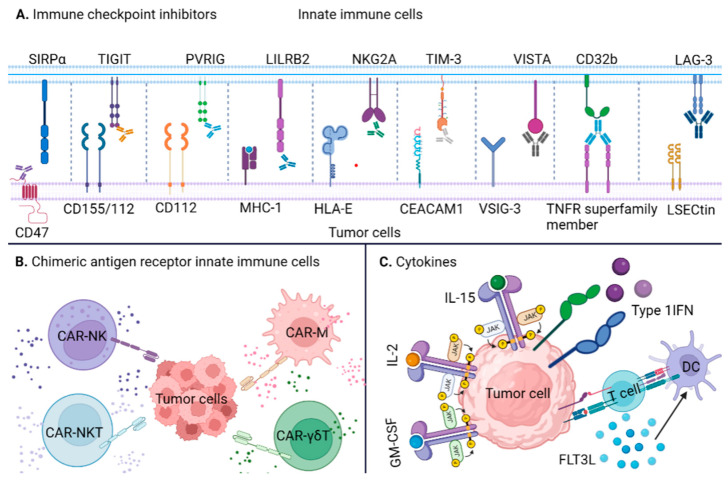
Innate immune cell-based immunotherapy. Innate immunotherapies include innate ICIs, CAR innate immune cells and cytokines. (A) innate immunity-based ICIs; (B) CAR innate immune cells; (C) cytokines in innate immunity.

References

    1. Anwar S., Almatroudi A., Alsahli A.M., Khan A.M., Khan A.A., Rahmani H.A. Natural Products: Implication in Cancer Prevention and Treatment through Modulating Various Biological Activities. Anti-Cancer Agents Med. Chem. 2020;20:2025–2040. doi: 10.2174/1871520620666200705220307. - DOI - PubMed
    1. Chinnadurai R.K., Khan N., Meghwanshi G.K., Ponne S., Althobiti M., Kumar R. Current research status of anti-cancer peptides: Mechanism of action, production, and clinical applications. Biomed. Pharmacother. 2023;164:114996. doi: 10.1016/j.biopha.2023.114996. - DOI - PubMed
    1. Zhong L., Li Y., Xiong L., Wang W., Wu M., Yuan T., Yang W., Tian C., Miao Z., Wang T., et al. Small molecules in targeted cancer therapy: Advances, challenges, and future perspectives. Signal Transduct. Target. Ther. 2021;6:201. doi: 10.1038/s41392-021-00572-w. - DOI - PMC - PubMed
    1. Zhang Y., Zhang Z. The history and advances in cancer immunotherapy: Understanding the characteristics of tumor-infiltrating immune cells and their therapeutic implications. Cell. Mol. Immunol. 2020;17:807–821. doi: 10.1038/s41423-020-0488-6. - DOI - PMC - PubMed
    1. Seager R.J., Hajal C., Spill F., Kamm R.D., Zaman M.H. Dynamic interplay between tumour, stroma and immune system can drive or prevent tumour progression. Converg. Sci. Phys. Oncol. 2017;3:034002. doi: 10.1088/2057-1739/aa7e86. - DOI - PMC - PubMed