Review
. 2023 Jul 13;24(14):11412.
doi: 10.3390/ijms241411412.

Early Splicing Complexes and Human Disease

Affiliations
Review

Early Splicing Complexes and Human Disease

Chloe K Nagasawa et al. Int J Mol Sci. .

Abstract

Over the last decade, our understanding of spliceosome structure and function has significantly improved, refining the study of the impact of dysregulated splicing on human disease. As a result, targeted splicing therapeutics have been developed, treating various diseases including spinal muscular atrophy and Duchenne muscular dystrophy. These advancements are very promising and emphasize the critical role of proper splicing in maintaining human health. Herein, we provide an overview of the current information on the composition and assembly of early splicing complexes-commitment complex and pre-spliceosome-and their association with human disease.

Keywords: Alzheimer’s diseases; cancer; commitment complex; multiple sclerosis; pre-spliceosome complex; splicing.


Conflict of interest statement

C.K.N. has no conflict of interest to declare. M.A.G.-B. is founder and has significant ownership of Autoimmunity Biologic Solutions, Inc., which is commercializing therapeutic approaches that target the alternative splicing of IL7R transcripts. This ownership and associated intellectual property could constitute or be perceived as constituting a conflict of interest.

Figures

Figure 1
Figure 1
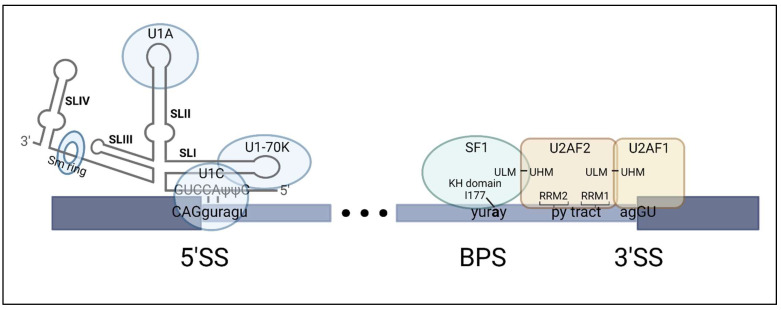
Molecular mechanism of commitment complex assembly. The U1 snRNP, which is composed of U1 snRNA, the U1 snRNP-specific proteins, U1-70K, U1A and U1C, and the Sm ring, interacts with the 5′ splice site (SS). More specifically, the 5′ end of U1 snRNA interacts with the 5′SS at the exon (dark blue)–intron (light blue) junction of the pre-mRNA. This interaction is stabilized by U1C, which is recruited to the RNA duplex via U1-70K [20,21]. U1A binds stem-loop II (SLII). At the 3′ end of the intron, SF1 binds to the branchpoint sequence (BPS), U2AF2 binds to the polypyrimidine tract (py tract) and U2AF1 binds to the 3′SS at the intron–exon junction. In particular, the isoleucine residue at position 177 of the KH domain of SF1 binds the branchpoint adenosine while the U2AF-homology ligand motif (ULM) of SF1 binds the U2AF homology motif (UHM) domain of U2AF2. U2AF2 has two RRM motifs that bind the py tract and a ULM domain that binds the UHM of U2AF1. (Created with BioRender.com (accessed on 12 May 2023)).
Figure 2
Figure 2
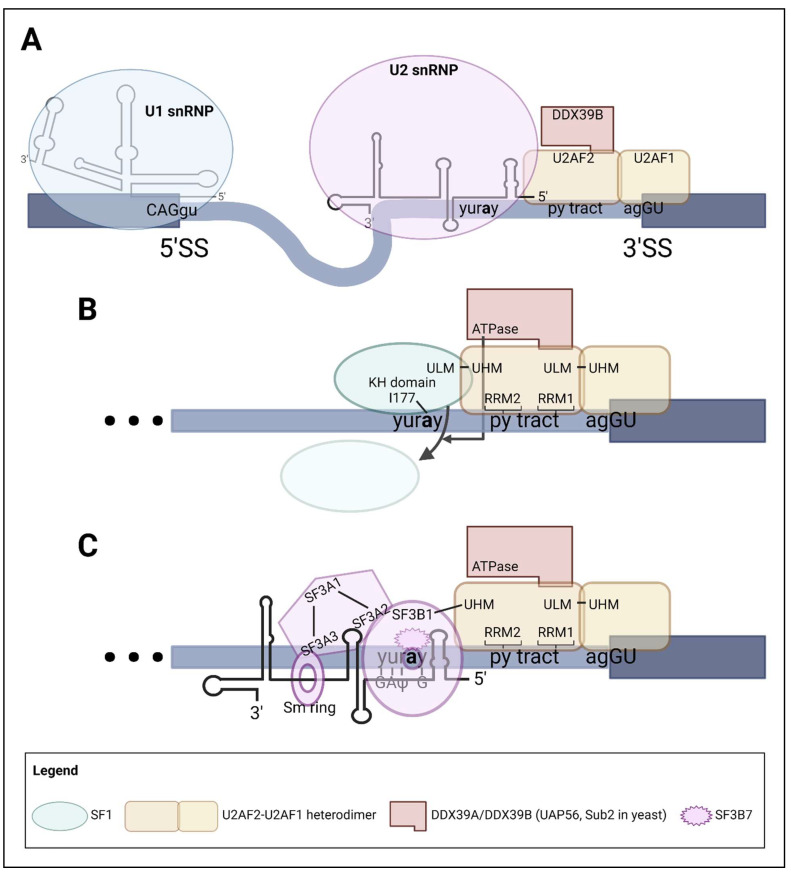
Molecular mechanism of pre-spliceosome complex assembly. (A) Schematic diagram of pre-spliceosome complex. The U2 snRNP associates with the pre-mRNA via binding to the BPS and its conformational changes begin to orient the pre-mRNA for ideal interaction with the U1 snRNP. (B) Displacement of SF1 by the ATPase activity of DDX39A/DDX39B (UAP56, Sub2 in yeast) allows for U2 snRNP to bind the branchpoint. DDX39A/DDX39B (UAP56, Sub2 in yeast) is stably bound to U2AF2. (C) Binding of U2 snRNP to the branchpoint sequence. The branchpoint adenosine sits in a pocket created by SF3B7 and SF3B1. SF3B1 interacts with the UHM domain of U2AF2. The SF3A complex forms a bridge-like structure between the SF3B complex and the Sm ring, stabilizing the U2 snRNP. (Created with BioRender.com (accessed on 12 May 2023)).

References

    1. Sharp P.A., Burge C.B. Classification of Introns: U2-Type or U12-Type. Cell. 1997;91:875–879. doi: 10.1016/S0092-8674(00)80479-1. - DOI - PubMed
    1. Lerner M.R., Steitz J.A. Antibodies to Small Nuclear RNAs Complexed with Proteins Are Produced by Patients with Systemic Lupus Erythematosus. Proc. Natl. Acad. Sci. USA. 1979;76:5495–5499. doi: 10.1073/pnas.76.11.5495. - DOI - PMC - PubMed
    1. Lerner M.R., Boyle J.A., Mount S.M., Wolin S.L., Steitz J.A. Are SnRNPs Involved in Splicing? Nature. 1980;283:220–224. doi: 10.1038/283220a0. - DOI - PubMed
    1. Kastner B., Will C.L., Stark H., Lührmann R. Structural Insights into Nuclear Pre-MRNA Splicing in Higher Eukaryotes. Cold Spring Harb. Perspect. Biol. 2019;11:a032417. doi: 10.1101/cshperspect.a032417. - DOI - PMC - PubMed
    1. De Conti L., Baralle M., Buratti E. Exon and Intron Definition in Pre-MRNA Splicing. WIREs RNA. 2013;4:49–60. doi: 10.1002/wrna.1140. - DOI - PubMed

MeSH terms