Review
. 2023 Jul 14;24(14):11471.
doi: 10.3390/ijms241411471.

Immune System and Hepatocellular Carcinoma (HCC): New Insights into HCC Progression

Affiliations
Review

Immune System and Hepatocellular Carcinoma (HCC): New Insights into HCC Progression

Maria Kotsari et al. Int J Mol Sci. .

Abstract

According to the WHO's recently released worldwide cancer data for 2020, liver cancer ranks sixth in morbidity and third in mortality among all malignancies. Hepatocellular carcinoma (HCC), the most common kind of liver cancer, accounts approximately for 80% of all primary liver malignancies and is one of the leading causes of death globally. The intractable tumor microenvironment plays an important role in the development and progression of HCC and is one of three major unresolved issues in clinical practice (cancer recurrence, fatal metastasis, and the refractory tumor microenvironment). Despite significant advances, improved molecular and cellular characterization of the tumor microenvironment is still required since it plays an important role in the genesis and progression of HCC. The purpose of this review is to present an overview of the HCC immune microenvironment, distinct cellular constituents, current therapies, and potential immunotherapy methods.

Keywords: hepatocellular carcinoma; immunotherapy; tumor microenvironment; tumor-associated macrophages.


Conflict of interest statement

The authors declare no conflict of interest.

Figures
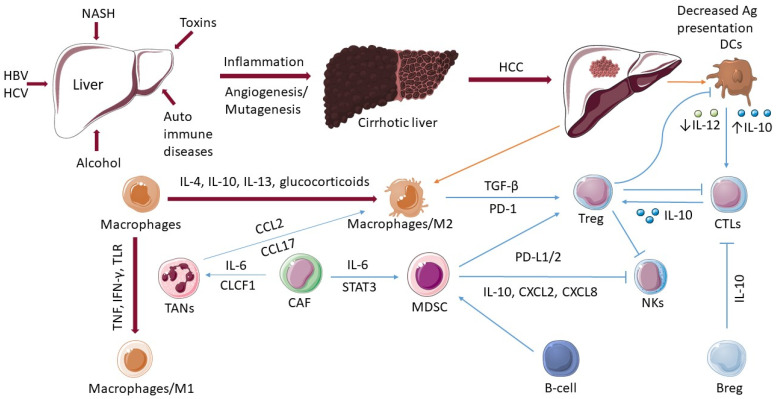
Figure 1
Figure 1
The role of immune cells in hepatocellular cancer. In the development of HCC, various factors play a decisive role such as hepatitis B virus (HBV), hepatitis C virus (HCV), non-alcoholic fatty liver disease (NAFLD), non-alcoholic steatohepatitis (NASH), toxins, and autoimmune diseases. The actions of numerous immune cells become dysregulated as the disease develops from cirrhosis of the liver to hepatocellular carcinoma (HCC). The ability of dendritic cells (DCs) to present antigens is decreased. The activation of CD8+ T-cells (CTLs) is dependent on the activation of a DCs. Macrophages differentiate into an “alternatively-activated phenotype”, M2, which promotes the recruitment and growth of regulatory T-cells (Tregs). Tregs have a negative impact on CTLs, DCs, and natural killer (NK) cells. M1 macrophages are activated by microbial components or proinflammatory cytokines (TNF, IFN-γ, TLR). Tumor-associated neutrophils (TANs) produce the chemokines, and CCL2 and CCL17 were observed to recruit tumor-associated macrophages (TAMs). Cancer-associated fibroblasts (CAFs) induce activation of TANs via IL-6 and CLCF1 and promote the differentiation of monocytes into MDSCs via IL-6-mediated STAT3 activation. B cells can be associated with pro-tumorigenic processes by activating MDSCs. Regulatory B-cells (Bregs) promote T-cell dysregulation through an IL10-dependent mechanism.

References

    1. Sung H., Ferlay J., Siegel R.L., Laversanne M., Soerjomataram I., Jemal A., Bray F. Global Cancer Statistics 2020: GLOBOCAN Estimates of Incidence and Mortality Worldwide for 36 Cancers in 185 Countries. CA Cancer J. Clin. 2021;71:209–249. doi: 10.3322/caac.21660. - DOI - PubMed
    1. Jemal A., Ward E.M., Johnson C.J., Cronin K.A., Ma J., Ryerson A.B., Mariotto A., Lake A.J., Wilson R., Sherman R.L., et al. Annual Report to the Nation on the Status of Cancer, 1975–2014, Featuring Survival. J. Natl. Cancer Inst. 2017;109:djx030. doi: 10.1093/jnci/djx030. - DOI - PMC - PubMed
    1. Akinyemiju T., Abera S., Ahmed M., Alam N., Alemayohu M.A., Allen C., Al-Raddadi R., Alvis-Guzman N., Amoako Y., Artaman A., et al. The Burden of Primary Liver Cancer and Underlying Etiologies from 1990 to 2015 at the Global, Regional, and National Level. JAMA Oncol. 2017;3:1683–1691. doi: 10.1001/jamaoncol.2017.305. - DOI - PMC - PubMed
    1. Sanyal A., Poklepovic A., Moyneur E., Barghout V. Population-based risk factors and resource utilization for HCC: US perspective. Curr. Med. Res. Opin. 2010;26:2183–2191. doi: 10.1185/03007995.2010.506375. - DOI - PubMed
    1. Kanwal F., Kramer J.R., Mapakshi S., Natarajan Y., Chayanupatkul M., Richardson P.A., Li L., Desiderio R., Thrift A.P., Asch S.M., et al. Risk of Hepatocellular Cancer in Patients with Non-Alcoholic Fatty Liver Disease. Gastroenterology. 2018;155:1828–1837.e2. doi: 10.1053/j.gastro.2018.08.024. - DOI - PMC - PubMed
