


Expression of Immune-Related and Inflammatory Markers and Their Prognostic Impact in Colorectal Cancer Patients
- PMID: 37511338
- PMCID: PMC10380610
- DOI: 10.3390/ijms241411579
Expression of Immune-Related and Inflammatory Markers and Their Prognostic Impact in Colorectal Cancer Patients
Abstract
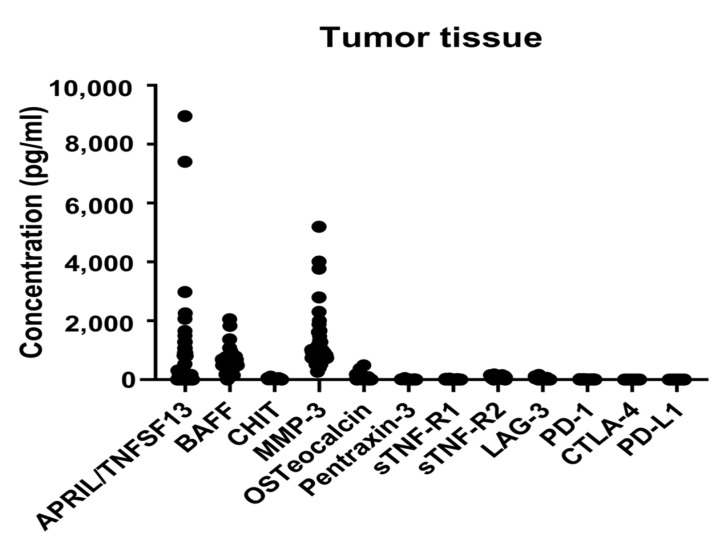
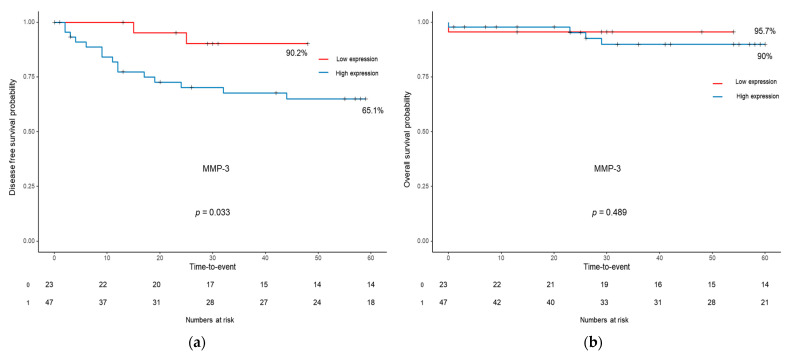
The tumor microenvironment of colorectal cancer (CRC) is heterogenous; thus, it is likely that multiple immune-related and inflammatory markers are simultaneously expressed in the tumor. The aim of this study was to identify immune-related and inflammatory markers expressed in freshly frozen CRC tissues and to investigate whether they are related to the clinicopathological features and prognosis of CRC. Seventy patients with CRC who underwent curative surgical resection between December 2014 and January 2017 were included in this study. Tissue samples were obtained from tumor and non-tumor areas in the patients' colons. The concentrations of immune-related markers (APRIL/TNFSF13, BAFF, LAG-3, PD-1, PD-L1, and CTLA-4) and inflammatory markers (CHIT, MMP-3, osteocalcin, pentraxin-3, sTNF-R1, and sTNF-R2) in the samples were measured using the Bio-plex Multiplex Immunoassay system. The concentrations of APRIL/TNFSF13, BAFF, and MMP-3 in the samples were significantly high; thus, we conducted analyses based on the cut-off values for these three markers. The high-APRIL/TNFSH13-expression group showed a significantly higher rate of metastatic lesions than the low-expression group, whereas the high-MMP-3-expression group had higher CEA levels, more lymph node metastases, and more advanced disease stages than the low-expression group. The five-year disease-free survival of the high-MMP-3-expression group was significantly shorter than that of the low-expression group (65.1% vs. 90.2%, p = 0.033). This study provides evidence that the APRIL/TNFSF13, BAFF, and MMP-3 pathway is overexpressed in CRC tissues and is associated with unfavorable clinicopathological features and poor prognosis in CRC patients. These markers could serve as diagnostic or prognostic biomarkers for CRC.
Keywords: biomarkers; bioplex; colorectal neoplasm; immune checkpoint proteins.
Conflict of interest statement
The authors declare no conflict of interest.
Figures
References
-
- Paz-Ares L., Ciuleanu T.E., Cobo M., Schenker M., Zurawski B., Menezes J., Richardet E., Bennouna J., Felip E., Juan-Vidal O., et al. First-line nivolumab plus ipilimumab combined with two cycles of chemotherapy in patients with non-small-cell lung cancer (checkmate 9la): An international, randomised, open-label, phase 3 trial. Lancet Oncol. 2021;22:198–211. doi: 10.1016/S1470-2045(20)30641-0. - DOI - PubMed
MeSH terms
Substances
LinkOut - more resources
Full Text Sources
Medical
Research Materials
Miscellaneous
