Review
. 2023 Jul 18;24(14):11582.
doi: 10.3390/ijms241411582.

Pim Kinases: Important Regulators of Cardiovascular Disease

Affiliations
Review

Pim Kinases: Important Regulators of Cardiovascular Disease

Sophie Nock et al. Int J Mol Sci. .

Abstract

Pim Kinases; Pim-1, Pim-2, and Pim-3, are a family of constitutively active serine/threonine kinases, widely associated with cell survival, proliferation, and migration. Historically considered to be functionally redundant, independent roles for the individual isoforms have been described. Whilst most established for their role in cancer progression, there is increasing evidence for wider pathological roles of Pim kinases within the context of cardiovascular disease, including inflammation, thrombosis, and cardiac injury. The Pim kinase isoforms have widespread expression in cardiovascular tissues, including the heart, coronary artery, aorta, and blood, and have been demonstrated to be upregulated in several co-morbidities/risk factors for cardiovascular disease. Pim kinase inhibition may thus be a desirable therapeutic for a multi-targeted approach to treat cardiovascular disease and some of the associated risk factors. In this review, we discuss what is known about Pim kinase expression and activity in cells of the cardiovascular system, identify areas where the role of Pim kinase has yet to be fully explored and characterised and review the suitability of targeting Pim kinase for the prevention and treatment of cardiovascular events in high-risk individuals.

Keywords: Pim kinase; atherosclerosis; cardiovascular disease.


Conflict of interest statement

The authors declare no conflict of interest.

Figures
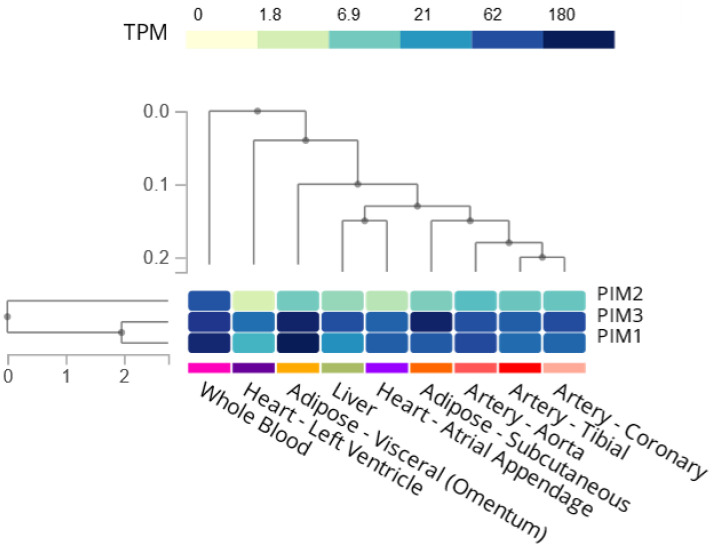
Figure 1
Figure 1
Bulk tissue gene expression of Pim kinases in tissues relating to the cardiovascular system. Created using the GTEX portal [20,21]. Darker colour refers to more transcripts per million (TPM).
Figure 2
Figure 2
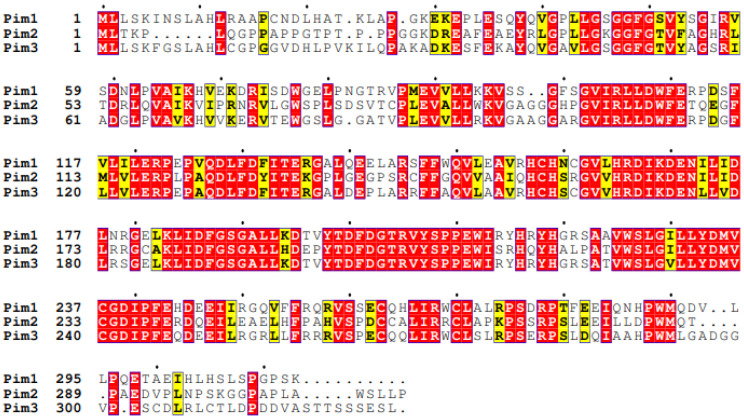
Sequence alignment of Human Pim family kinases. Sequences were aligned using Clustal Omega [25] and ESPript 3 [26] using Uniprot accession sequences Pim-1—P11309, Pim-2—Q9P1W9, and Pim-3—Q86V86. Exact matches are shown in white text on a red background, and similar residues in boxed yellow and black text on a white background are little consensus between the three isoforms.
Figure 3
Figure 3
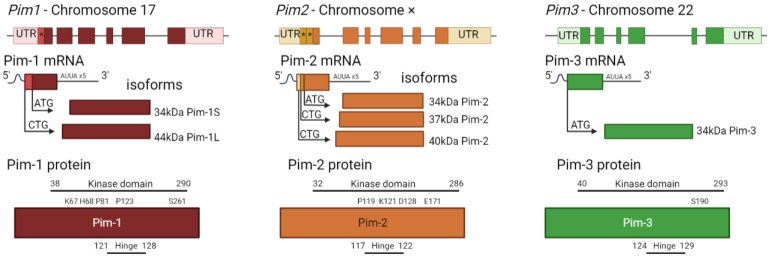
Pim kinase family gene structures and corresponding protein structures. Each gene has six codons surrounded by large untranslated regions (UTR). Alternative start codons within the gene (*) correspond to alternate mRNA transcripts, representing the different isoforms. Each isoform consists of only a serine/threonine kinase domain, with molecular weights varying from 34–44 kDa. The largest isoform is shown in more detail as to where the kinase domain and hinge regions are present and where key sites are located (not to scale). Pim-1 key sites include K67, H68 (site mutation increases kinase activity [23]), P81 (site mutation decreases kinase activity [23]), P123 (proline region in hinge site which is unique to Pim family kinases [11,15]), and S261 (phosphorylation site [27]). Pim-2 key sites include P119 (proline residue in hinge site, unique to Pim kinases (Q9P1W9—[28]), K121 (site mutation renders kinase inactive [16]), D128 and E171 (required for potent drug inhibition [29]). Pim 3 sites are the hinge region (Q86V86 [28]) and S190 (predicted autophosphorylation site [30]).
Figure 4
Figure 4
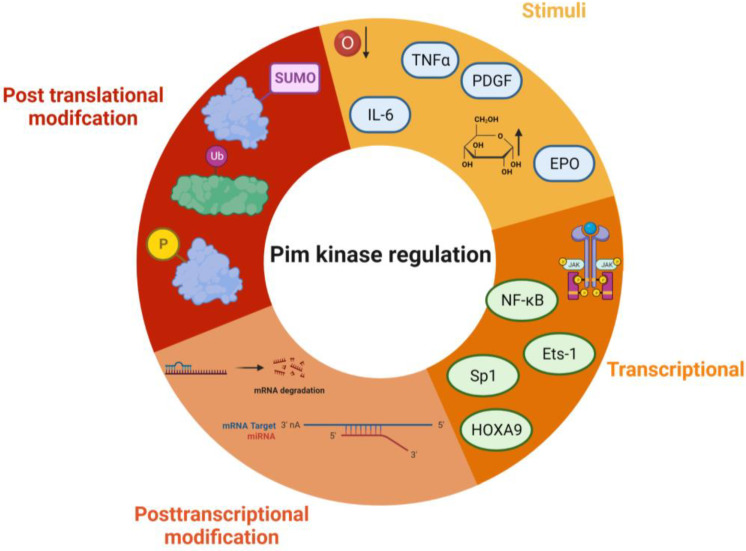
Regulation of Pim kinases. Some of the key regulatory pathways that control Pim kinase activity and signalling. Stimuli—TNFα—Tumour necrosis factor alpha, EPO—erythropoietin, IL-6—interleukin 6, PDGF—platelet-derived growth factor, hypoxia, and high glucose. Transcriptional modifications include NF-Kb—Nuclear factor kappa B, Ets-1—ETS proto-oncogene 1, Sp1—Specificity Protein 1, and HOXA9—Homeobox A9. Post-translational modifications include ubiquitination, sumoylation, and phosphorylation. Post-transcriptional modification—mRNA degradation, and miRNA binding. The figure was created using Biorender.
Figure 5
Figure 5
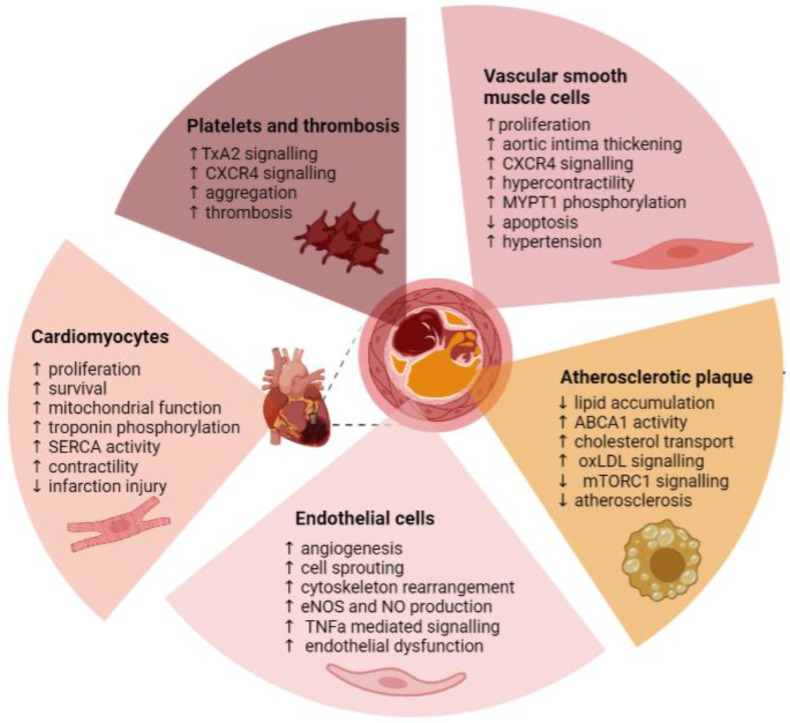
Summary of the role of Pim kinases within the cardiovascular system. TxA2—thromboxane A2; MYPT1—myosin phosphatase target subunit 1; ABCA1—ATP-binding cassette subfamily A member 1; oxLDL—oxidised low-density lipoprotein; mTORC1—mammalian target of rapamycin complex 1; eNOS—endothelial nitric oxide synthase; NO—nitric oxide; TNF-α—tumour necrosis factor alpha; SERCA—sarco(endo)plasmic reticulum calcium transport ATPase; ↑–increase; ↓–decrease. Figure created using Biorender.

References

    1. Khoury G.A., Baliban R.C., Floudas C.A. Proteome-wide post-translational modification statistics: Frequency analysis and curation of the swiss-prot database. Sci. Rep. 2011;1:90. doi: 10.1038/srep00090. - DOI - PMC - PubMed
    1. Shahin R., Shaheen O., El-Dahiyat F., Habash M., Saffour S. Research advances in kinase enzymes and inhibitors for cardiovascular disease treatment. Future Sci. OA. 2017;3:Fso204. doi: 10.4155/fsoa-2017-0010. - DOI - PMC - PubMed
    1. O’Donoghue M.L., Glaser R., Cavender M.A., Aylward P.E., Bonaca M.P., Budaj A., Davies R.Y., Dellborg M., Fox K.A., Gutierrez J.A., et al. Effect of Losmapimod on Cardiovascular Outcomes in Patients Hospitalized With Acute Myocardial Infarction: A Randomized Clinical Trial. JAMA. 2016;315:1591–1599. doi: 10.1001/jama.2016.3609. - DOI - PubMed
    1. Theo Cuypers H., Selten G., Quint W., Zijlstra M., Maandag E.R., Boelens W., van Wezenbeek P., Melief C., Berns A. Murine leukemia virus-induced T-cell lymphomagenesis: Integration of proviruses in a distinct chromosomal region. Cell. 1984;37:141–150. doi: 10.1016/0092-8674(84)90309-X. - DOI - PubMed
    1. Aho T.L.T., Sandholm J., Peltola K.J., Mankonen H.P., Lilly M., Koskinen P.J. Pim-1 kinase promotes inactivation of the pro-apoptotic Bad protein by phosphorylating it on the Ser112 gatekeeper site. FEBS Lett. 2004;571:43–49. doi: 10.1016/j.febslet.2004.06.050. - DOI - PubMed

MeSH terms

Substances