


Water Safety Plan, Monochloramine Disinfection and Extensive Environmental Sampling Effectively Control Legionella and Other Waterborne Pathogens in Nosocomial Settings: The Ten-Year Experience of an Italian Hospital
- PMID: 37512966
- PMCID: PMC10384652
- DOI: 10.3390/microorganisms11071794
Water Safety Plan, Monochloramine Disinfection and Extensive Environmental Sampling Effectively Control Legionella and Other Waterborne Pathogens in Nosocomial Settings: The Ten-Year Experience of an Italian Hospital
Abstract
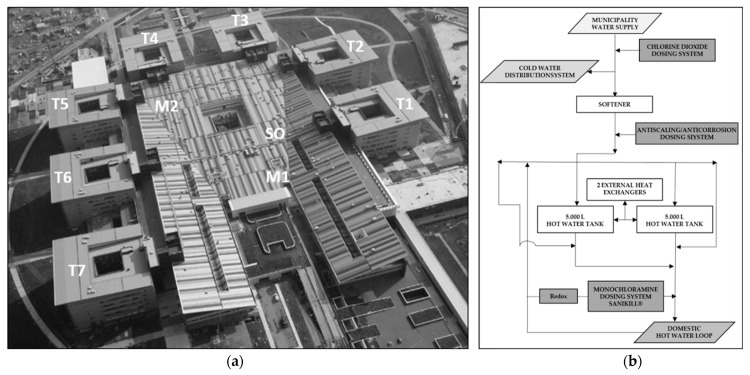
Legionella contamination control is crucial in healthcare settings where patients suffer an increased risk of disease and fatal outcome. To ensure an effective management of this health hazard, the accurate application of a hospital-specific Water Safety Plan (WSP), the choice of a suitable water disinfection system and an extensive monitoring program are required. Here, the ten-year experience of an Italian hospital is reported: since its commissioning, Legionellosis risk management has been entrusted to a multi-disciplinary Working Group, applying the principles of the World Health Organization's WSP. The disinfection strategy to prevent Legionella and other waterborne pathogens relies on the treatment of domestic hot water with a system ensuring the in situ production and dosage of monochloramine. An average of 250 samples/year were collected and analyzed to allow an accurate assessment of the microbiological status of water network. With the aim of increasing the monitoring sensitivity, in addition to the standard culture method, an optimized MALDI-ToF MS-based strategy was applied, allowing the identification of Legionella species and other relevant opportunistic pathogens. Data collected so far confirmed the effectiveness of this multidisciplinary approach: the fraction of positive samples never overcame 1% on a yearly basis and Legionnaires' Disease cases never occurred.
Keywords: Legionella; Water Safety Plan; monochloramine; prevention; waterborne pathogens.
Conflict of interest statement
Beatrice Fermi and Nicola Doniselli are active members of the ESGLI Group and belong to the Research & Development Department of Sanipur SpA. They contributed with their impartial scientific and technical support but did not participate in the water samples collection, isolation and identification of legionellae and other microorganisms nor in the data processing and interpretation. Sanipur SpA did not provide any financial contribution to this work and only covered the publication fees.
Figures
References
-
- Bartram J., Chartier Y., Lee J.V., Pond K., Surman-Lee S. Legionella and the Prevention of Legionellosis. World Health Organization; Genava, Switzerland: 2007.
LinkOut - more resources
Full Text Sources
