


The Role of Gut Microbiota in Anxiety, Depression, and Other Mental Disorders as Well as the Protective Effects of Dietary Components
- PMID: 37513676
- PMCID: PMC10384867
- DOI: 10.3390/nu15143258
The Role of Gut Microbiota in Anxiety, Depression, and Other Mental Disorders as Well as the Protective Effects of Dietary Components
Abstract
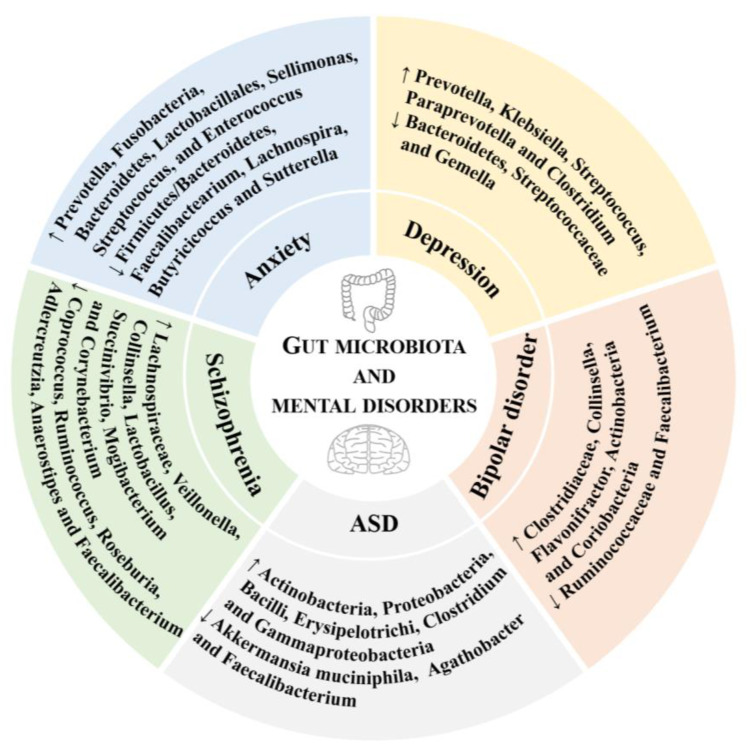
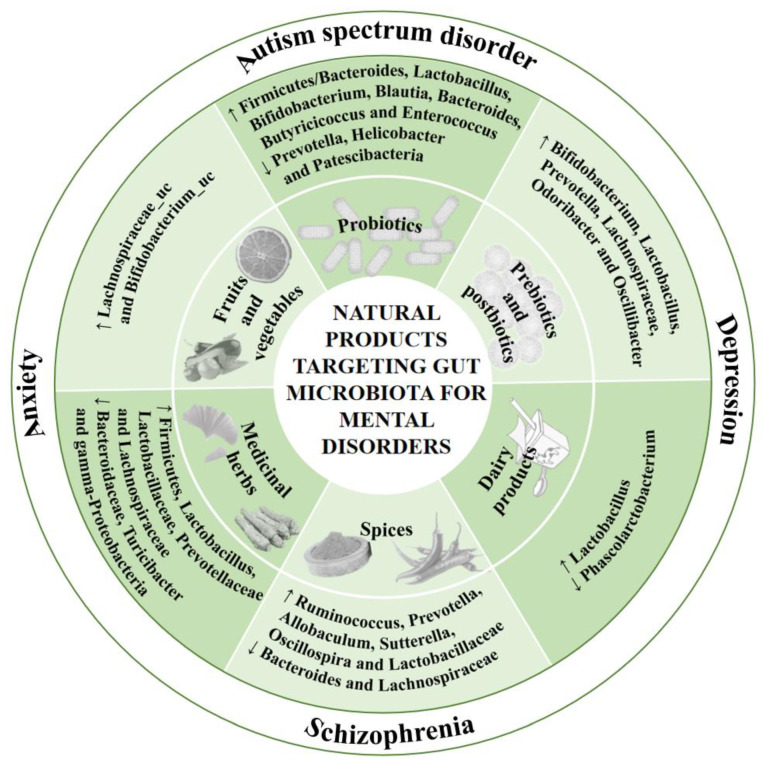
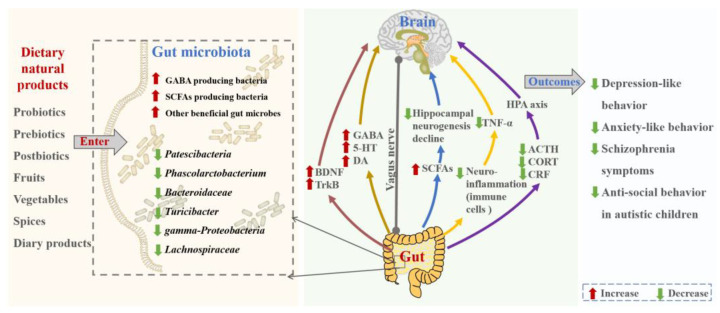
The number of individuals experiencing mental disorders (e.g., anxiety and depression) has significantly risen in recent years. Therefore, it is essential to seek prevention and treatment strategies for mental disorders. Several gut microbiota, especially Firmicutes and Bacteroidetes, are demonstrated to affect mental health through microbiota-gut-brain axis, and the gut microbiota dysbiosis can be related to mental disorders, such as anxiety, depression, and other mental disorders. On the other hand, dietary components, including probiotics (e.g., Lactobacillus and Bifidobacterium), prebiotics (e.g., dietary fiber and alpha-lactalbumin), synbiotics, postbiotics (e.g., short-chain fatty acids), dairy products, spices (e.g., Zanthoxylum bungeanum, curcumin, and capsaicin), fruits, vegetables, medicinal herbs, and so on, could exert protective effects against mental disorders by enhancing beneficial gut microbiota while suppressing harmful ones. In this paper, the mental disorder-associated gut microbiota are summarized. In addition, the protective effects of dietary components on mental health through targeting the gut microbiota are discussed. This paper can be helpful to develop some dietary natural products into pharmaceuticals and functional foods to prevent and treat mental disorders.
Keywords: anxiety; depression; gut microbiota; natural products; probiotics.
Conflict of interest statement
The authors declare no conflict of interest.
Figures
References
-
- Lund C., Brooke-Sumner C., Baingana F., Baron E.C., Breuer E., Chandra P., Haushofer J., Herrman H., Jordans M., Kieling C., et al. Social determinants of mental disorders and the Sustainable Development Goals: A systematic review of reviews. Lancet Psychiatry. 2018;5:357–369. doi: 10.1016/S2215-0366(18)30060-9. - DOI - PubMed
-
- Ferrari A.J., Santomauro D.F., Herrera A.M.M., Shadid J., Ashbaugh C., Erskine H.E., Charlson F.J., Degenhardt L., Scott J.G., McGrath J.J., et al. Global, regional, and national burden of 12 mental disorders in 204 countries and territories, 1990-2019: A systematic analysis for the Global Burden of Disease Study 2019. Lancet Psychiatry. 2022;9:137–150. doi: 10.1016/S2215-0366(21)00395-3. - DOI - PMC - PubMed
-
- Pan K.Y., Kok A.A.L., Eikelenboom M., Horsfall M., Jorg F., Luteijn R.A., Rhebergen D., van Oppen P., Giltay E.J., Penninx B. The mental health impact of the COVID-19 pandemic on people with and without depressive, anxiety, or obsessive-compulsive disorders: A longitudinal study of three Dutch case-control cohorts. Lancet Psychiatry. 2021;8:121–129. doi: 10.1016/S2215-0366(20)30491-0. - DOI - PMC - PubMed
-
- Cao S.Y., Zhao C.N., Xu X.Y., Tang G.Y., Corke H., Gan R.Y., Li H.B. Dietary plants, gut microbiota, and obesity: Effects and mechanisms. Trends Food Sci. Technol. 2019;92:194–204. doi: 10.1016/j.tifs.2019.08.004. - DOI
Publication types
MeSH terms
Substances
Grants and funding
LinkOut - more resources
Full Text Sources
Medical
