


Adherence to the DASH Diet and Risk of Hypertension: A Systematic Review and Meta-Analysis
- PMID: 37513679
- PMCID: PMC10383418
- DOI: 10.3390/nu15143261
Adherence to the DASH Diet and Risk of Hypertension: A Systematic Review and Meta-Analysis
Abstract
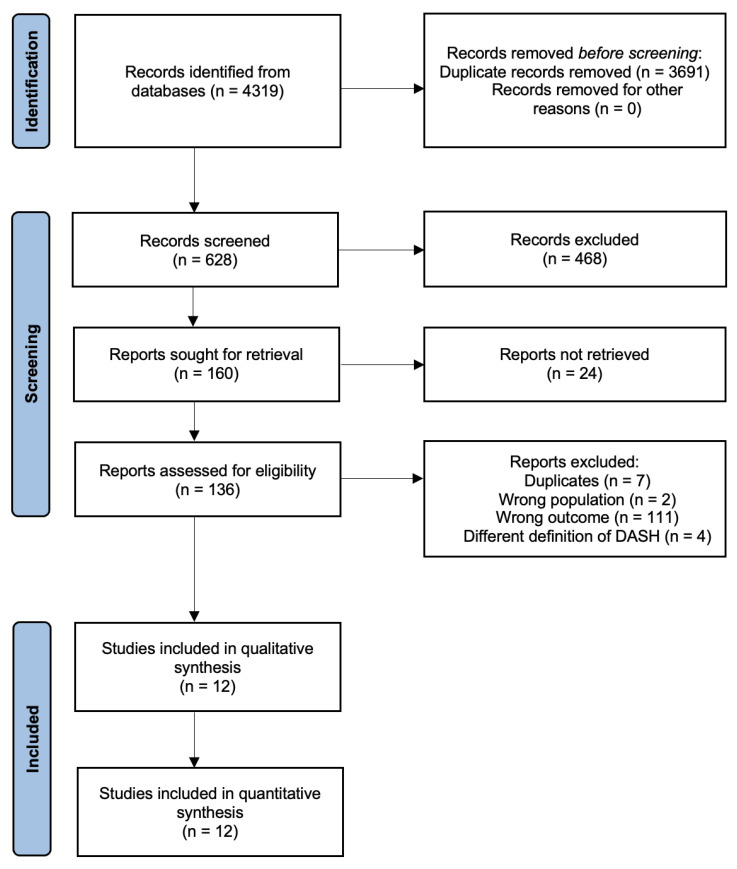
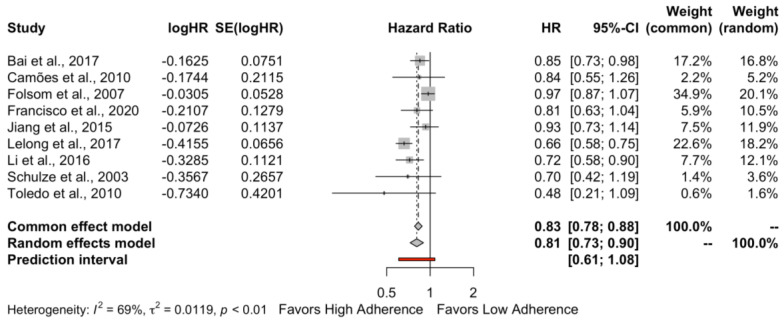
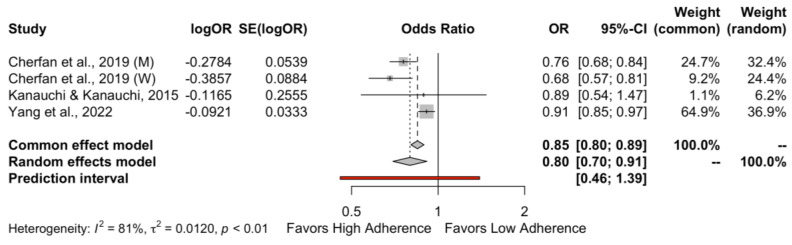
The aim of this study was to assess the effect of the level of adherence to the DASH diet on hypertension risk by conducting a systematic review and meta-analysis. A systematic literature search was performed. Two independent investigators performed the study selection, data abstraction, and assessment of the included studies. The meta-analysis was performed separately with the adjusted hazard (HR) or incident rate ratios (IRR) and the odds ratios (OR) of the highest compared to the lowest DASH diet adherence scores using a random effects model. A total of 12 studies were included in the qualitative and quantitative synthesis. When cohort studies reporting HR were pooled together, high adherence to the DASH diet was associated with a lower risk of hypertension (HR: 0.81, 95% CI 0.73-0.90, I2 = 69%, PI 0.61-1.08) compared to the low adherence. When cross-sectional studies reporting OR were combined, high adherence to the DASH diet was also related to a lower risk of hypertension (OR: 0.80, 95% CI 0.70-0.91, I2 = 81%, PI 0.46-1.39). The findings suggest that high adherence to the DASH diet has a positive effect on reducing hypertension risk compared to low adherence. These data strengthen and are in line with all hypertension guidelines, indicating that lifestyle changes should start early even in populations with normal blood pressure.
Keywords: DASH diet; blood pressure; compliance; hypertension; meta-analysis; systematic review.
Conflict of interest statement
The authors declare no conflict of interest.
Figures
References
-
- Zhou B., Carrillo-Larco R.M., Danaei G., Riley L.M., Paciorek C.J., Stevens G.A., Gregg E.W., Bennett J.E., Solomon B., Singleton R.K., et al. Worldwide Trends in Hypertension Prevalence and Progress in Treatment and Control from 1990 to 2019: A Pooled Analysis of 1201 Population-Representative Studies with 104 Million Participants. Lancet. 2021;398:957–980. doi: 10.1016/S0140-6736(21)01330-1. - DOI - PMC - PubMed
-
- World Health Organization Hypertension. [(accessed on 27 November 2022)]; Available online: https://www.who.int/news-room/fact-sheets/detail/hypertension.
-
- Mensah G.A. Epidemiology and Global Burden of Hypertension. In: Came J., Lüscher T., Maurer G., Serruys P., editors. The ESC Textbook of Cardiovascular Medicine. Oxford University Press; Oxford, UK: 2018. pp. 290–297.
Publication types
MeSH terms
LinkOut - more resources
Full Text Sources
Medical
Research Materials
Miscellaneous
