Review
. 2023 Jun 28;16(7):937.
doi: 10.3390/ph16070937.

Droplet-Based Microfluidics: Applications in Pharmaceuticals

Affiliations
Review

Droplet-Based Microfluidics: Applications in Pharmaceuticals

Thi Ngoc Diep Trinh et al. Pharmaceuticals (Basel). .

Abstract

Droplet-based microfluidics offer great opportunities for applications in various fields, such as diagnostics, food sciences, and drug discovery. A droplet provides an isolated environment for performing a single reaction within a microscale-volume sample, allowing for a fast reaction with a high sensitivity, high throughput, and low risk of cross-contamination. Owing to several remarkable features, droplet-based microfluidic techniques have been intensively studied. In this review, we discuss the impact of droplet microfluidics, particularly focusing on drug screening and development. In addition, we surveyed various methods of device fabrication and droplet generation/manipulation. We further highlight some promising studies covering drug synthesis and delivery that were updated within the last 5 years. This review provides researchers with a quick guide that includes the most up-to-date and relevant information on the latest scientific findings on the development of droplet-based microfluidics in the pharmaceutical field.

Keywords: cell culture; droplet; drug delivery; drug discovery; drug screening; microfluidics; spheroids.


Conflict of interest statement

The authors declare no conflict of interest.

Figures
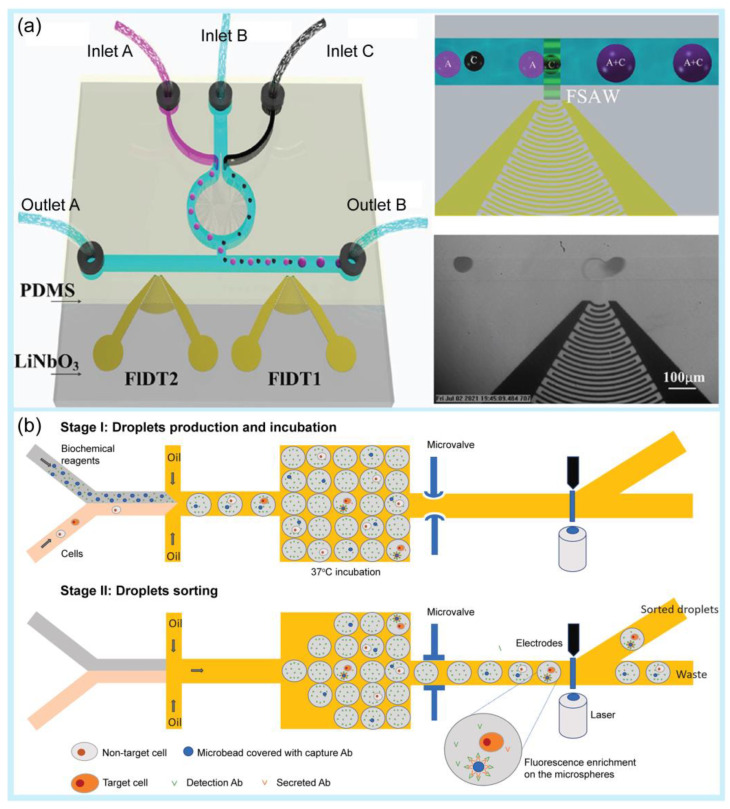
Figure 2
Figure 2
Examples of droplet manipulation. (a) Droplet fusion. Schematic of the microfluidic device based on focused surface acoustic waves (FSAW) as an acoustics-controlled fusion method of microdroplets and microbubbles. Reprinted with permission from [108]. Copyright (2022) ACS publications. (b) Droplet sorting. Schematic of single-cell sorting using an integrated pneumatic valve droplet microfluidic device. Reprinted with permission from [117]. Copyright (2023) Elsevier.
Figure 1
Figure 1
Examples of droplet generation techniques. (a) Co-flow. Experiment setup and schematic of a microfluidic chip for droplet generation. Variations in droplet size as a function of PPEG at different PDEX. Reprinted with permission from [68]. Copyright (2018) ACS publications. (b) A multi-inlet flow-focusing channel generator. The morphology of double-emulsion drops formed at different core–shell flow-rate ratios (scale bar: 20 μm). Image of the double-emulsion drops generated at flow rates of 200 μL/h (DEX-rich), 600 μL/h (PEG-rich), and 3000 μL/h (oil). Scale bar: 100 μm. Reprinted with permission from [69]. Copyright (2020) Springer Nature. (c) Thermal control. Schematic of the microfluidic droplet chip and integrated heating system. Endoskeletal droplets generated using this technique at a higher temperature (T > Tm) and a lower temperature (T < Tm). Reprinted with permission from [70]. Copyright (2022) Springer Nature. (d) Mechanical control. Image showing the manual operation of a pushbutton-activated microfluidic dropenser (PAMD) that generates and dispenses droplets. Image showing the droplets generated by the PAMD. Schematic of the composition of the single droplet generation channel and the pumping unit. Reprinted with permission from [71]. Copyright (2021) Elsevier.
Figure 3
Figure 3
Example of open droplet microfluidic. (a) Schematic of the device, (b) image of generated droplets in the outlet reservoir, and (c) droplets generated in parallel. (d) Workflow for droplet generation using passive forces derived from pressure. (e) Downstream droplet manipulations. Reprinted with permission from [120]. Copyright (2021) Wiley.
Figure 4
Figure 4
Schematic and optical images of the biphasic slug flow microreactor for in situ synthesis of HMF. The inner circulation in droplets and slugs promoted mixing/reaction in the aqueous phase and enhanced in situ extraction of HMF to the organic phase. Reprinted with permission from [127]. Copyright (2020) Elsevier.
Figure 5
Figure 5
Examples of droplet-based microfluidic applications in drug screening. (a) Schematic of high-throughput generation of alginate microbeads with tumor pieces encapsulated by the microfluidic droplet technique. (b) Potential application of the mammary tumor organoids in alginate microbeads. (c) Microfluidic chip channel under a 4× objective lens. (d) High-throughput generation of mammary tumor organoids in alginate microbeads. Scale bar: 200 µm. (e) 3D schematic of a 140 µm luminal organoid: nuclear mapping within the Z-axis (upper image) and cross-sectional view at z = 63 µm (bottom, right). Bright-field image of the organoid (bottom, left). Scale bar: 10 µm. (f) Fluorescence intensity of dead cells after the drug treatment. The values were normalized against the highest intensity (mean ± SD, n = 10, *** p < 0.001). (g) Correlation of doxorubicin uptake, organoid size, and luminal pressure. Reprinted with permission from [136]. Copyright (2021) Wiley.
Figure 6
Figure 6
(a) Schematic of high-throughput generation of hydrogel microspheres with tumor pieces encapsulated by the microfluidic droplet technique for 3D culture and tumorigenic characterizations. (b,c) Drug testing results on MDA-MB-231 microspheres with untreated and treated microspheres with 100 μM doxorubicin for 48 h. Scale bar: 200 µm. (d) Fluorescent images of MDA-MB-231 microspheres before and after spinning for delivering drugs to the assay plate. (e) MDA-MB-231 microspheres treated with 1 μM staurosporine for 72 h completely degraded. Scale bar = 200 μm. (f) MDA-MB-231 microspheres treated with 10 μM doxorubicin are mostly intact but with visible cell damage. Scale bar = 200 μm. (g) Assessing the viability of MDA-MB-231 microspheres after 72 h of incubation (* p < 0.05, n = 5 wells per group). Reprinted with permission from [137]. Copyright (2022) ACS publications.
Figure 7
Figure 7
Examples of droplet-based microfluidic applications in drug delivery. (a) Schematic of biodegradable microneedles (MNs) embedded with drug-containing microcapsules that release the drug over time. The photograph shows the MNs containing microcapsulates, and the graph shows the concentration of FITC-BSA in PBS over time, that is, the time course of cumulative release to PBS. Surface SEM image of the porcine skin surface after insertion and removal of the MNs. Reprinted with permission from [151]. Copyright (2021) Royal Society of Chemistry. (b) Schematic of the preparation of drug-loaded PEGDA microcapsules using a droplet-based microchip and its application in drug evaluation of PC12 cells. The graphs show the results of PC12 cells after paclitaxel-loaded PEGDA and 6-OHDA-loaded PEFDA microcapsule treatment for 1 and 3 days. *** p < 0.001; n = 9. Reprinted with permission from [160]. Copyright (2022) Elsevier.

References

    1. Kelm J.M., Lal-Nag M., Sittampalam G.S., Ferrer M. Translational in vitro research: Integrating 3D drug discovery and development processes into the drug development pipeline. Drug. Discov. Today. 2019;24:26–30. doi: 10.1016/j.drudis.2018.07.007. - DOI - PubMed
    1. Wang Y., Chen Z., Bian F., Shang L., Zhu K., Zhao Y. Advances of droplet-based microfluidics in drug discovery. Expert. Opin. Drug. Discov. 2020;15:969–979. doi: 10.1080/17460441.2020.1758663. - DOI - PubMed
    1. Dittrich P.S., Manz A. Lab-on-a-chip: Microfluidics in drug discovery. Nat. Rev. Drug. Discov. 2006;5:210–218. doi: 10.1038/nrd1985. - DOI - PubMed
    1. Sun J., Warden A.R., Ding X. Recent advances in microfluidics for drug screening. Biomicrofluidics. 2019;13:061503. doi: 10.1063/1.5121200. - DOI - PMC - PubMed
    1. Mak K.K., Pichika M.R. Artificial intelligence in drug development: Present status and future prospects. Drug. Discov. Today. 2019;24:773–780. doi: 10.1016/j.drudis.2018.11.014. - DOI - PubMed

LinkOut - more resources
