


Synergistic Integration of Skeletal Kinematic Features for Vision-Based Fall Detection
- PMID: 37514578
- PMCID: PMC10385725
- DOI: 10.3390/s23146283
Synergistic Integration of Skeletal Kinematic Features for Vision-Based Fall Detection
Abstract
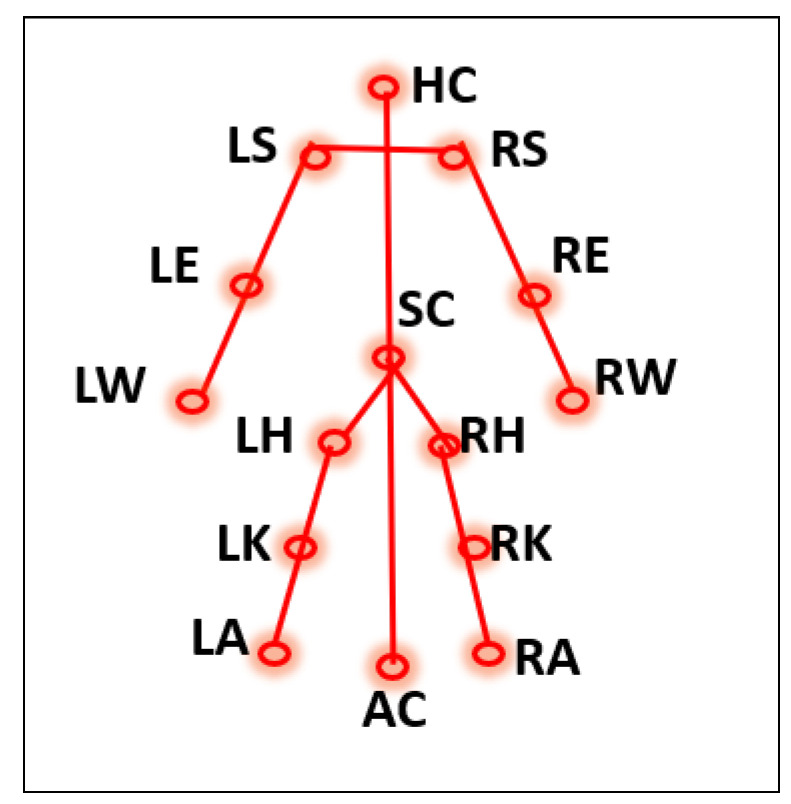
According to the World Health Organisation, falling is a major health problem with potentially fatal implications. Each year, thousands of people die as a result of falls, with seniors making up 80% of these fatalities. The automatic detection of falls may reduce the severity of the consequences. Our study focuses on developing a vision-based fall detection system. Our work proposes a new feature descriptor that results in a new fall detection framework. The body geometry of the subject is analyzed and patterns that help to distinguish falls from non-fall activities are identified in our proposed method. An AlphaPose network is employed to identify 17 keypoints on the human skeleton. Thirteen keypoints are used in our study, and we compute two additional keypoints. These 15 keypoints are divided into five segments, each of which consists of a group of three non-collinear points. These five segments represent the left hand, right hand, left leg, right leg and craniocaudal section. A novel feature descriptor is generated by extracting the distances from the segmented parts, angles within the segmented parts and the angle of inclination for every segmented part. As a result, we may extract three features from each segment, giving us 15 features per frame that preserve spatial information. To capture temporal dynamics, the extracted spatial features are arranged in the temporal sequence. As a result, the feature descriptor in the proposed approach preserves the spatio-temporal dynamics. Thus, a feature descriptor of size [m×15] is formed where m is the number of frames. To recognize fall patterns, machine learning approaches such as decision trees, random forests, and gradient boost are applied to the feature descriptor. Our system was evaluated on the UPfall dataset, which is a benchmark dataset. It has shown very good performance compared to the state-of-the-art approaches.
Keywords: ambient intelligence; assistive technology; fall detection; fall prevention; real-time monitoring; risk assessment; signal processing; video analysis; vision-based human activity recognition.
Conflict of interest statement
The authors declare that there is no conflict of interest.
Figures




References
-
- CDC Fact Sheet. [(accessed on 1 January 2023)];2021 Available online: https://www.cdc.gov/visionhealth/resources/features/vision-loss-falls.html.
-
- Alarifi A., Alwadain A. Killer heuristic optimized convolution neural network-based fall detection with wearable IoT sensor devices. Measurement. 2021;167:108258. doi: 10.1016/j.measurement.2020.108258. - DOI
-
- Şengül G., Karakaya M., Misra S., Abayomi-Alli O.O., Damaševičius R. Deep learning based fall detection using smartwatches for healthcare applications. Biomed. Signal Process. Control. 2022;71:103242. doi: 10.1016/j.bspc.2021.103242. - DOI
-
- Wu X., Zheng Y., Chu C.H., Cheng L., Kim J. Applying deep learning technology for automatic fall detection using mobile sensors. Biomed. Signal Process. Control. 2022;72:103355. doi: 10.1016/j.bspc.2021.103355. - DOI
MeSH terms
Grants and funding
LinkOut - more resources
Full Text Sources
Research Materials
