Review
. 2023 Jul 14;11(7):1240.
doi: 10.3390/vaccines11071240.

A Review: Understanding Molecular Mechanisms of Antibody-Dependent Enhancement in Viral Infections

Affiliations
Review

A Review: Understanding Molecular Mechanisms of Antibody-Dependent Enhancement in Viral Infections

Jyoti Sawant et al. Vaccines (Basel). .

Abstract

Antibody Dependent Enhancement (ADE) of an infection has been of interest in the investigation of many viruses. It is associated with the severity of the infection. ADE is mediated by non-neutralizing antibodies, antibodies at sub-neutralizing concentrations, or cross-reactive non-neutralizing antibodies. Treatments like plasma therapy, B cell immunizations, and antibody therapies may trigger ADE. It is seen as an impediment to vaccine development as well. In viruses including the Dengue virus (DENV), severe acute respiratory syndrome (SARS) virus, Middle East respiratory syndrome (MERS) virus, human immunodeficiency virus (HIV), Ebola virus, Zika virus, and influenza virus, the likely mechanisms of ADE are postulated and described. ADE improves the likelihood of productively infecting cells that are expressing the complement receptor or the Fc receptor (FcR) rather than the viral receptors. ADE occurs when the FcR, particularly the Fc gamma receptor, and/or complement system, particularly Complement 1q (C1q), allow the entry of the virus-antibody complex into the cell. Moreover, ADE alters the innate immune pathways to escape from lysis, promoting viral replication inside the cell that produces viral particles. This review discusses the involvement of FcR and the downstream immunomodulatory pathways in ADE, the complement system, and innate antiviral signaling pathways modification in ADE and its impact on facilitating viral replication. Additionally, we have outlined the modes of ADE in the cases of different viruses reported until now.

Keywords: Antibody Dependent Enhancement (ADE); Fc receptor; complement protein C1q; mechanism of ADE; severe acute respiratory syndrome coronavirus 2 (SARS-CoV-2).


Conflict of interest statement

The authors declare no conflict of interest.

Figures
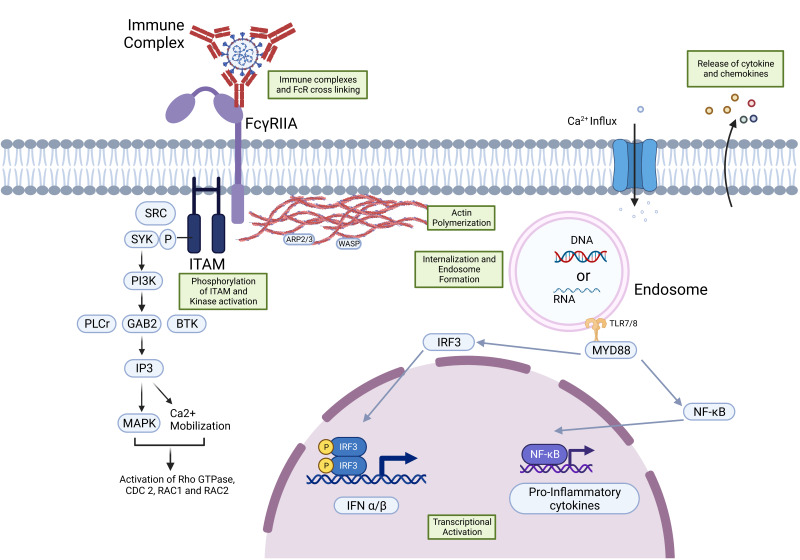
Figure 1
Figure 1
Signaling events occurring after binding of the IgG immune complex to the FcγR immune complex and receptor interactions result in phosphorylation of the immunoreceptor tyrosine activating motifs (ITAMs), followed by activation of the spleen tyrosine kinase (SYK)-mediated PI3K/PKB activation, and SRC family kinases result in the influx of Ca2+, which also promotes actin remodeling, which is important for the immune complex phagocytosis and internalization of the receptor. Eventually, the activation of transcription through NF-kB and IRF-3 leads to the expression of pro-inflammatory cytokines.
Figure 2
Figure 2
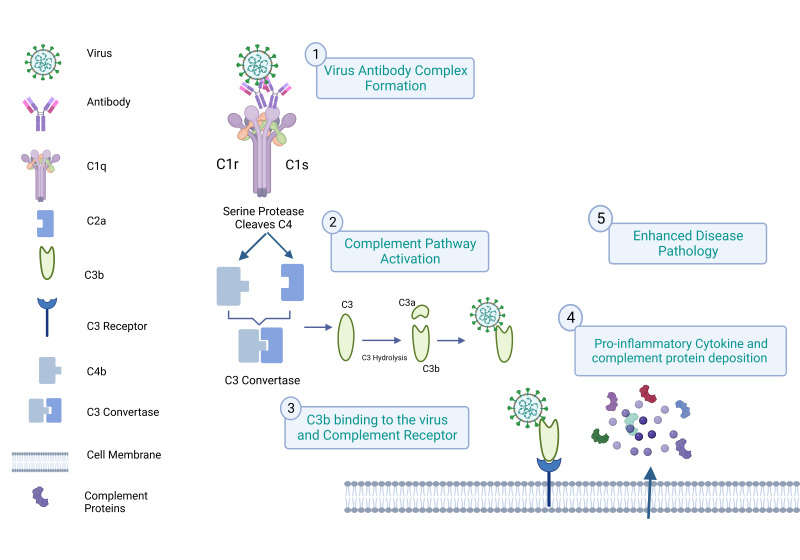
ADE in complement receptor-expressing cells: the virus-antibody complex activates the complement system first by interaction with C1q, followed by activation of C2a and C4b, and finally the production of the C3 convertase, which is the conversion point of all three complement pathways, viz., classical, lectin, and alternative complement activation pathways. The hydrolysis of the C3 produces C3b, interacts with the virus, and complements the receptor on the cell. Finally, the figure shows the lysis of the cell and enhanced disease pathology.
Figure 3
Figure 3
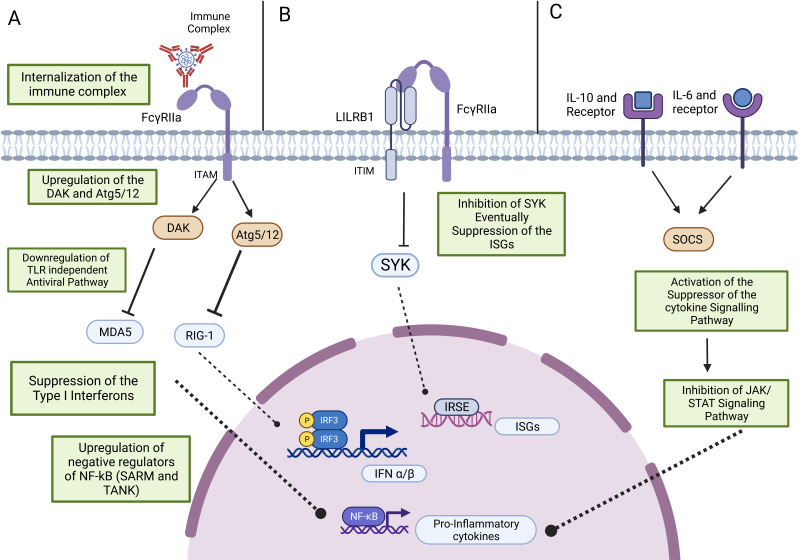
Antiviral response in the ADE Mechanism. (A) Upregulation of the DAK and Atg5/12 and downregulation of the MDA5 and RIG-1, which are the components of the TLR-independent antiviral pathway, results in the suppression of type-1 interferon and proinflammatory cytokine production. (B) An immune complex with FcγRIIa co-ligate to LILRB1 inhibits SYK activation, and revocation of the ISGs expression takes place. (C) IL-10 produced after FcR and immune complex interaction triggers the SOCS and inhibits pro-inflammatory cytokine production by impeding the JAK/STAT signaling pathway.

References

    1. Ahangarzadeh S., Payandeh Z., Arezumand R., Shahzamani K., Yarian F., Alibakhshi A. An update on antiviral antibody-based biopharmaceuticals. Int. Immunopharmacol. 2020;86:106760. doi: 10.1016/j.intimp.2020.106760. - DOI - PMC - PubMed
    1. Sedova E.S., Scherbinin D.N., Lysenko A.A., Alekseeva S.V., Artemova E.A., Shmarov M.M. Non-neutralizing Antibodies Directed at Conservative Influenza Antigens. Acta Nat. 2019;11:22–32. doi: 10.32607/20758251-2019-11-4-22-32. - DOI - PMC - PubMed
    1. Hawkes R.A., Lafferty K.J. The enhancement of virus infectivity by antibody. Virology. 1967;33:250–261. doi: 10.1016/0042-6822(67)90144-4. - DOI - PubMed
    1. Dejnirattisai W., Jumnainsong A., Onsirisakul N., Fitton P., Vasanawathana S., Limpitikul W., Puttikhunt C., Edwards C., Duangchinda T., Supasa S., et al. Cross-reacting antibodies enhance dengue virus infection in humans. Science. 2010;328:745–748. doi: 10.1126/science.1185181. - DOI - PMC - PubMed
    1. Roy S.K., Bhattacharjee S. Dengue virus: Epidemiology, biology, and disease aetiology. Can. J. Microbiol. 2021;67:687–702. doi: 10.1139/cjm-2020-0572. - DOI - PubMed

LinkOut - more resources