. 2023 Jun 28;15(7):1465.
doi: 10.3390/v15071465.

Cholesterol-Lowering Drugs as Potential Antivirals: A Repurposing Approach against Flavivirus Infections

Affiliations

Cholesterol-Lowering Drugs as Potential Antivirals: A Repurposing Approach against Flavivirus Infections

Juan Fidel Osuna-Ramos et al. Viruses. .

Abstract

Flaviviruses, including Dengue (DENV), Zika (ZIKV), and Yellow Fever (YFV) viruses, represent a significant global health burden. The development of effective antiviral therapies against these viruses is crucial to mitigate their impact. This study investigated the antiviral potential of the cholesterol-lowering drugs atorvastatin and ezetimibe in monotherapy and combination against DENV, ZIKV, and YFV. In vitro results demonstrated a dose-dependent reduction in the percentage of infected cells for both drugs. The combination of atorvastatin and ezetimibe showed a synergistic effect against DENV 2, an additive effect against DENV 4 and ZIKV, and an antagonistic effect against YFV. In AG129 mice infected with DENV 2, monotherapy with atorvastatin or ezetimibe significantly reduced clinical signs and increased survival. However, the combination of both drugs did not significantly affect survival. This study provides valuable insights into the potential of atorvastatin and ezetimibe as antiviral agents against flaviviruses and highlights the need for further investigations into their combined therapeutic effects.

Keywords: DENV; YFV; ZIKV; antiviral agents; atorvastatin; cholesterol-lowering drugs; ezetimibe; flaviviruses; synergistic effect; therapeutic use.


Conflict of interest statement

The authors declare no conflict of interest.

Figures
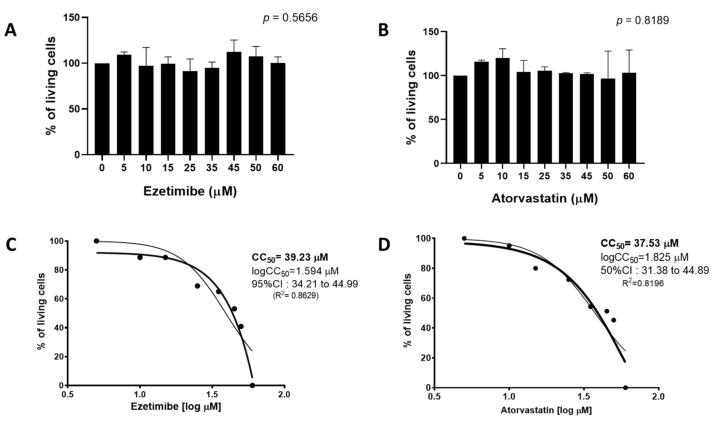
Figure 1
Figure 1
The effects of ezetimibe and atorvastatin on cell viability in monotherapy. The effect of ezetimibe (A) and atorvastatin (B) concentrations on the percentage of living Huh-7 cells after 48 h of treatment by IP. The dose–response curves representing the CC50 for ezetimibe (C) and atorvastatin (D), the CC50 was determined by an MTT assay. The error represents the standard error of the mean (SEM), and the results are displayed as bar graphs. The CC50 was represented as normalized logarithmic dose–response curves.
Figure 2
Figure 2
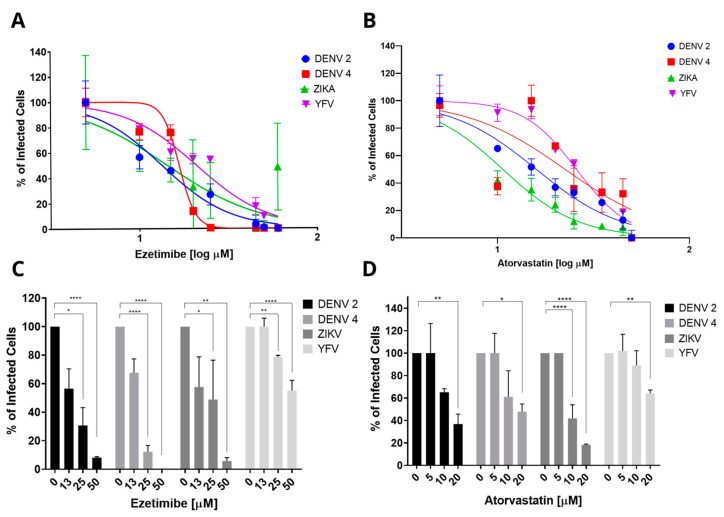
Antiviral effect of ezetimibe and atorvastatin. The dose–response curves representing the IC50 of ezetimibe (A) and atorvastatin (B) in monotherapy against DENV 2, DENV 4, ZIKV, and YFV (A). The percentage of HUH-7 infected cells with DENV 2, DENV 4, ZIKV, and YFV following treatment with 13, 25, and 50 μM of ezetimibe and vehicle (0 μM) (C) and 5, 10, and 20 μM of atorvastatin and vehicle (0 μM) (D). The asterisk values indicate the statistical significance of the value of * p = 0.05, ** p = 0.005, and **** p < 0.0001.
Figure 3
Figure 3
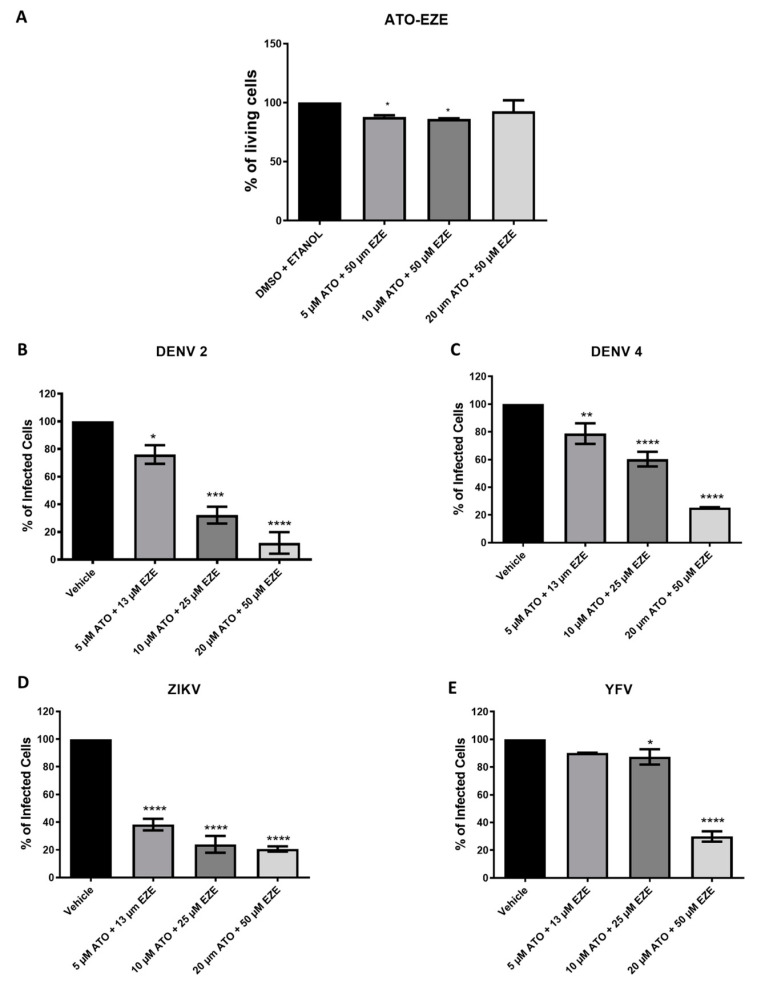
Cell viability of atorvastatin and ezetimibe drugs in combination (A). Bar plots show the antiviral effect of atorvastatin and ezetimibe in combination against (B) DENV 2, (C) DENV 4, (D) ZIKV, and (E) YFV. Asterisks values represent statistical significance of * p value = 0.05, ** p value = 0.01, *** p = 0.001, and **** p < 0.0001.
Figure 4
Figure 4
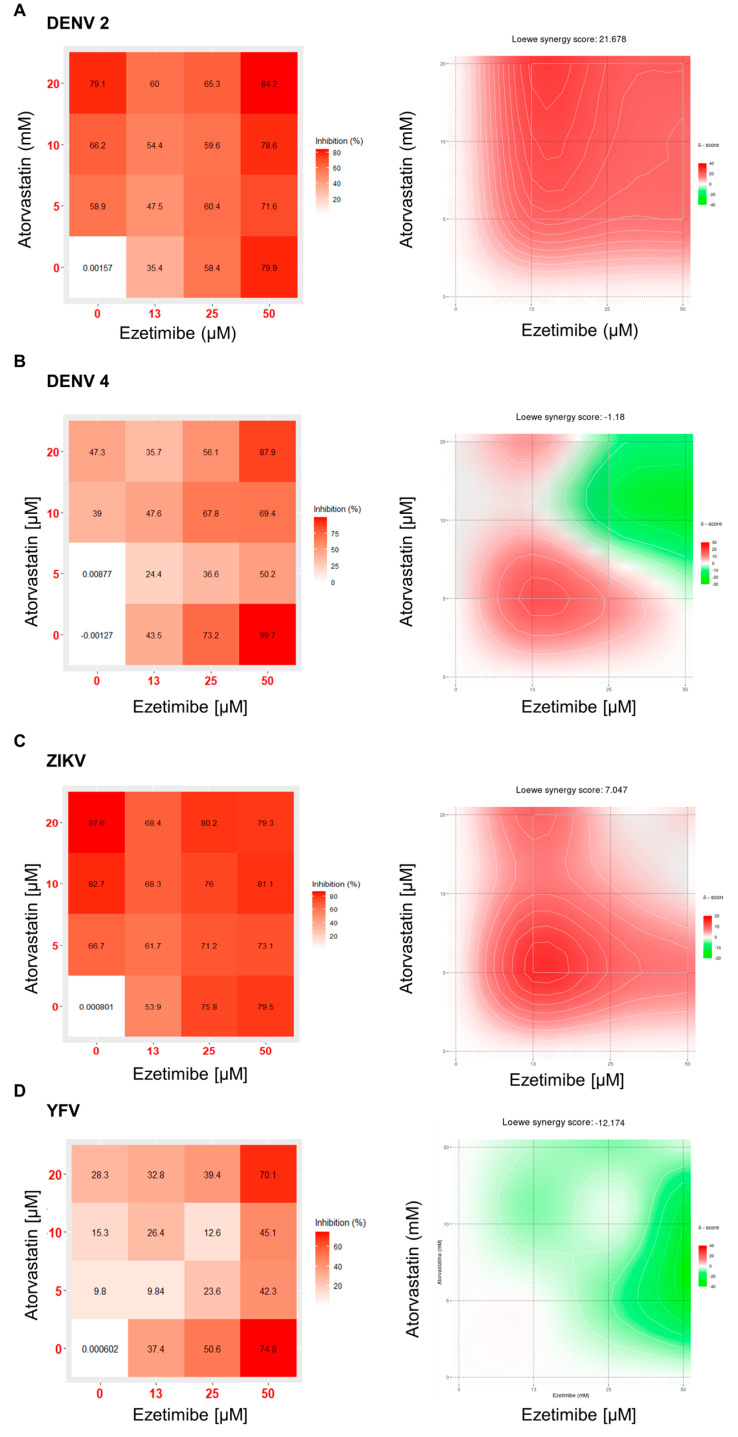
Analysis of the synergism effect between atorvastatin and ezetimibe against DENV-2 (A), DENV-4 (B), ZIKV (C), and YFV (D). The dose–response percentage inhibition matrices of the combined treatments of atorvastatin and ezetimibe and the interaction maps calculated using the Loewe additive model are shown. Areas with synergism scores of 10 or more (in red) represent synergy between the drugs.
Figure 5
Figure 5
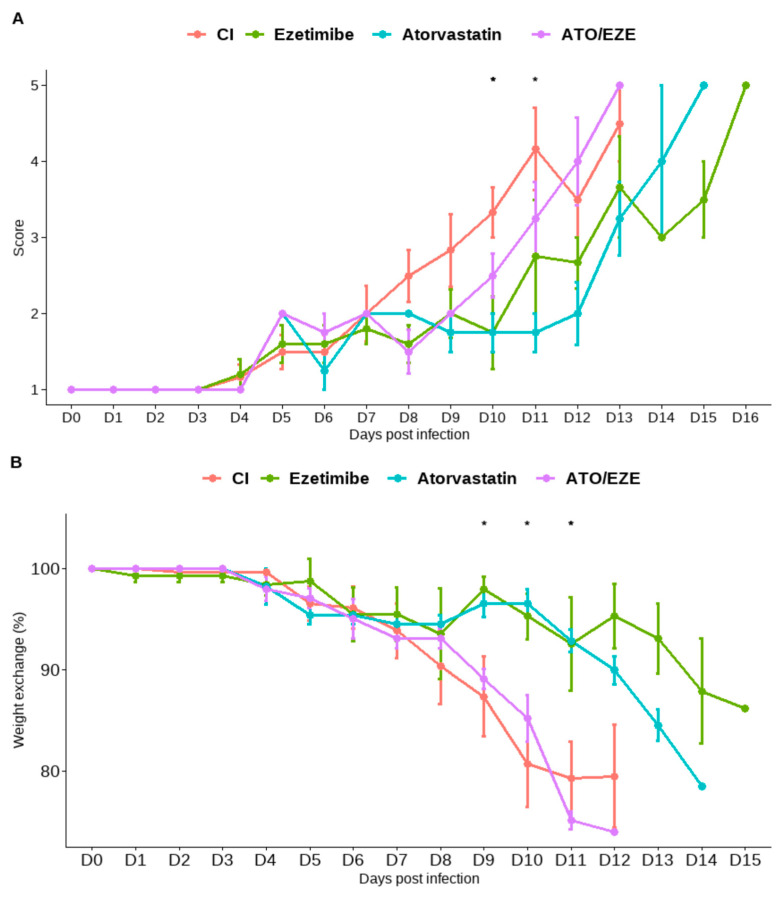
Effect of treatment with atorvastatin and ezetimibe in monotherapy and combined treatment in AG129 mice infected with DENV 2. Clinical sign scores (A) and percent change in weight (B) assessed daily from day of inoculation (D0) to euthanasia. Asterisks (*) shows statistical significance (* = p < 0.05).
Figure 6
Figure 6
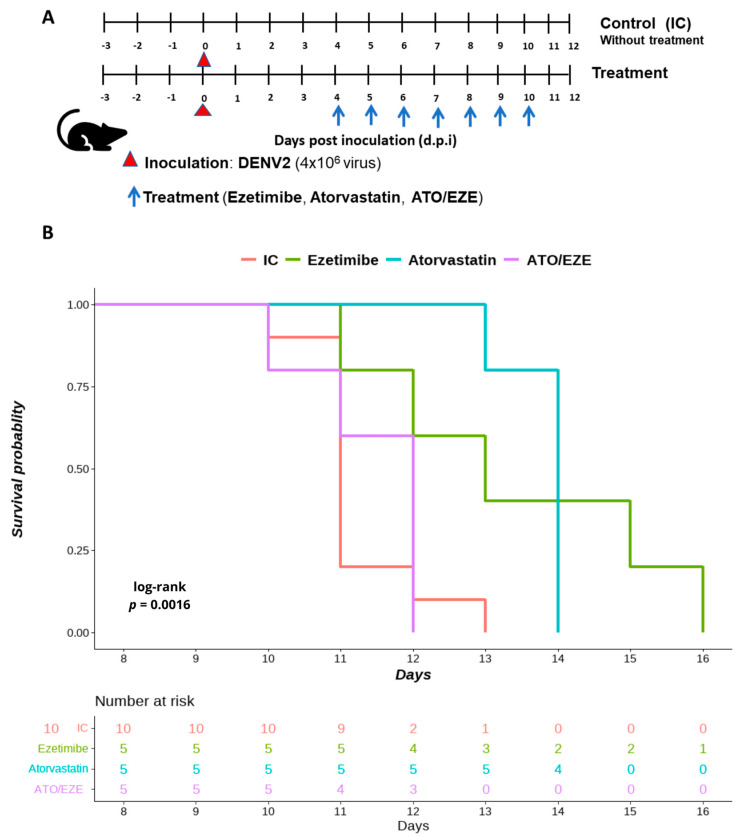
Survival analysis of DENV-2. infected AG129 mice treated with atorvastatin and ezetimibe. A schedule for in vivo experimental strategy is displayed (A). Survival probabilities for atorvastatin and ezetimibe are depicted using Kaplan–Meier curves (B).

References

    1. Suwanmanee S., Luplertlop N. Dengue and Zika Viruses: Lessons Learned from the Similarities between These Aedes Mosquito-Vectored Arboviruses. J. Microbiol. 2017;55:81–89. doi: 10.1007/s12275-017-6494-4. - DOI - PubMed
    1. Chippaux J.-P., Chippaux A. Yellow Fever in Africa and the Americas: A Historical and Epidemiological Perspective. J. Venom. Anim. Toxins Incl. Trop. Dis. 2018;24:20. doi: 10.1186/s40409-018-0162-y. - DOI - PMC - PubMed
    1. Vicente C.R., da Silva T.C.C., Pereira L.D., Miranda A.E. Impact of Concurrent Epidemics of Dengue, Chikungunya, Zika, and COVID-19. Rev. Soc. Bras. Med. Trop. 2021;54:e08372020. doi: 10.1590/0037-8682-0837-2020. - DOI - PMC - PubMed
    1. Guzman M.G., Harris E. Dengue. Lancet. 2015;385:453–465. doi: 10.1016/S0140-6736(14)60572-9. - DOI - PubMed
    1. Monath T.P., Vasconcelos P.F.C. Yellow Fever. J. Clin. Virol. Off. Publ. Pan Am. Soc. Clin. Virol. 2015;64:160–173. doi: 10.1016/j.jcv.2014.08.030. - DOI - PubMed

Publication types