Review
. 2023 Jul 20;15(7):1585.
doi: 10.3390/v15071585.

How Infection and Vaccination Are Linked to Acute and Chronic Urticaria: A Special Focus on COVID-19

Affiliations
Review

How Infection and Vaccination Are Linked to Acute and Chronic Urticaria: A Special Focus on COVID-19

Emek Kocatürk et al. Viruses. .

Abstract

Since more than a century ago, there has been awareness of the connection between viral infections and the onset and exacerbation of urticaria. Our knowledge about the role of viral infection and vaccination in acute and chronic urticaria improved as a result of the COVID-19 pandemic but it has also highlighted knowledge gaps. Viral infections, especially respiratory tract infections like COVID-19, can trigger the onset of acute urticaria (AU) and the exacerbation of chronic urticaria (CU). Less frequently, vaccination against viruses including SARS-CoV-2 can also lead to new onset urticaria as well as worsening of CU in minority. Here, with a particular focus on COVID-19, we review what is known about the role of viral infections and vaccinations as triggers and causes of acute and chronic urticaria. We also discuss possible mechanistic pathways and outline the unmet needs in our knowledge. Although the underlying mechanisms are not clearly understood, it is believed that viral signals, medications, and stress can activate skin mast cells (MCs). Further studies are needed to fully understand the relevance of viral infections and vaccinations in acute and chronic urticaria and to better clarify causal pathways.

Keywords: COVID-19; SARS-CoV-2; adverse events; anaphylaxis; angioedema; exacerbation; omalizumab; urticaria; vaccination; vaccine; viral infections.


Conflict of interest statement

The authors declare no conflict of interest regarding this article.

Figures
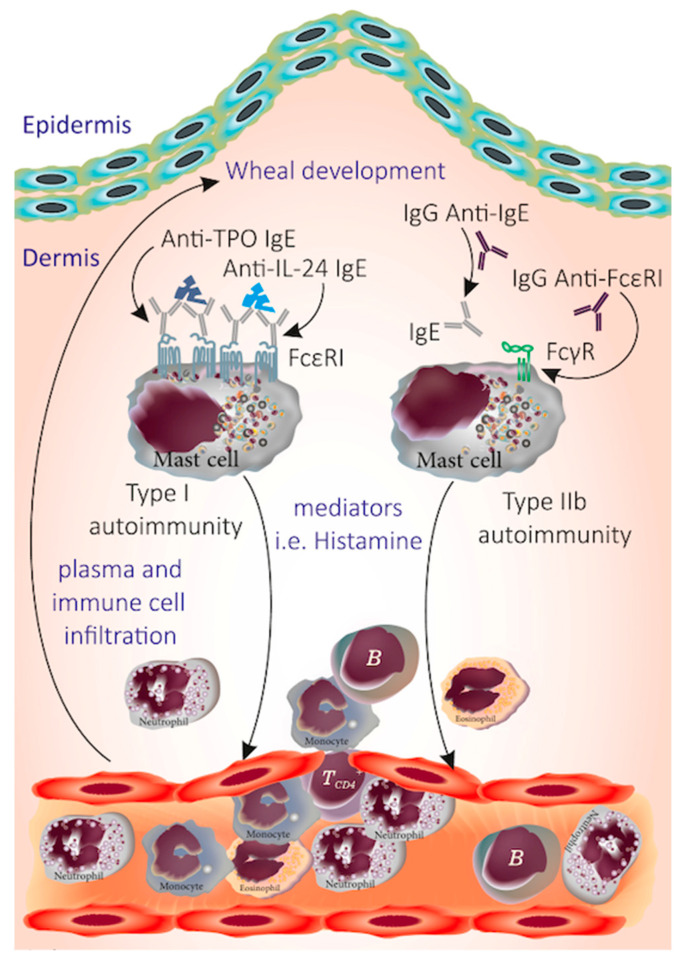
Figure 1
Figure 1
A schematic demonstration of autoimmune mechanisms in CSU. The autoimmunity in CSU can be studied in two main categories of type I and IIb in which either the presence of IgE against autoallergens (TPO, IL-24, etc.) or the IgG autoantibodies against IgE and its receptor FcεRI, respectively, activate dermal MCs and induce the release of mediators such as histamine that mediate cellular infiltration and contribute to the development of wheal.
Figure 2
Figure 2
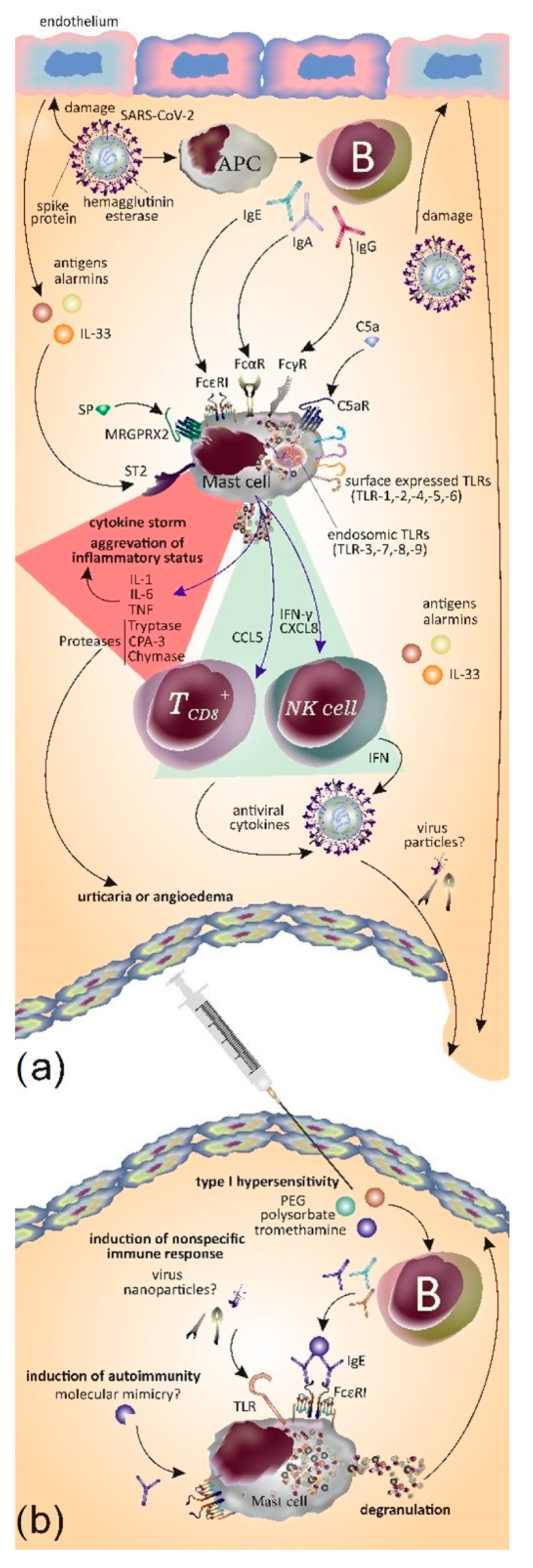
(a) MCs play a role in defense against SARS-CoV-2 by releasing CCL5 which activates CD8+ T cells to release antiviral cytokines; also, MCs release IFN-γ and CXCL8 which acts on NK cells and induces the production of IFN. However, the activation of MCs may also lead to detrimental effects. Main mechanisms on how MCs are activated by SARS-CoV-2 are depicted in the figure. SARS-CoV-2 induces endothelium damage and in turn endothelial cells release antigens, alarmins, and cytokines including IL-33 which activate MCs by engaging ST2. Moreover, MCs express TLRs that sense the pathogen antigens. B cells become activated by antigen presenting cells and in turn produce different classes of immunoglobulins such as IgE, IgA, and IgG which binds to MCs. The activation of MCs induces the release of cytokines and proteases that result in a cytokine storm, the aggravation of inflammatory status, and the induction of urticaria or angioedema (red triangle). (b) Main mechanisms as to how MCs may become activated upon administration of SARS-CoV-2 vaccines and lead to the formation of urticaria and/or angioedema. 1. Type 1 hypersensitivity: the production of IgE against vaccine components, namely mainly PEG, polysorbate, and tromethamine, activates MCs via FcεRI. 2. Induction of non-specific immune responses: MCs may sense the presence of virus nanoparticles via its expressed PRRs, mainly TLRs, which results in the orchestration of nonspecific immune responses. 3. Induction of autoimmunity: Additionally, mechanisms such as molecular mimicry may induce autoimmunity and the production of IgE capable of activation of MCs.

References

    1. Zuberbier T., Abdul Latiff A.H., Abuzakouk M., Aquilina S., Asero R., Baker D., Ballmer-Weber B., Bangert C., Ben-Shoshan M., Bernstein J.A., et al. The international EAACI/GA(2)LEN/EuroGuiDerm/APAAACI guideline for the definition, classification, diagnosis, and management of urticaria. Allergy. 2021;77:734–766. doi: 10.1111/all.15090. - DOI - PubMed
    1. Mostmans Y., De Smedt K., Richert B., Elieh Ali Komi D., Maurer M., Michel O. Markers for the involvement of endothelial cells and the coagulation system in chronic urticaria: A systematic review. Allergy. 2021;76:2998–3016. doi: 10.1111/all.14828. - DOI - PubMed
    1. Elieh-Ali-Komi D., Metz M., Kolkhir P., Kocatürk E., Scheffel J., Frischbutter S., Terhorst-Molawi D., Fox L., Maurer M. Chronic urticaria and the pathogenic role of mast cells. Allergol. Int. 2023;18:359–368. doi: 10.1016/j.alit.2023.05.003. - DOI - PubMed
    1. Kolkhir P., Muñoz M., Asero R., Ferrer M., Kocatürk E., Metz M., Xiang Y.K., Maurer M. Autoimmune chronic spontaneous urticaria. J. Allergy Clin. Immunol. 2022;149:1819–1831. doi: 10.1016/j.jaci.2022.04.010. - DOI - PubMed
    1. Konstantinou G.N., Papadopoulos N.G., Tavladaki T., Tsekoura T., Tsilimigaki A., Grattan C.E.H. Childhood acute urticaria in northern and southern Europe shows a similar epidemiological pattern and significant meteorological influences. Pediatr. Allergy Immunol. 2011;22:36–42. doi: 10.1111/j.1399-3038.2010.01093.x. - DOI - PubMed