Review
. 2023 Jul 29;6(1):135.
doi: 10.1038/s41746-023-00879-8.

The shaky foundations of large language models and foundation models for electronic health records

Affiliations
Review

The shaky foundations of large language models and foundation models for electronic health records

Michael Wornow et al. NPJ Digit Med. .

Abstract

The success of foundation models such as ChatGPT and AlphaFold has spurred significant interest in building similar models for electronic medical records (EMRs) to improve patient care and hospital operations. However, recent hype has obscured critical gaps in our understanding of these models' capabilities. In this narrative review, we examine 84 foundation models trained on non-imaging EMR data (i.e., clinical text and/or structured data) and create a taxonomy delineating their architectures, training data, and potential use cases. We find that most models are trained on small, narrowly-scoped clinical datasets (e.g., MIMIC-III) or broad, public biomedical corpora (e.g., PubMed) and are evaluated on tasks that do not provide meaningful insights on their usefulness to health systems. Considering these findings, we propose an improved evaluation framework for measuring the benefits of clinical foundation models that is more closely grounded to metrics that matter in healthcare.


Conflict of interest statement

B.P. reports stock-based compensation from Google, LLC. Otherwise, the authors declare that there are no competing interests.

Figures
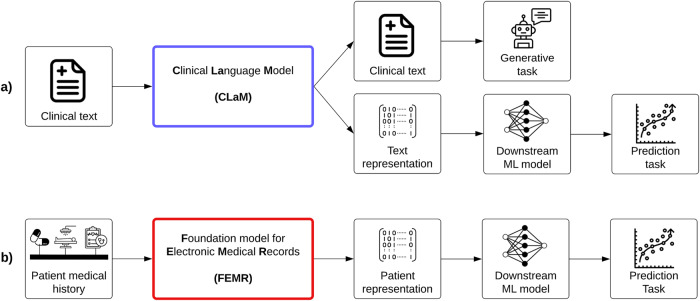
Fig. 1
Fig. 1. The two types of clinical FMs.
Overview of the inputs and outputs of the two main types of clinical FMs. a The inputs and outputs of Clinical Language Models (CLaMs). CLaMs ingest clinical text and output either clinical text or a machine-understandable representation of the input text, which can then be used for downstream prediction tasks. b The inputs and outputs of Foundation models for Electronic Medical Records (FEMRs). FEMRs ingest a patient’s medical history—which is simply a sequence of medical events with some temporal ordering—and output a machine-understandable representation of the patient, which can then be used for downstream prediction tasks.
Fig. 2
Fig. 2. Overview of CLaMs.
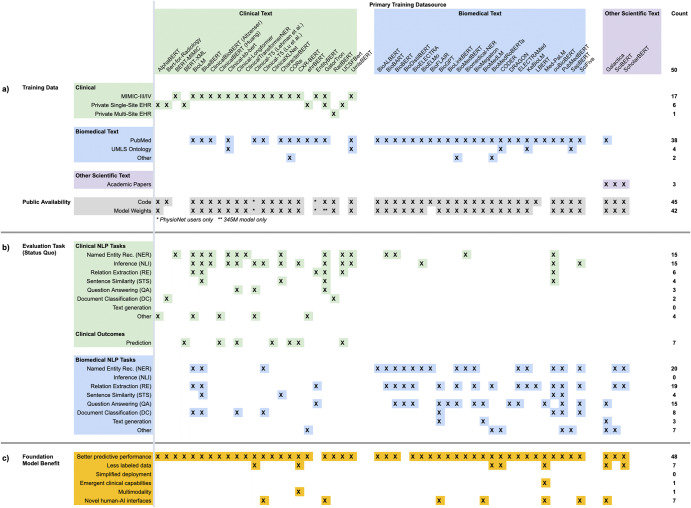
A summary of CLaMs and how they were trained, evaluated, and published. Each column is a specific CLaM, grouped by the primary type of data they were trained on. Columnwise, the CLaMs primarily trained on clinical text are green (n = 23), those trained primarily on biomedical text are blue (n = 24), and models trained on general academic text are purple (n = 3). The last column is the count of entries in each row. An X indicates that the model has that characteristic. An * indicates that a model partially has that characteristic. a Training data and public availability of each model. The top rows mark whether a CLaM was trained on a specific dataset, while the bottom-most row records whether a model’s code and weights have been published. Almost all CLaMs have had their model weights published, typically via shared repositories like the HuggingFace Model Hub. b Evaluation tasks on which each model was evaluated in its original paper. Green rows are tasks whose data were sourced from clinical text and blue rows are evaluation tasks sourced from biomedical text. The tasks are presented by the way they are commonly organized in the literature. CLaMs primarily trained on clinical text are evaluated on tasks drawn from clinical datasets, while CLaMs primarily trained on biomedical text are almost exclusively evaluated on tasks that contain general biomedical text (i.e., not clinical text). c Clinical FM benefits on which each model was evaluated in its original paper. The underlying tasks presented in this section are identical to those in (b), but here the tasks are reorganized into six buckets that reflect the six primary FM benefits described in Benefits of clinical FMs. While almost all CLaMs have demonstrated the ability to improve predictive accuracy over traditional ML approaches, there is scant evidence for the other five value propositions of clinical FMs.
Fig. 3
Fig. 3. Overview of FEMRs.
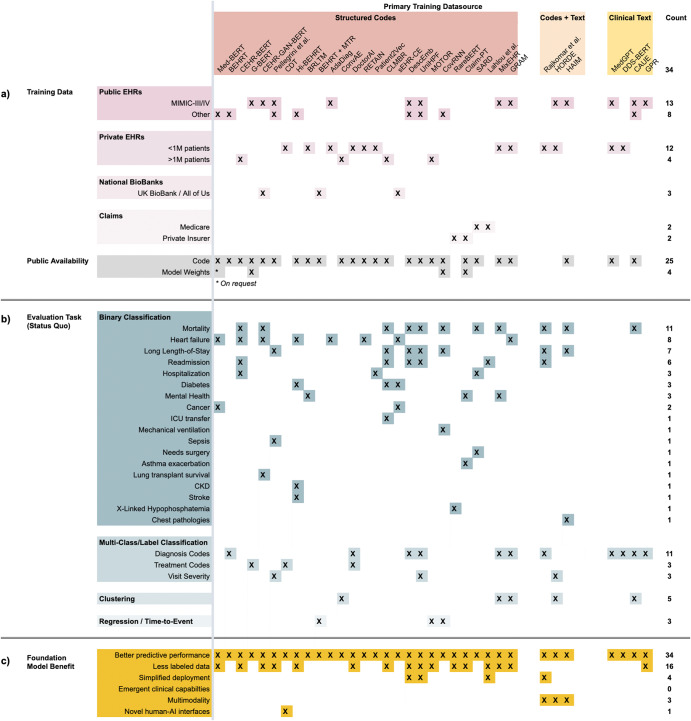
A summary of FEMRs and how they were trained, evaluated, and published. Each column is a specific FEMR, grouped by the primary type of data they were trained on. Columnwise, the FEMRs primarily trained on structured EMR codes (e.g., billing, medications, etc.) are red (n = 27), those trained on both structured codes and clinical text are orange (n = 3), and models trained only on clinical text are yellow (n = 4). The last column is the count of entries in each row. An X indicates that the model has that characteristic. An * indicates that a model partially has that characteristic. a Training data and public availability of each model. The top rows mark whether a FEMR was trained on a specific dataset, while the bottom-most row records whether a model’s code and weights have been published. Very few FEMRs have had their model weights published, as they are limited by data privacy concerns and a lack of interoperability between EMR schemas. b Evaluation tasks on which each model was evaluated in its original paper. From top to bottom, the evaluation tasks are binary classification, multi-class/label classification, clustering of patients/diseases, and regression tasks like time-to-event. The tasks are presented by the way they are commonly organized in the literature. FEMRs are evaluated on a very broad and sparse set of evaluation tasks—even the same nominal task will often have different definitions across papers. c Clinical FM benefits on which each model was evaluated in its original paper. The underlying tasks presented in this section are identical to those in (b), but here the tasks are reorganized into six buckets that reflect the six primary FM benefits described in “Benefits of clinical FMs”. While almost all FEMRs have demonstrated the ability to improve predictive accuracy over traditional ML approaches, and a significant number have demonstrated improved sample efficiency, there is scant evidence for the other four value propositions of clinical FMs.
Fig. 4
Fig. 4. Better evaluations of clinical FMs.
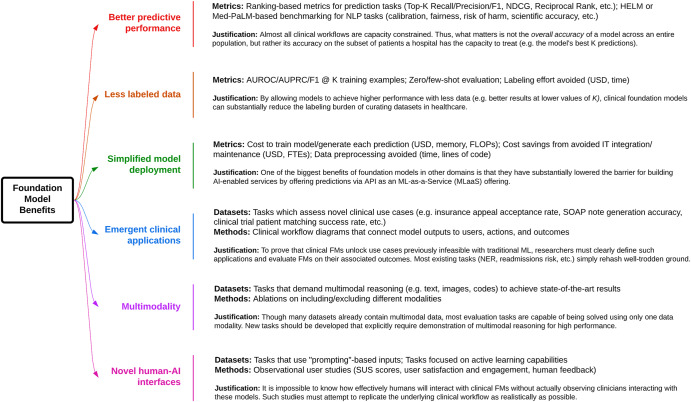
Proposals for how to demonstrate the value of CLaMs and FEMRs for achieving the six primary value propositions of FMs to health systems over traditional ML models.

References

    1. Bommasani, R. et al. On the opportunities and risks of foundation models. Preprint at arXiv: 2108.07258 (2021).
    1. Brown, T. B. et al. Language models are few-shot learners. Preprint at arXiv:2005.14165 (2020).
    1. Esser, P., Chiu, J., Atighehchian, P., Granskog, J. & Germanidis, A. Structure and content-guided video synthesis with diffusion models. Preprint at arXiv: 2302.03011 (2023).
    1. Jumper J, et al. Highly accurate protein structure prediction with AlphaFold. Nature. 2021;596:583–589. doi: 10.1038/s41586-021-03819-2. - DOI - PMC - PubMed
    1. Jiang, Y. et al. VIMA: general robot manipulation with multimodal prompts. Preprint at arXiv: 2210.03094 (2022).