. 2023 Jul 29;13(1):12299.
doi: 10.1038/s41598-023-39562-z.

Optical and pharmacological manipulation of hypoglossal motor nucleus identifies differential effects of taltirelin on sleeping tonic motor activity and responsiveness

Affiliations

Optical and pharmacological manipulation of hypoglossal motor nucleus identifies differential effects of taltirelin on sleeping tonic motor activity and responsiveness

Jasmin Aggarwal et al. Sci Rep. .

Abstract

Pharyngeal muscle activity and responsiveness are key pathophysiological traits in human obstructive sleep apnea (OSA) and strong contributors to improvements with pharmacotherapy. The thyrotropin-releasing hormone (TRH) analog taltirelin is of high pre-clinical interest given its neuronal-stimulant properties, minimal endocrine activity, tongue muscle activation following microperfusion into the hypoglossal motor nucleus (HMN) or systemic delivery, and high TRH receptor expression at the HMN compared to rest of the brain. Here we test the hypothesis that taltirelin increases HMN activity and/or responsivity to excitatory stimuli applied across sleep-wake states in-vivo. To target hypoglossal motoneurons with simultaneous pharmacological and optical stimuli we used customized "opto-dialysis" probes and chronically implanted them in mice expressing a light sensitive cation channel exclusively on cholinergic neurons (ChAT-ChR2, n = 12) and wild-type mice lacking the opsin (n = 10). Both optical stimuli applied across a range of powers (P < 0.001) and microperfusion of taltirelin into the HMN (P < 0.020) increased tongue motor activity in sleeping ChAT-ChR2 mice. Notably, taltirelin increased tonic background tongue motor activity (P < 0.001) but not responsivity to excitatory optical stimuli across sleep-wake states (P > 0.098). This differential effect on tonic motor activity versus responsivity informs human studies of the potential beneficial effects of taltirelin on pharyngeal motor control and OSA pharmacotherapy.


Conflict of interest statement

The authors declare no competing interests.

Figures

Figure 1
Figure 1
Example (a) and group (b,c) data showing the sites of microdialysis on coronal diagrams of the mouse medulla from all the experiments in the ChAT–ChR2 and wild-type mice. The ventral tips of the probe sites are identified (see arrow, a), and sites of microdialysis reconstructed and plotted to scale on representative standard sections (b,c); overlap obscures some of the individual dialysis sites. The sites of microdialysis perfusion were located within or immediately adjacent to the hypoglossal motor nucleus in all experiments. The tip of the microdialysis probe extended 1 mm farther than the tip of the optical fiber. An example is shown (d) of a site of optical stimulation with the calculated divergence angle (see “Methods” section) of the light stimulation from the tip of the optical fiber. The diminution of power with increasing distance from the fiber tip is represented as decreased intensity of the blue light for visual purposes only. Abbreviations: 12N, hypoglossal motor nucleus; 10N, dorsal motor nucleus of the vagus; IRt, intermediate medullary reticular region; Amb, nucleus ambiguous.
Figure 2
Figure 2
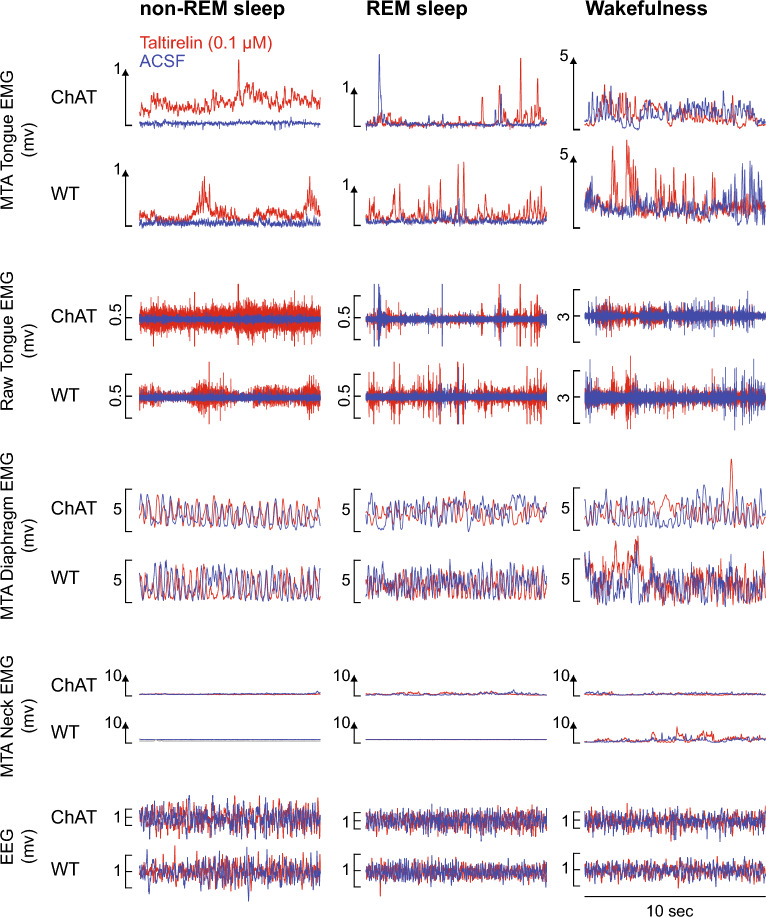
Representative traces of baseline tongue muscle activity (i.e., in the absence of optical stimulation) recorded from one individual wild-type (WT) mouse and one ChAT mouse across sleep–wake states with and without microperfusion of taltirelin into the hypoglossal motor nucleus. Note the increased tongue motor activity in the presence of taltirelin compared to artificial cerebrospinal fluid (ACSF) in the ChAT and WT mice. The pairs of traces in each case are superimposed to show the augmentation of tongue motor activity by taltirelin, and similarity in other signals such as diaphragm and neck electromyogram (EMG) activities and the electroencephalogram (EEG). Abbreviations: MTA, moving time average.
Figure 3
Figure 3
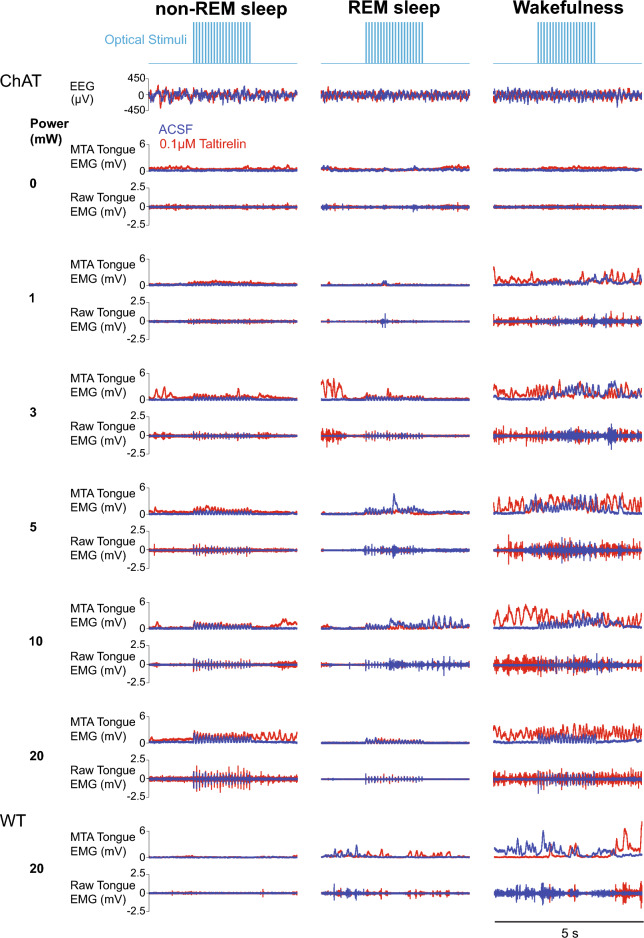
Examples of tongue motor responses in ChAT–ChR2 mice elicited by optical stimulation in sample periods of wakefulness, non-REM sleep and REM sleep, with and without microperfusion of taltirelin into the hypoglossal motor nucleus. Typically, in each sleep and awake state the magnitude of the elicited tongue motor responses increased with increasing power of stimulation, with lesser responses in REM sleep compared to the other states. Baseline tonic tongue motor activity also increased in the presence of taltirelin, but motor responses to the excitatory pulses of optical stimuli were typically unchanged with taltirelin versus ACSF. No tongue motor responses were observed with optical stimulation in the wild-type (WT) mice lacking the opsin. Traces are from one individual WT mouse and one ChAT mouse. Abbreviations: EEG, electroencephalogram; EMG, electromyogram; MTA, moving time average.
Figure 4
Figure 4
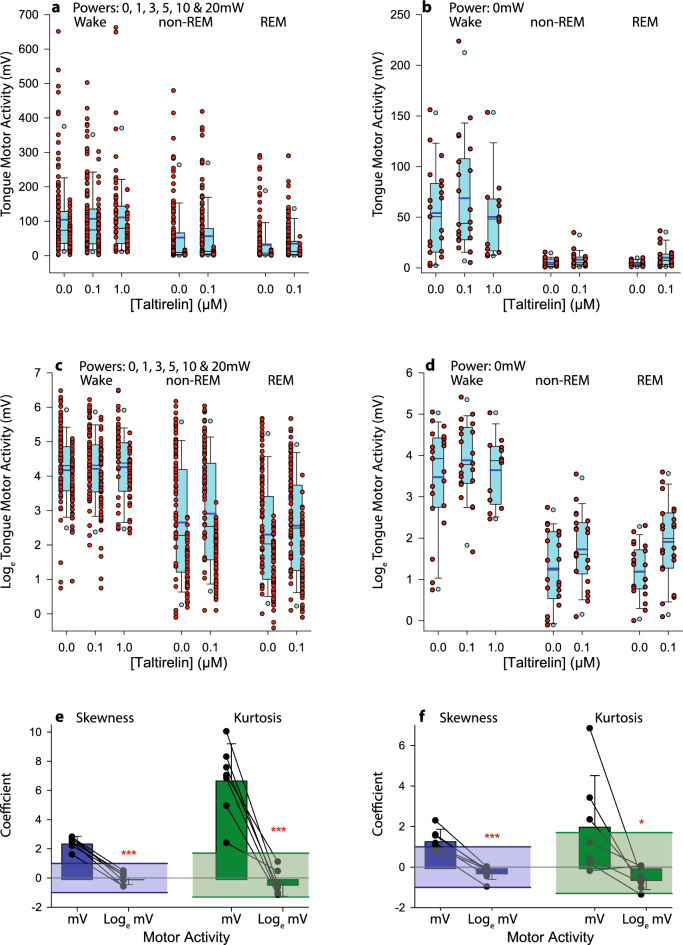
Distribution of the magnitude of tongue motor responses to optical stimulation of the hypoglossal motor nucleus. The box and whisker plots (blue boxes in panels a to d) show the group data as median (solid line), mean (thicker solid line), 25th and 75th percentiles, and data points indicating the 5th and 95th percentiles. The individual data points superimposed on each plot (red symbols) show average responses to optical stimulation at each indicated power at each concentration of taltirelin at the hypoglossal motoneuron pool for each of wakefulness, non-REM and REM sleep. Each response in each mouse is indicated by a discrete symbol (n = 12 ChAT, data shown on the left of each boxplot, and n = 10 wild-type, data shown on the right of each boxplot). The natural logarithm (loge) of the motor responses normalized the distributions such that the coefficients of skewness and kurtosis of the data were significantly reduced to within the range for normal distribution (skewness: <  ± 1, blue solid line and blue box; kurtosis: 1.7 to − 1.3, green solid lines and green box, panels a and f). Abbreviations: ***P < 0.001; *P < 0.05.
Figure 5
Figure 5
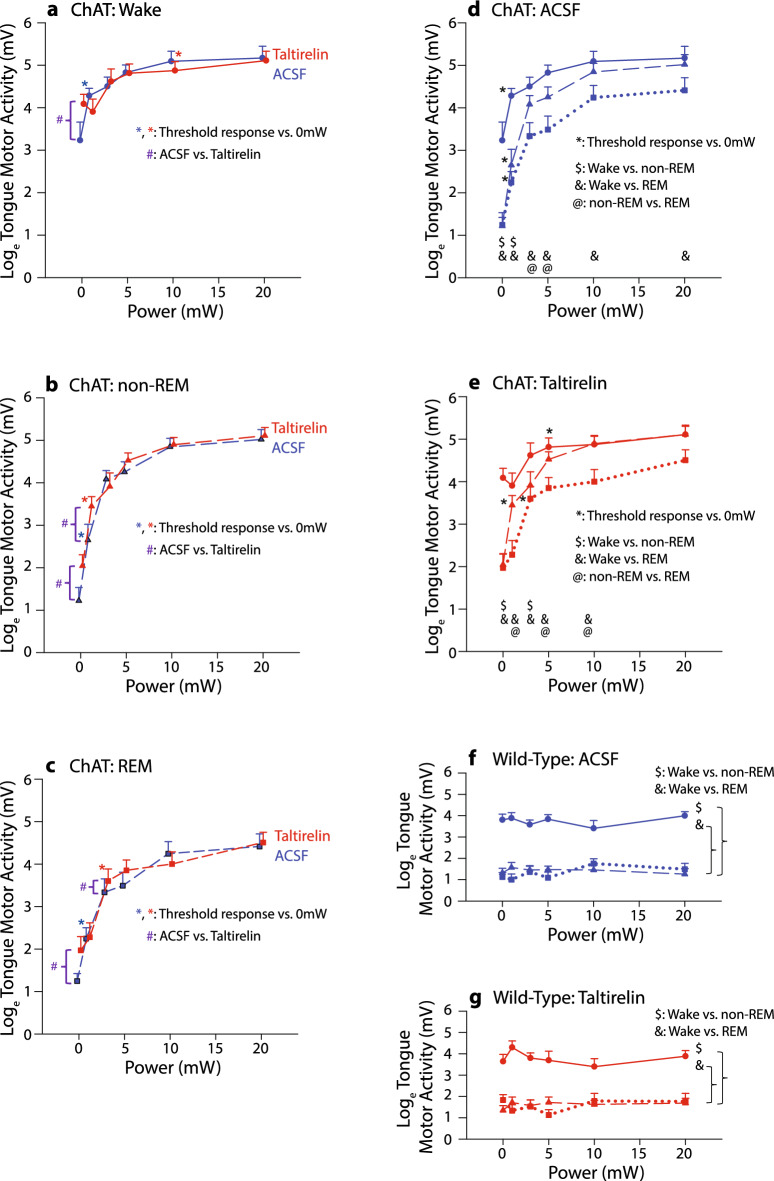
Group mean (+ SEM) data showing the effect of optical stimulation power (0, 1, 3, 5, 10 and 20 mW) on tongue motor responses in wakefulness, non-REM and REM sleep with microperfusion of taltirelin or vehicle (i.e., artificial cerebrospinal fluid, ACSF) into the hypoglossal motor nucleus in ChAT–ChR2 and wild-type mice. Statistically significant differences are indicated by the respective symbols in panels (a) to (g): *threshold response at the indicated power versus 0 mW (i.e., sham) controls; #, ACSF versus taltirelin for the indicated comparisons; $, wakefulness versus non-REM sleep; &, wakefulness versus REM sleep, and @, non-REM versus REM sleep. See text for further details.

References

    1. Benjafield AV, et al. Estimation of the global prevalence and burden of obstructive sleep apnoea: A literature-based analysis. Lancet Respir. Med. 2019;7:687–698. doi: 10.1016/S2213-2600(19)30198-5. - DOI - PMC - PubMed
    1. Peppard PE, et al. Increased prevalence of sleep-disordered breathing in adults. Am. J. Epidemiol. 2013;177:1006–1014. doi: 10.1093/aje/kws342. - DOI - PMC - PubMed
    1. Younes M. Role of respiratory control mechanisms in the pathogenesis of obstructive sleep disorders. J Appl Physiol. 2008;105:1389–1405. doi: 10.1152/japplphysiol.90408.2008. - DOI - PubMed
    1. Wellman A, et al. A method for measuring and modeling the physiological traits causing obstructive sleep apnea. J. Appl. Physiol. 2011;110:1627–1637. doi: 10.1152/japplphysiol.00972.2010. - DOI - PMC - PubMed
    1. Eckert DJ, White DP, Jordan AS, Malhotra A, Wellman A. Defining phenotypic causes of obstructive sleep apnea. Identification of novel therapeutic targets. Am. J. Respir. Crit. Care Med. 2013;188:996–1004. doi: 10.1164/rccm.201303-0448OC. - DOI - PMC - PubMed

Publication types

Grants and funding