Review
. 2023 Sep;30(9):2035-2052.
doi: 10.1038/s41418-023-01196-z. Epub 2023 Jul 29.

Cyclers' kinases in cell division: from molecules to cancer therapy

Affiliations
Review

Cyclers' kinases in cell division: from molecules to cancer therapy

Giacomo Milletti et al. Cell Death Differ. 2023 Sep.

Abstract

Faithful eucaryotic cell division requires spatio-temporal orchestration of multiple sequential events. To ensure the dynamic nature of these molecular and morphological transitions, a swift modulation of key regulatory pathways is necessary. The molecular process that most certainly fits this description is phosphorylation, the post-translational modification provided by kinases, that is crucial to allowing the progression of the cell cycle and that culminates with the separation of two identical daughter cells. In detail, from the early stages of the interphase to the cytokinesis, each critical step of this process is tightly regulated by multiple families of kinases including the Cyclin-dependent kinases (CDKs), kinases of the Aurora, Polo, Wee1 families, and many others. While cell-cycle-related CDKs control the timing of the different phases, preventing replication machinery errors, the latter modulate the centrosome cycle and the spindle function, avoiding karyotypic abnormalities typical of chromosome instability. Such chromosomal abnormalities may result from replication stress (RS) and chromosome mis-segregation and are considered a hallmark of poor prognosis, therapeutic resistance, and metastasis in cancer patients. Here, we discuss recent advances in the understanding of how different families of kinases concur to govern cell cycle, preventing RS and mitotic infidelity. Additionally, considering the growing number of clinical trials targeting these molecules, we review to what extent and in which tumor context cell-cycle-related kinases inhibitors are worth exploiting as an effective therapeutic strategy.


Conflict of interest statement

The authors declare no competing interests.

Figures
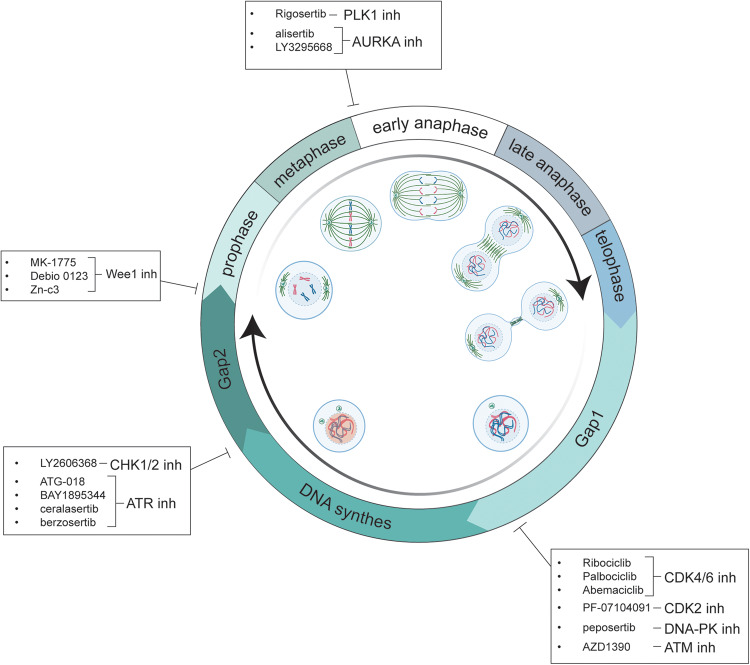
Fig. 1
Fig. 1. Cell cycle-associated kinases inhibitors in clinical trials.
A significant number of inhibitors have been developed to specifically target kinases involved in cell cycle regulation and DNA replication. In each box, the active compounds that target cells undergoing the different cell cycle phases currently subjected to clinical trials (see Table 1). Figure created with BioRender.com.
Fig. 2
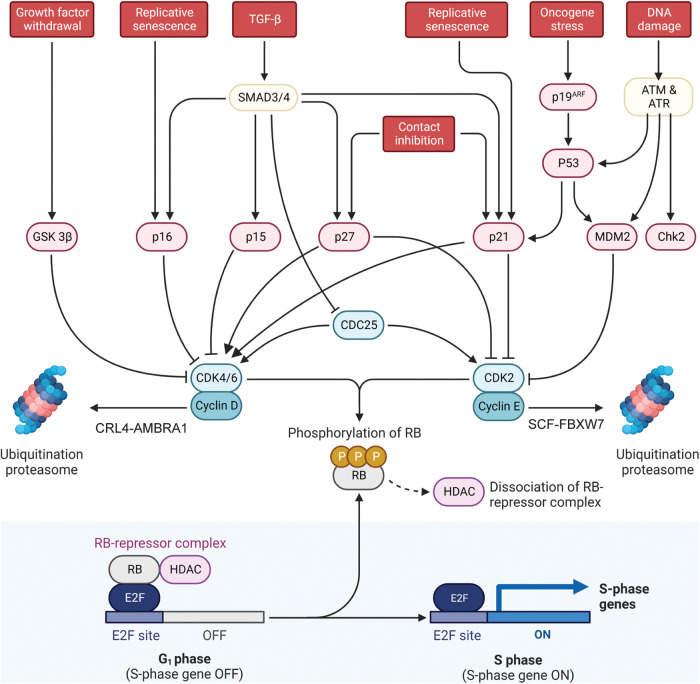
Fig. 2. Molecular overview of G1/S transition.
The decision of a cell to enter the replicative phase is governed by a multifactorial network that controls faithfully the timing of the transition. The multiple processes involved converge all together on the de-repression of the E2F transcription factor, inducing the expression of S-phase related genes. Figure created with BioRender.com.
Fig. 3
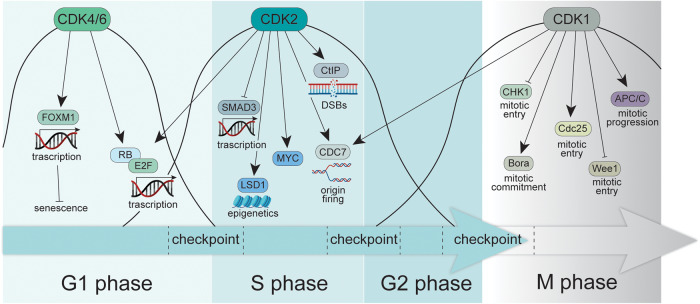
Fig. 3. Relevant CDKs phosphorylation targets throughout cell cycle.
Upon cell cycle entry, CDK4 and CDK6 kinases are activated allosterically by binding Cyclins D. Their catalitic activity mainly targets RB, in order to release E2F transcriptional activity and FOXM1 to suppress senescence. At the onset of the decision window between G1 and S phases, CDK2 activity arises and positively regulates multiple targets involved in DNA replication, repair and epigenetic control, while inhibiting SMAD3 transcriptional activity. Last, at the interface between G2 and M phase, CDK1 is activated and supports the mitotic process from the commitment to the completion, by phoshorylating - among others, targets such as CHK1, Bora, Cdc25, Wee1 and APC/C.
Fig. 4
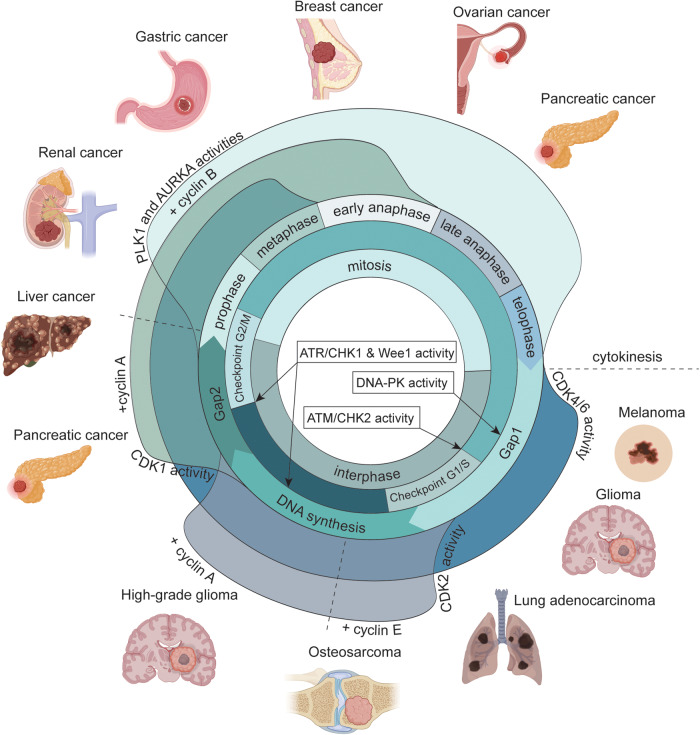
Fig. 4. Cell cycle-associated kinases activity waves and their related tumors.
Cell division in unicellular and multicellular eukaryotes is governed by a sophisticated network of regulatory systems and balances to ensure that no errors occur before a cell is permitted to enter and advance through the cell cycle. Cell cycle is divided into mitosis and interphase (inner circle), and within each of these cellular states multiple subphases are present. The timely and precise duplication and segregation of the genomic DNA is granted by multiple kinases activity (outer waves and inner circle boxes), that when deregulated contributes to the onset of several cancer types (in the figure the type of cancer is related by proximity to the respective kinase wave). Figure created with BioRender.com.

References

    1. Adikes RC, Kohrman AQ, Martinez MAQ, Palmisano NJ, Smith JJ, Medwig-Kinney TN, et al. Visualizing the metazoan proliferation-quiescence decision in vivo. Elife. 2020;9:e63265. doi: 10.7554/eLife.63265. - DOI - PMC - PubMed
    1. Matthews HK, Bertoli C, de Bruin RAM. Cell cycle control in cancer. Nat Rev Mol Cell Biol. 2022;23:74–88. doi: 10.1038/s41580-021-00404-3. - DOI - PubMed
    1. Pienta KJ, Hammarlund EU, Brown JS, Amend SR, Axelrod RM. Cancer recurrence and lethality are enabled by enhanced survival and reversible cell cycle arrest of polyaneuploid cells. Proc Natl Acad Sci USA. 2021;118:e2020838118. doi: 10.1073/pnas.2020838118. - DOI - PMC - PubMed
    1. Segeren HA, van Rijnberk LM, Moreno E, Riemers FM, van Liere EA, Yuan R, et al. Excessive E2F transcription in single cancer cells precludes transient cell-cycle exit after DNA damage. Cell Rep. 2020;33:108449. doi: 10.1016/j.celrep.2020.108449. - DOI - PubMed
    1. Serrano M, Hannon GJ, Beach D. A new regulatory motif in cell-cycle control causing specific inhibition of cyclin D/CDK4. Nature. 1993;366:704–7. doi: 10.1038/366704a0. - DOI - PubMed

Publication types

LinkOut - more resources