


Screening Guidelines and Programs for Cervical Cancer Control in Countries of Different Economic Groups: A Narrative Review
- PMID: 37519623
- PMCID: PMC10381098
- DOI: 10.7759/cureus.41098
Screening Guidelines and Programs for Cervical Cancer Control in Countries of Different Economic Groups: A Narrative Review
Abstract
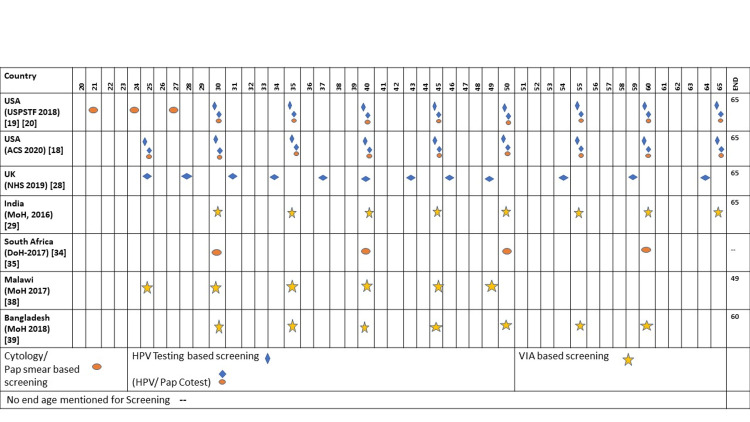
Screening guidelines and practices differ according to resource availability and continually update as scientific developments take place. In this article, we have reviewed screening guidelines and programs for cervical cancer prevention in selected countries belonging to different economic groups viz high income, middle income, and low income. We have selected six countries - the United States of America (USA), the United Kingdom (UK), India, South Africa, Bangladesh, and Malawi. Considerable differences are observed across the health systems. Countries with established screening guidelines complemented by organised nationwide programs or insurance practices have much better screening rates. Human Papilloma Virus (HPV) DNA testing is currently the test of choice in the majority of settings for cervical cancer screening due to its higher sensitivity (up to 90-100%) and longer screening intervals (three to five years). It is also cost-effective, less dependent on operator expertise, and suitable for all settings as compared to a Pap smear test or visual inspection with acetic acid (VIA). Self-sampling of HPV can further help to improve screening coverage by increasing opportunities of reaching to women who would otherwise not participate in screening programs. Resource-constrained countries recommend VIA-based screening in their national programs due to its low cost. The share of cervical cancer is higher in middle and low-income countries as they have lower screening coverage, compared to high-income countries. The main barriers faced in the implementation of the program in low-income countries (LICs) are pertaining to the health system, patient-specific challenges, and healthcare provider-specific challenges.
Keywords: barriers; cervical cancer; guidelines; health system challenges; implementation; program; screening.
Copyright © 2023, Sharma et al.
Conflict of interest statement
The authors have declared that no competing interests exist.
Figures
References
-
- Globocan: Cancer today, International agency for research on cancer. [ May; 2023 ];https://gco.iarc.fr/today/home 2020 21:2023.
-
- Cervical cancer in low and middle-income countries. Hull R, Mbele M, Makhafola T, et al. https://pubmed.ncbi.nlm.nih.gov/32782524/ Oncol Lett. 2020;20:2058–2074. - PMC - PubMed
-
- Sexually transmitted infections among US women and men: prevalence and incidence estimates, 2008. Satterwhite CL, Torrone E, Meites E, et al. Sex Transm Dis. 2013;40:187–193. - PubMed
-
- HPV vaccine development: a case study of prevention and politics. Grimes JL. https://iubmb.onlinelibrary.wiley.com/doi/full/10.1002/bmb.2006.49403402148. Biochem Mol Biol Educ. 2006;34:148–154. - PubMed
Publication types
LinkOut - more resources
Full Text Sources
Research Materials