


Investigating the validity and reliability of the GLFS-25 questionnaire by factor analysis in the elderly hospitalized at the intensive and cardiac care units
- PMID: 37519703
- PMCID: PMC10372237
- DOI: 10.1016/j.heliyon.2023.e18111
Investigating the validity and reliability of the GLFS-25 questionnaire by factor analysis in the elderly hospitalized at the intensive and cardiac care units
Abstract
Introduction: Geriatric Locomotive Function Scale-25 (GLFS-25) is a 25-item tool most commonly used to diagnose locomotive syndrome in the elderly. The purpose of the present study was to investigate the validity and reliability of the GLFS-25 questionnaire using factor analysis.
Materials and methods: This descriptive-analytical study was conducted on 186 elderly people. The GLFS-25 questionnaire contains 25 items, and each item is scored on a five-point Likert scale from 0 to 4. Data were analyzed by SPSS V.19 software. Descriptive (frequency, percentage, mean, and standard deviation) and inferential (Cronbach's alpha, correlation coefficient, Bartlett test, KMO index, scree plot, and factor analysis) statistics were used to present the findings.
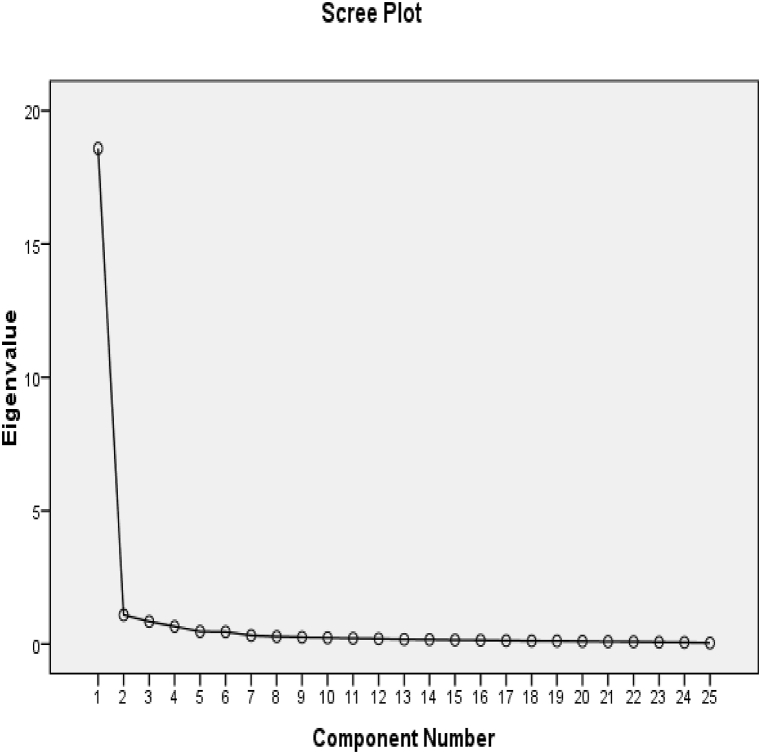
Results: Factor analysis revealed two hidden factors in the four dimensions of the questionnaire (i.e., pain, daily activities, social relations, and mental health). The first factor, named mobility and its consequential concerns), with a variance percentage of 74.323, had an effect on questions No. 19, 11, 25, 16, 6, 24, 5, 4, and 3. The second factor, named the problems and risks associated with daily and social activities, with a variance percentage of 78.680, had an effect on questions No. 17, 22, 7, 18, 14, 20, 13, 9, 12, 8, 10, 21, 2, 15, 1, and 23. Cronbach's alpha coefficient among the questionnaire's dimensions was 78.4%.
Conclusion: The GLFS-25 questionnaire can be used as a valid and reliable tool to diagnose locomotive syndrome in the elderly.
Keywords: Elderly; Factor analysis; Locomotive syndrome.
© 2023 The Authors.
Conflict of interest statement
The authors declare that they have no known competing financial interests or personal relationships that could have appeared to influence the work reported in this paper.
Figures
References
-
- Akahane M., et al. The impact of musculoskeletal diseases on the presence of locomotive syndrome, Modern. Rheumatology. 2018;29(1):151–156. 2018. - PubMed
-
- Saleh M., et al. Old-Old elderly problems which can be effective in choosing their own bed. J. Geriat. Nurs. 2018;4(2):20–34.
-
- Sadeghimahalli N., et al. Locomotive syndrome in the elderly and its risk factors, Salmand. Iran. J. Age. 2019;13:604–613.
-
- Kobayashi T., et al. The association of comorbidities with the 25-question geriatric locomotive function scale and the diagnosis of locomotive syndrome. J. Orthop. Sci. 2023;28(2):453–459. - PubMed
LinkOut - more resources
Full Text Sources
