


The Effect of Anxiety and Stress on Acceptance of Dental Procedure before and after Inhalation Sedation in Pediatric Patients: An In Vivo Study
- PMID: 37519985
- PMCID: PMC10373752
- DOI: 10.5005/jp-journals-10005-2534
The Effect of Anxiety and Stress on Acceptance of Dental Procedure before and after Inhalation Sedation in Pediatric Patients: An In Vivo Study
Abstract
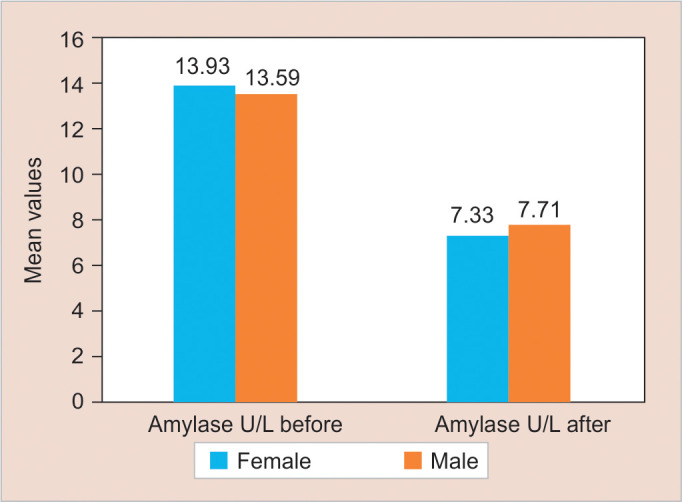
Aim: The study aimed to assess the anxiety and stress levels on acceptance of dental treatment in child patients approaching dental extraction procedures before and after nitrous oxide (N2O) inhalation sedation (IHS) by measuring serum amyloid A (SAA) and salivary cortisol (SC).
Materials and methods: A total of 32 children, ages ranging from 6 to 10 years, were randomly grouped as TI (before N2O IHS) and TII (after N2O IHS). Saliva samples were taken for biochemical evaluation of SAA before and after the procedure. Subjectively anxiety and stress levels were evaluated using modified child dental anxiety scale (MCDAS). Wilcoxon rank-sum test was used to compare the means of dental anxiety, SAA, and SC before and after N2O IHS. The Karl Pearson correlation coefficient was employed to determine the correlation between dental anxiety and SAA and SC before and after N2O IHS.
Results: There were significant differences in the dental anxiety level in child patients after administration of N2O IHS, and it also showed an increased rate of acceptance of dental treatment.
Conclusion: This study showed that N2O is a safe and effective method in reducing dental anxiety and increasing acceptance of dental treatment in child patients with improved behavior and with no adverse effects.
Clinical significance: Anxiety and stress will always hinder the acceptance of dental treatment in child patients, especially during extraction procedures. N2O IHS is a safe and effective technique to overcome anxiety and stress in child patients and as well as allows them to undergo dental treatment with improved behavior.
How to cite this article: Kunta S, Arora RV, Jain R, et al. The Effect of Anxiety and Stress on Acceptance of Dental Procedure before and after Inhalation Sedation in Pediatric Patients: An In Vivo Study. Int J Clin Pediatr Dent 2023;16(2):302-307.
Keywords: Dental anxiety; Nitrous oxide inhalation sedation; Salivary cortisol; Salivary α-amylase.
Copyright © 2023; The Author(s).
Conflict of interest statement
Source of support: Nil Conflict of interest: None
Figures



References
-
- Swetah CSV, Ramakrishnan M. Dental anxiety among children regarding different dental treatment-modified child dental anxiety scale (MCDAS)—a cross sectional study. Indian J Public Health Res Dev. 2019;10(11):3668. doi: 10.5958/0976-5506.2019.04159.7. - DOI
LinkOut - more resources
Full Text Sources