


Oral microbiome of the inner surface of face masks and whole saliva during the COVID-19 pandemic
- PMID: 37521176
- PMCID: PMC10379621
- DOI: 10.3389/froh.2023.1178020
Oral microbiome of the inner surface of face masks and whole saliva during the COVID-19 pandemic
Abstract
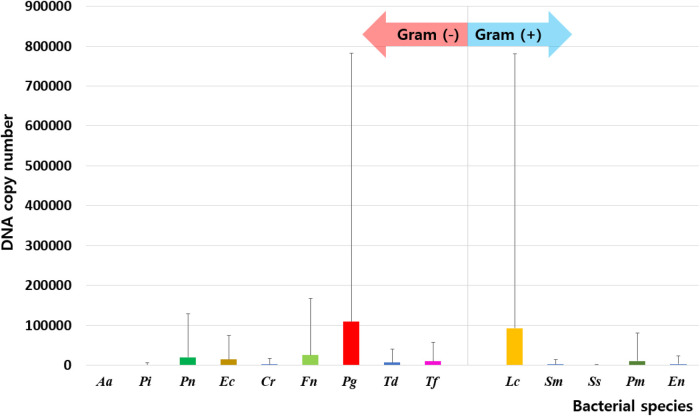
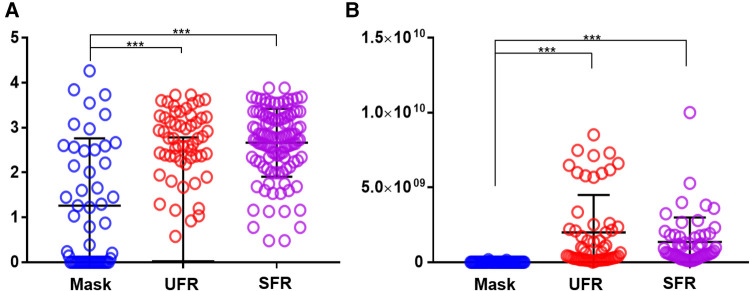
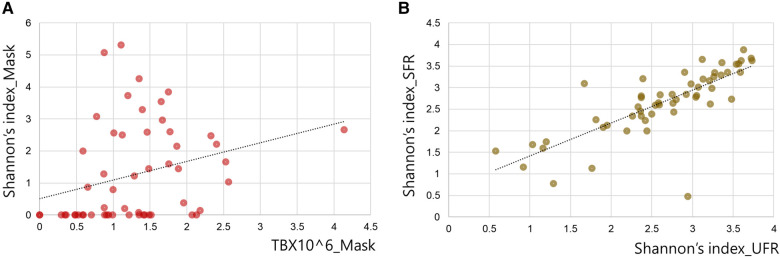
Wearing a face mask was strongly recommended during the COVID-19 pandemic. The purpose of this study was to investigate the diversity of the oral microbiome, the abundance of each bacterium on the inner surface of the mask, and the effects of xerostomia on the microbiota. The study was conducted on 55 generally healthy adults (45 women and 10 men, mean age 38.18 ± 12.49 years). Unstimulated flow rate (UFR) and stimulated flow rate (SFR) were measured in whole saliva samples collected for each condition. The 14 major oral bacterial species, including Porphyromonas gingivalis (P. gingivalis), Lactobacillus casei (L. casei), Tannerella forsythia (T. forsythia), and Treponema denticola (T. denticola) on the inner surface of the mask and in the UFR and SFR samples, were analyzed by real-time PCR. We found that the total DNA copy number of oral bacteria was significantly higher in UFR and SFR than in the mask (p < 0.001). On the inner surface of the mask, P. gingivalis and L. casei were the most abundant Gram-negative and Gram-positive species, respectively. The oral microbiome profile of the mask differed from that of the UFR and SFR samples. Shannon's diversity index was also significantly higher in the UFR and SFR than in the mask (2.64 ± 0.78, 2.66 ± 0.76, and 1.26 ± 1.51, respectively, p < 0.001). Shannon's diversity index of UFR and SFR had a significant positive correlation with each other (r = 0.828, p < 0.001), but there was no significant relationship with Shannon's diversity index of mask. Red complex abundance, including P. gingivalis, T. forsythia, and T. denticola, was significantly higher in UFR than in the mask. Interestingly, the DNA copy number of each of the 14 bacteria, the total bacterial amount, and Shannon's diversity index did not differ in the absence or presence of xerostomia (p > 0.05). In summary, oral bacteria migrated to and existed on the inside of the mask, and the presence of xerostomia did not affect the bacterial profiles. The inner surface of the mask had an independent oral microbiome profile, although this showed lower quantity and diversity than the UFR and SFR samples.
Keywords: bacteria; mask; microbiome; saliva; shannon diversity index; xerostomia.
© 2023 Lee, Kim, Heo, Ahn and Park.
Conflict of interest statement
The authors declare that the research was conducted in the absence of any commercial or financial relationships that could be construed as a potential conflict of interest.
Figures
References
-
- Chiu NC, Chi H, Tai YL, Peng CC, Tseng CY, Chen CC, et al. Impact of wearing masks, hand hygiene, and social distancing on influenza, enterovirus, and all-cause pneumonia during the coronavirus pandemic: retrospective national epidemiological surveillance study. J Med Internet Res. (2020) 22:e21257. 10.2196/21257 - DOI - PMC - PubMed
LinkOut - more resources
Full Text Sources
