


Reconstructing the value puzzle in health technology assessment: a pragmatic review to determine which modelling methods can account for additional value elements
- PMID: 37521458
- PMCID: PMC10372435
- DOI: 10.3389/fphar.2023.1197259
Reconstructing the value puzzle in health technology assessment: a pragmatic review to determine which modelling methods can account for additional value elements
Abstract
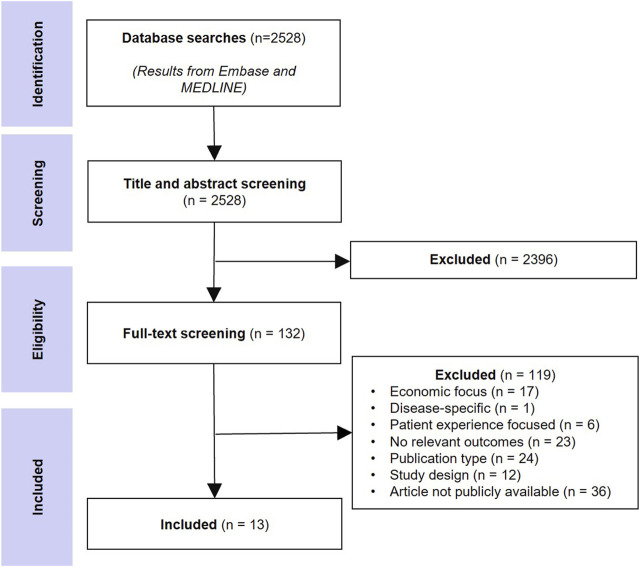
Health technology assessment (HTA) has traditionally relied on cost-effectiveness analysis (CEA) as a cornerstone of evaluation of new therapies, assessing the clinical validity and utility, the efficacy, and the cost-effectiveness of new interventions. The current format of cost-effectiveness analysis, however, does not allow for inclusion of more holistic aspects of health and, therefore, value elements for new technologies such as the impact on patients and society beyond its pure clinical and economic value. This study aimed to review the recent modelling attempts to expand the traditional cost-effectiveness analysis approach by incorporating additional elements of value in health technology assessment. A pragmatic literature review was conducted for articles published between 2012 and 2022 reporting cost-effectiveness analysis including value aspects beyond the clinical and cost-effectiveness estimates; searches identified 13 articles that were eligible for inclusion. These expanded modelling approaches mainly focused on integrating the impact of societal values and health equity in cost-effectiveness analysis, both of which were championed as important aspects of health technology assessment that should be incorporated into future technology assessments. The reviewed cost-effectiveness analysis methods included modification of the current cost-effectiveness analysis methodology (distributional cost-effectiveness analysis, augmented cost-effectiveness analysis, extended cost-effectiveness analysis) or the use of multi-criteria decision analysis. Of these approaches, augmented cost-effectiveness analysis appears to have the most potential by expanding traditional aspects of value, as it uses techniques already familiar to health technology assessment agencies but also allows space for incorporation of qualitative aspects of a product's value. This review showcases that methods to unravel additional value elements for technology assessment exist, therefore, patient access to promising technologies can be improved by moving the discussion from "if" to "how" additional value elements can inform decision-making.
Keywords: cost-effectiveness analysis; health equity; health policy; health technology assessment; societal value; value elements.
Copyright © 2023 Muir, Radhakrishnan, Freitag, Ozer Stillman and Sarri.
Conflict of interest statement
Authors JM, GS, AR, and AF were employed by Cytel, Inc. Author IO was employed by Takeda Pharmaceuticals, Inc.
Figures


References
Publication types
LinkOut - more resources
Full Text Sources
