. 2022;1(1):13.
doi: 10.1038/s44184-022-00013-8. Epub 2022 Oct 5.

Youth with severe mental illness and complex non-somatic motor abnormalities: conflicting conceptualizations and unequal treatment

Affiliations

Youth with severe mental illness and complex non-somatic motor abnormalities: conflicting conceptualizations and unequal treatment

Peter Andersson et al. Npj Ment Health Res. 2022.

Abstract

Two emerging diagnostic concepts promote distinct treatments for youth with acute-onset motor abnormalities and severe concurrent psychiatric symptoms: Pediatric acute-onset neuropsychiatric syndrome (PANS) and pediatric catatonia. Both have institutional approval in parts of Europe and in the USA, meriting an unconditional comparison of supporting evidence. Here we report results of qualitative and quantitative analyses of literature and Swedish National Registry Data suggesting that (1) catatonic patients are liable to fulfilling diagnostic criteria for PANS, (2) three conservatively assessed PANS case-reports present with possible unrecognized catatonia, (3) lithium and electroconvulsive therapy usage frequencies in Swedish minors (exclusively recommended for severe mental illness) are strongly intercorrelated and unequally distributed across Swedish counties, (4) established severe mental disorders are rarely overtly considered amongst PANS-specific research and (5) best-available evidence treatments appear markedly superior for pediatric catatonia compared to PANS in both childhood and adolescence. Prioritizing treatments for pediatric catatonia in concerned subjects could markedly improve treatment outcomes.

Keywords: Diagnosis; Paediatric research; Psychiatric disorders; Schizophrenia.


Conflict of interest statement

Competing interestsThe authors declare no competing interests.

Figures
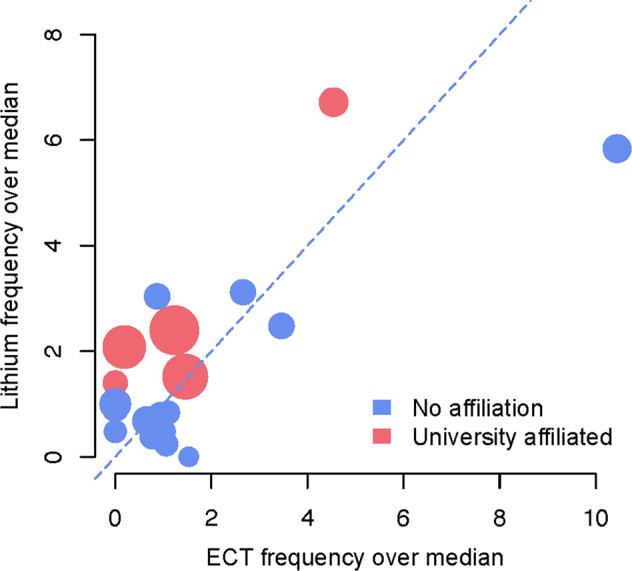
Fig. 1
Fig. 1. Frequencies of lithium and ECT usage, their deviation from the median, and correlation across Swedish regional councils (2016–2020).
Openly available data from the Swedish National Board of Health and Welfare was analyzed to evaluate the frequency of lithium and ECT usage in adolescents for the period 2016–2020, separated by the regional council. For lithium treatment, the number of patients aged 0–17 years and receiving lithium treatment per 1000 inhabitants was extracted for each respective region. Similarly, the number of patients aged 13–17 years and receiving ECT treatment per 1000 inhabitants was extracted from the Swedish ECT registry for each respective region. The figure depicts the usage frequency of lithium and ECT over the national median. University-affiliated counties are highlighted in red, others in blue. County population, retrieved from the Swedish Central Bureau of Statistics, is illustrated by circle diameter. Correlations between ECT and lithium frequencies were assessed by robust linear regression models and the regression slope is illustrated by the dashed line. For a detailed description pertaining to the methods underlying Fig. 1, please see Supplementary Information. Figure 1 demonstrates that (1) Five regions in Sweden—caring for 65 736 adolescents and ~11% of Sweden’s population aged 13–17—did not utilize ECT treatment at all in the care of adolescents over a 5-year-period. (2) There were large variations in frequencies of advanced treatment usage between regions compared to the national average: 0–6.7× for Lithium and 0–11.1× for ECT. (3) Frequencies of ECT and lithium usage were significantly positively correlated across regions (r = 0.75, p < 0.05). (4) There were no significant associations between university-affiliated major regions when compared to other regions in terms of frequencies of ECT (p > 0.05) or lithium (p > 0.05) usages. (5) Lastly, counties affiliated with major cities and university research clinics were not among the five counties with the highest frequencies of ECT treatment usage.
Fig. 2
Fig. 2. Network visualization of co-occurrence analysis of keywords corresponding to all retrievable articles related to PANS/PANDAS and pediatric catatonia.
The Vosviewer software was implemented to unconditionally investigate all available published articles pertaining to PANS, PANDAS, and pediatric catatonia. Bibliographies were extracted from the online Web of Science platform 2021–11–07. Data sets were visualized at an aggregate level in dependency of the relatedness of items determined by the number of articles in which key search terms occur together (co-occurrence of key search terms). For a detailed description pertaining to the methods underlying the bibliographic analysis, please see Supplementary Information. Both figures include the same baseline network visualization. Visual differences pertain to the highlighting of specific keywords and their associated terms. (1) Two major clusters were revealed, clearly separating research related to pediatric catatonia from that of PANS and/or PANDAS. (2) Research articles including the keyword “catatonia” co-occur with terms pertaining to severe mental disorders, advanced treatments, developmental disorders, and some terms perceived to be associated with immunopsychiatry. (3) By contrast, keywords pertaining to PANS and/or PANDAS were associated with infectious agents and complications thereof, neurodevelopmental disorders, medical conditions, autoimmunity, and immunopsychiatry-related treatments. (4) Notably, PANS/PANDAS keywords were not associated with any advanced treatment and only “psychosis” among the severe mental disorders.

References

    1. Johnson M, et al. Paediatric acute-onset neuropsychiatric syndrome in children and adolescents: an observational cohort study. Lancet Child Adolesc. Health. 2019;3:175–180. doi: 10.1016/S2352-4642(18)30404-8. - DOI - PubMed
    1. Gromark C, et al. Establishing a pediatric acute-onset neuropsychiatric syndrome clinic: baseline clinical features of the pediatric acute-onset neuropsychiatric syndrome Cohort at Karolinska Institutet. J. Child Adolesc. Psychopharmacol. 2019;29:625. doi: 10.1089/cap.2018.0127. - DOI - PMC - PubMed
    1. Frankovich J, et al. Multidisciplinary Clinic dedicated to treating youth with pediatric acute-onset neuropsychiatric syndrome: presenting characteristics of the first 47 consecutive patients. J. Child Adolesc. Psychopharmacol. 2015;25:38. doi: 10.1089/cap.2014.0081. - DOI - PMC - PubMed
    1. Swedo S. E., Leckman J. F., Rose N. R. From research subgroup to clinical syndrome: modifying the PANDAS criteria to describe PANS (Pediatric Acute-onset Neuropsychiatric Syndrome). Pediatr. Ther.2. 10.4172/2161-0665.1000113 (2012).
    1. Pfeiffer HCV, et al. Clinical guidance for diagnosis and management of suspected pediatric acute-onset neuropsychiatric syndrome in the Nordic countries. Acta Paediatr. 2021;00:1–8. - PubMed
