


Thematic Analysis of Psychosocial Stressors and Adaptive Coping Strategies Among Informal Caregivers of Patients Surviving ICU Admission for Coma
- PMID: 37523110
- PMCID: PMC11426341
- DOI: 10.1007/s12028-023-01804-3
Thematic Analysis of Psychosocial Stressors and Adaptive Coping Strategies Among Informal Caregivers of Patients Surviving ICU Admission for Coma
Abstract
Background: Family caregivers of patients with severe acute brain injury (SABI) admitted to intensive care units (ICUs) with coma experience heightened emotional distress stemming from simultaneous stressors. Stress and coping frameworks can inform psychosocial intervention development by elucidating common challenges and ways of navigating such experiences but have yet to be employed with this population. The present study therefore sought to use a stress and coping framework to characterize the stressors and coping behaviors of family caregivers of patients with SABI hospitalized in ICUs and recovering after coma.
Methods: Our qualitative study recruited a convenience sample from 14 US neuroscience ICUs. Participants were family caregivers of patients who were admitted with ischemic stroke, intracerebral hemorrhage, subarachnoid hemorrhage, traumatic brain injury, or hypoxic-ischemic encephalopathy; had experienced a comatose state for > 24 h; and completed or were scheduled for tracheostomy and/or gastrostomy tube placement. Participants were recruited < 7 days after transfer out of the neuroscience ICU. We conducted live online video interviews from May 2021 to January 2022. One semistructured interview per participant was recorded and subsequently transcribed. Recruitment was stopped when thematic saturation was reached. We deductively derived two domains using a stress and coping framework to guide thematic analysis. Within each domain, we inductively derived themes to comprehensively characterize caregivers' experiences.
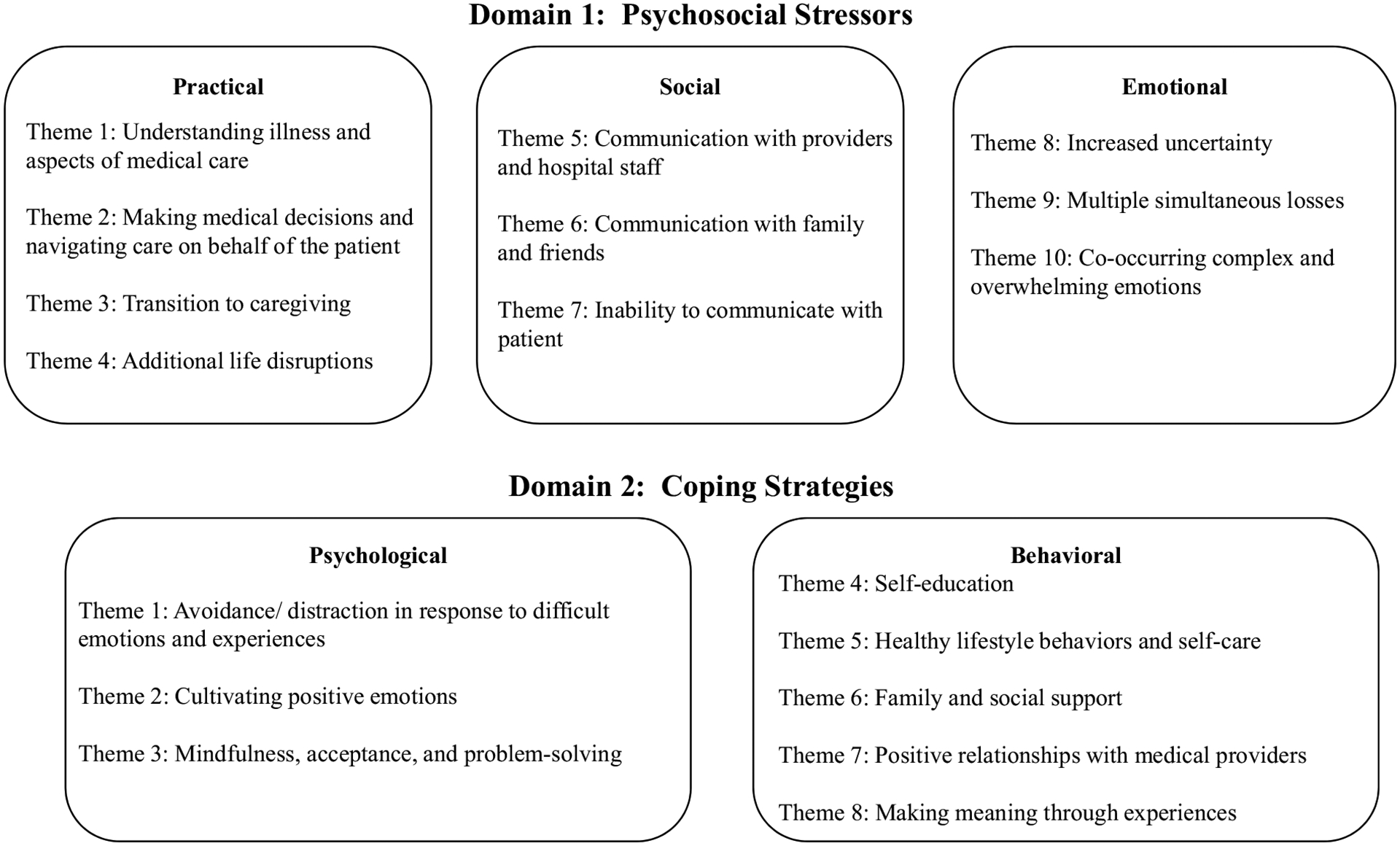
Results: We interviewed 30 caregivers. We identified 18 themes within the two theory-driven domains, including ten themes describing practical, social, and emotional stressors experienced by caregivers and eight themes describing the psychological and behavioral coping strategies that caregivers attempted to enact. Nearly all caregivers described using avoidance or distraction as an initial coping strategy to manage overwhelming emotions. Caregivers also expressed awareness of more adaptive strategies (e.g., cultivation of positive emotions, acceptance, self-education, and soliciting social and medical support) but had challenges employing them because of their heightened emotional distress.
Conclusions: In response to substantial stressors, family caregivers of patients with SABI attempted to enact various psychological and behavioral coping strategies. They described avoidance and distraction as less helpful than other coping strategies but had difficulty engaging in alternative strategies because of their emotional distress. These findings can directly inform the development of additional resources to mitigate the long-term impact of acute psychological distress among this caregiver population.
Keywords: Coma; Family caregivers; Informal caregivers; Interview.
© 2023. Springer Science+Business Media, LLC, part of Springer Nature and Neurocritical Care Society.
Conflict of interest statement
Conflict of interest
Ana-Maria Vranceanu reports serving on the Scientific Advisory Board for the Calm application and royalties from Oxford University Press outside of the submitted work. The other authors report no conflicts of interest.
Figures
References
-
- Muehlschlegel S, Perman SM, Elmer J, et al. The Experiences and Needs of Families of Comatose Patients After Cardiac Arrest and Severe Neurotrauma: The Perspectives of National Key Stakeholders During a National Institutes of Health-Funded Workshop. Critical Care Explorations. 2022;4(3):e0648. - PMC - PubMed
-
- Schutz RE, Coats HL, Engelberg RA, Curtis JR, Creutzfeldt CJ. Is there hope? Is she there? How families and clinicians experience severe acute brain injury. J Palliat Med. 2017;20(2):170–6. - PubMed
MeSH terms
Grants and funding
LinkOut - more resources
Full Text Sources
Medical
