An Ultrasensitive Norfentanyl Sensor Based on a Carbon Nanotube-Based Field-Effect Transistor for the Detection of Fentanyl Exposure
- PMID: 37523478
- PMCID: PMC10416144
- DOI: 10.1021/acsami.3c05958
An Ultrasensitive Norfentanyl Sensor Based on a Carbon Nanotube-Based Field-Effect Transistor for the Detection of Fentanyl Exposure
Abstract
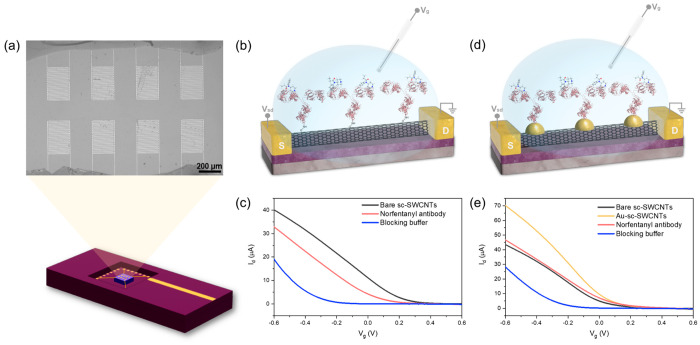
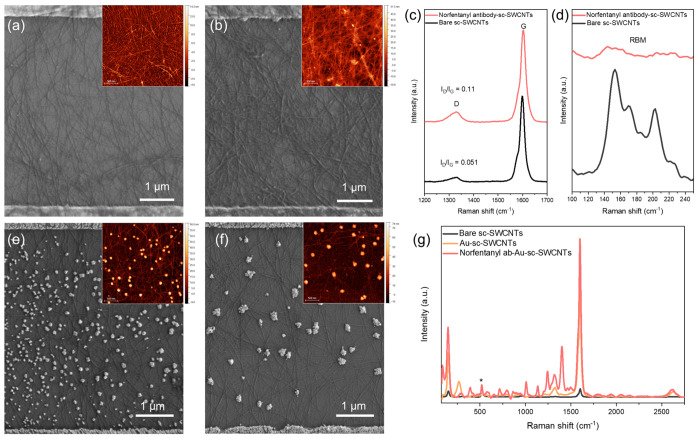
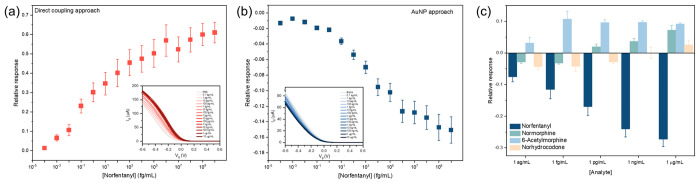
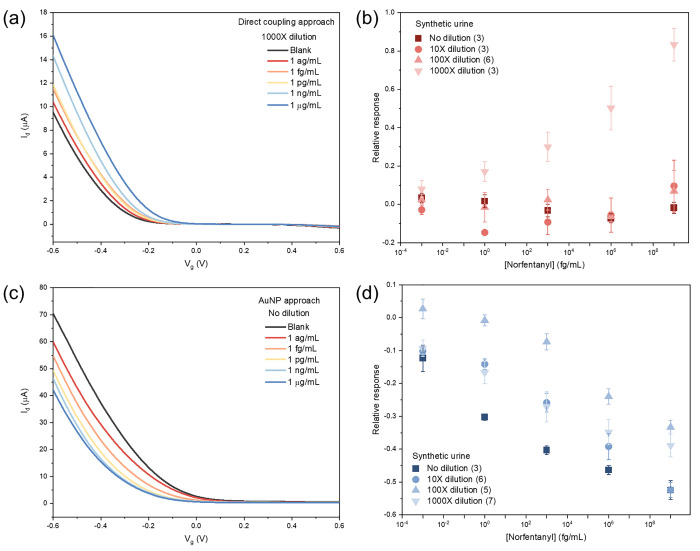
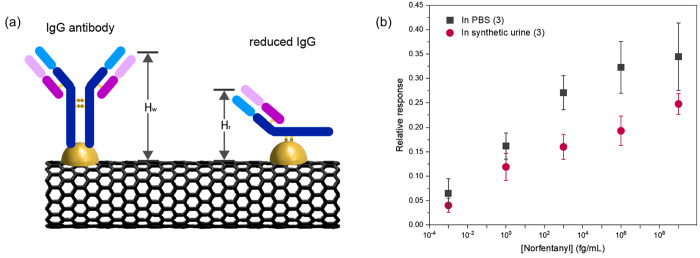
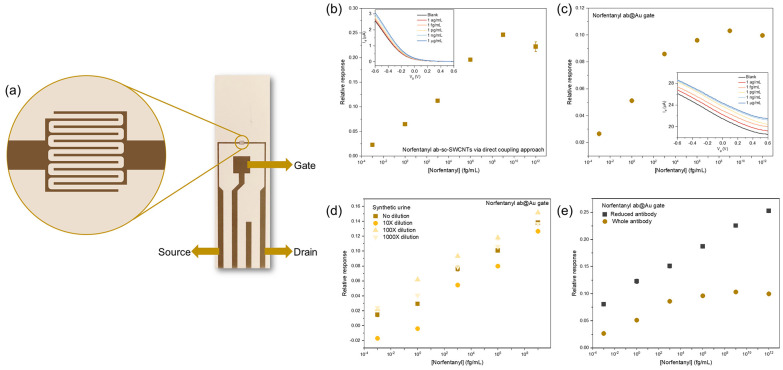
The opioid crisis is a worldwide public health crisis that has affected millions of people. In recent years, synthetic opioids, primarily illicit fentanyl, have become the primary driver of overdose deaths. There is a great need for a highly sensitive, portable, and inexpensive analytical tool that can quickly indicate the presence and relative threat of fentanyl. In this work, we develop a semiconductor enriched (sc-) single-walled carbon nanotube (SWCNT)-based field-effect transistor (FET) biosensor functionalized with norfentanyl antibodies for the sensitive detection of norfentanyl, the primary inactive metabolite of fentanyl, in urine samples. Different sensor configurations were explored in order to obtain the most optimized sensing results. Moreover, by employing the "reduced" antibody, we achieved orientated immobilization of the norfentanyl antibody and thus brought the antigen-antibody interaction closer to the sensor surface, further improving the sensitivity. The reported norfentanyl biosensors have a limit of detection in the fg/mL region in both calibration samples and synthetic urine samples, showing ultrasensitivity and high reliability.
Keywords: biosensor; carbon nanotube; fentanyl overdose; field-effect transistor; norfentanyl; opioid.
Conflict of interest statement
The authors declare no competing financial interest.
Figures
References
-
- Stringfellow E. J.; Lim T. Y.; Humphreys K.; DiGennaro C.; Stafford C.; Beaulieu E.; Homer J.; Wakeland W.; Bearnot B.; McHugh R. K.; et al. Reducing Opioid Use Disorder and Overdose Deaths in the United States: A Dynamic Modeling Analysis. Sci. Adv. 2022, 8, eabm8147 10.1126/sciadv.abm8147. - DOI - PMC - PubMed
MeSH terms
Substances
LinkOut - more resources
Full Text Sources