


Economic analysis of a new four-panel rapid screening test in antenatal care in Kenya, Rwanda, and Uganda
- PMID: 37525192
- PMCID: PMC10391856
- DOI: 10.1186/s12913-023-09775-z
Economic analysis of a new four-panel rapid screening test in antenatal care in Kenya, Rwanda, and Uganda
Abstract
Background: We performed an economic analysis of a new technology used in antenatal care (ANC) clinics, the ANC panel. Introduced in 2019-2020 in five Rwandan districts, the ANC panel screens for four infections [hepatitis B virus (HBV), human immunodeficiency virus (HIV), malaria, and syphilis] using blood from a single fingerstick. It increases the scope and sensitivity of screening over conventional testing.
Methods: We developed and applied an Excel-based economic and epidemiologic model to perform cost-effectiveness and cost-benefit analyses of this technology in Kenya, Rwanda, and Uganda. Costs include the ANC panel itself, its administration, and follow-up treatment. Effectiveness models predicted impacts on maternal and infant mortality and other outcomes. Key parameters are the baseline prevalence of each infection and the effectiveness of early treatment using observations from the Rwanda pilot, national and international literature, and expert opinion. For each parameter, we found the best estimate (with 95% confidence bound).
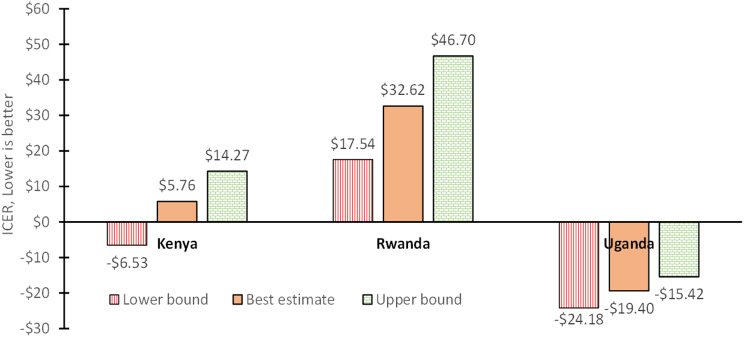
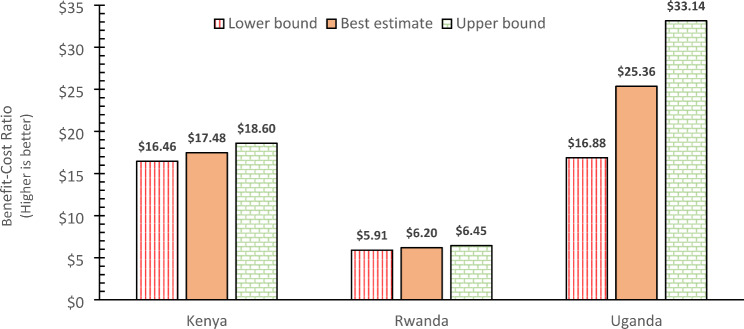
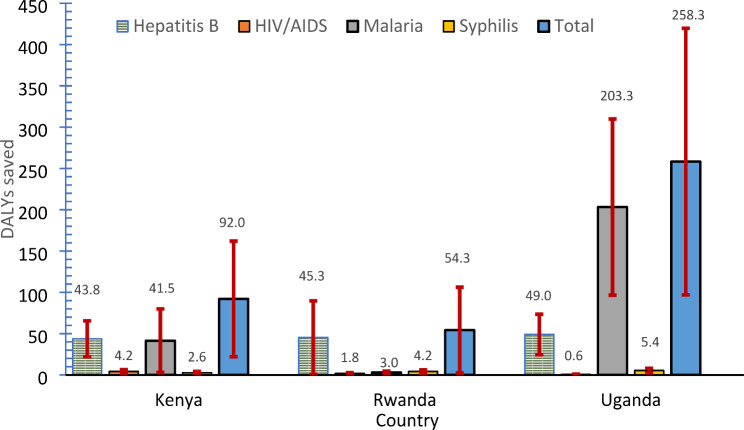
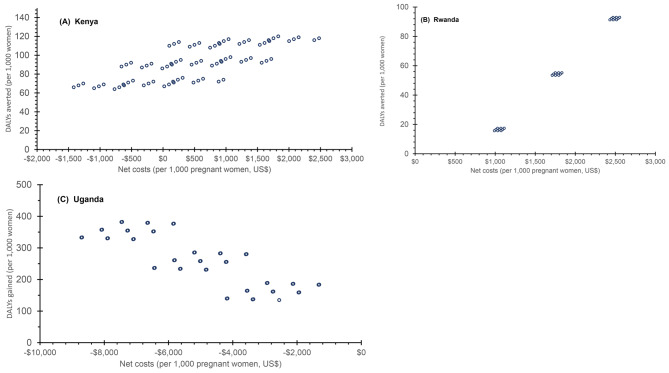
Results: The ANC panel averted 92 (69-115) disability-adjusted life years (DALYs) per 1,000 pregnant women in ANC in Kenya, 54 (52-57) in Rwanda, and 258 (156-360) in Uganda. Net healthcare costs per woman ranged from $0.53 ($0.02-$4.21) in Kenya, $1.77 ($1.23-$5.60) in Rwanda, and negative $5.01 (-$6.45 to $0.48) in Uganda. Incremental cost-effectiveness ratios (ICERs) in dollars per DALY averted were $5.76 (-$3.50-$11.13) in Kenya, $32.62 ($17.54-$46.70) in Rwanda, and negative $19.40 (-$24.18 to -$15.42) in Uganda. Benefit-cost ratios were $17.48 ($15.90-$23.71) in Kenya, $6.20 ($5.91-$6.45) in Rwanda, and $25.36 ($16.88-$33.14) in Uganda. All results appear very favorable and cost-saving in Uganda.
Conclusion: Though subject to uncertainty, even our lowest estimates were still favorable. By combining field data and literature, the ANC model could be applied to other countries.
Keywords: Antenatal care; Cost-effectiveness; HIV/AIDS; Hepatitis B; Kenya; Malaria; Rwanda; Syphilis; Uganda.
© 2023. The Author(s).
Conflict of interest statement
All authors received funding from Abbott Rapid Diagnostics International Ltd. through an agreement with Brandeis University. The authors declare no other competing interests.
Figures

References
-
- Global Burden of Disease Collaborative Network. Global Burden of Disease Study 2019 (GBD 2019) Results. 2020. Available from: http://ghdx.healthdata.org/gbd-results-tool. Accessed May 9 2022.
-
- Institute for Health Metrics and Evaluation (IHME). Global Burden of Disease (GBD) Study 2019. 2022. Available from: https://vizhub.healthdata.org/gbd-results/. Accessed October 11 2022.
MeSH terms
LinkOut - more resources
Full Text Sources
Medical
