. 2023 Jul 31;24(1):176.
doi: 10.1186/s13059-023-03011-x.

Genetic impacts on DNA methylation help elucidate regulatory genomic processes

Affiliations

Genetic impacts on DNA methylation help elucidate regulatory genomic processes

Sergio Villicaña et al. Genome Biol. .

Abstract

Background: Pinpointing genetic impacts on DNA methylation can improve our understanding of pathways that underlie gene regulation and disease risk.

Results: We report heritability and methylation quantitative trait locus (meQTL) analysis at 724,499 CpGs profiled with the Illumina Infinium MethylationEPIC array in 2358 blood samples from three UK cohorts. Methylation levels at 34.2% of CpGs are affected by SNPs, and 98% of effects are cis-acting or within 1 Mbp of the tested CpG. Our results are consistent with meQTL analyses based on the former Illumina Infinium HumanMethylation450 array. Both SNPs and CpGs with meQTLs are overrepresented in enhancers, which have improved coverage on this platform compared to previous approaches. Co-localisation analyses across genetic effects on DNA methylation and 56 human traits identify 1520 co-localisations across 1325 unique CpGs and 34 phenotypes, including in disease-relevant genes, such as USP1 and DOCK7 (total cholesterol levels), and ICOSLG (inflammatory bowel disease). Enrichment analysis of meQTLs and integration with expression QTLs give insights into mechanisms underlying cis-meQTLs (e.g. through disruption of transcription factor binding sites for CTCF and SMC3) and trans-meQTLs (e.g. through regulating the expression of ACD and SENP7 which can modulate DNA methylation at distal sites).

Conclusions: Our findings improve the characterisation of the mechanisms underlying DNA methylation variability and are informative for prioritisation of GWAS variants for functional follow-ups. The MeQTL EPIC Database and viewer are available online at https://epicmeqtl.kcl.ac.uk .

Keywords: DNA methylation; GWAS; Heritability; Methylation quantitative trait loci; meQTL.


Conflict of interest statement

The authors declare that they have no competing interests.

Figures
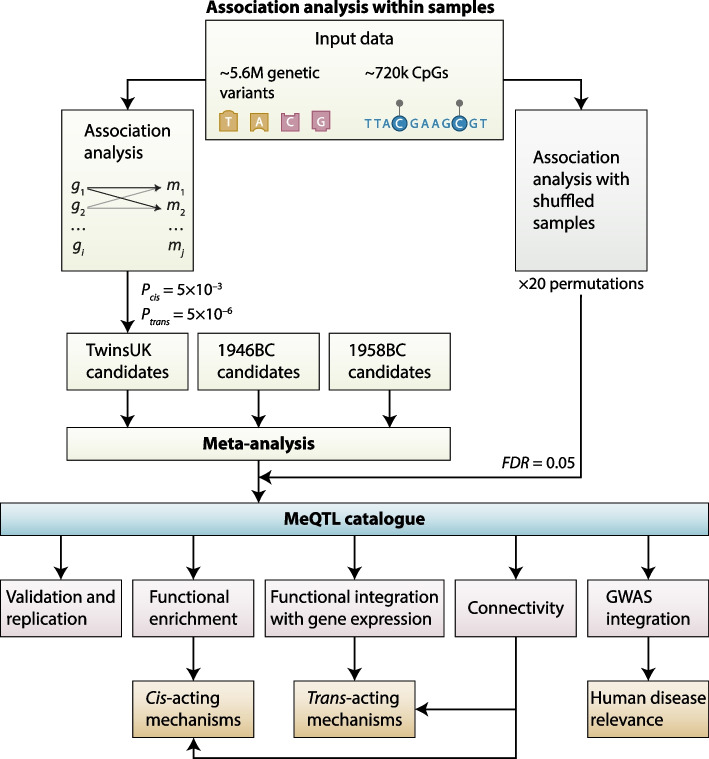
Fig. 1
Fig. 1
Study design. Genome-wide association analyses compared genotypes and DNA methylation levels profiled by the EPIC array. Each cohort sample was independently tested, and results were meta-analysed. Results are presented at a permutation-based false discovery rate (FDR). Follow-up analyses aimed to find evidence of underlying mechanisms and their relevance to human disease
Fig. 2
Fig. 2
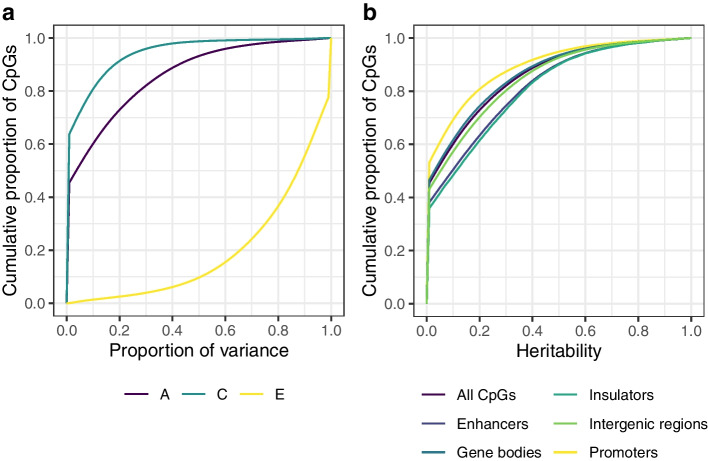
Proportion of variance of genome-wide DNA methylation levels attributed to genetic variation. Estimates for the 723,814 CpGs sites covered by the EPIC array after a classical twin study of 88 MZ and 70 DZ twin pairs from the TwinsUK cohort. a Cumulative proportion of variance components of the ACE model: variance explained by additive genetic effects, or heritability (A), common environmental effects (C) and nonshared environmental effects (E). b Cumulative proportion of heritability estimates by genomic annotations
Fig. 3
Fig. 3
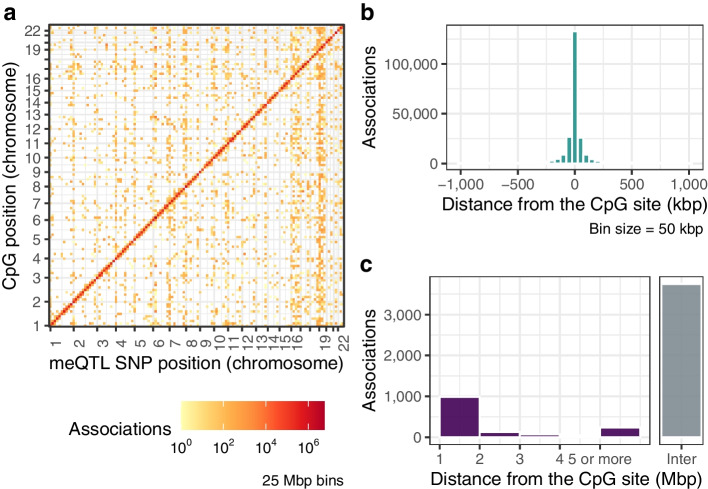
DNA methylation quantitative trait loci (meQTLs) for CpG sites genome-wide. Association analysis carried out between 724,499 CpGs vs. 6,361,063 SNPs. a Genomic distribution of meQTL associations at a significance level of FDR <0.05. The x-axis corresponds to the position of the SNPs within the 22 chromosomes and the y-axis to the position of the CpGs, with each pixel binning a range of 25 Mbps. The colour scale indicates the number of associations between specific CpGs/SNPs locations, on a logarithmic scale. b Histogram of distances between the CpGs and their most significant cis-meQTL SNPs. c Bar plot of absolute distances between the CpGs and their most significant trans-meQTL SNPs. Intra-chromosomal associations are shown in purple, and inter-chromosomal in grey
Fig. 4
Fig. 4
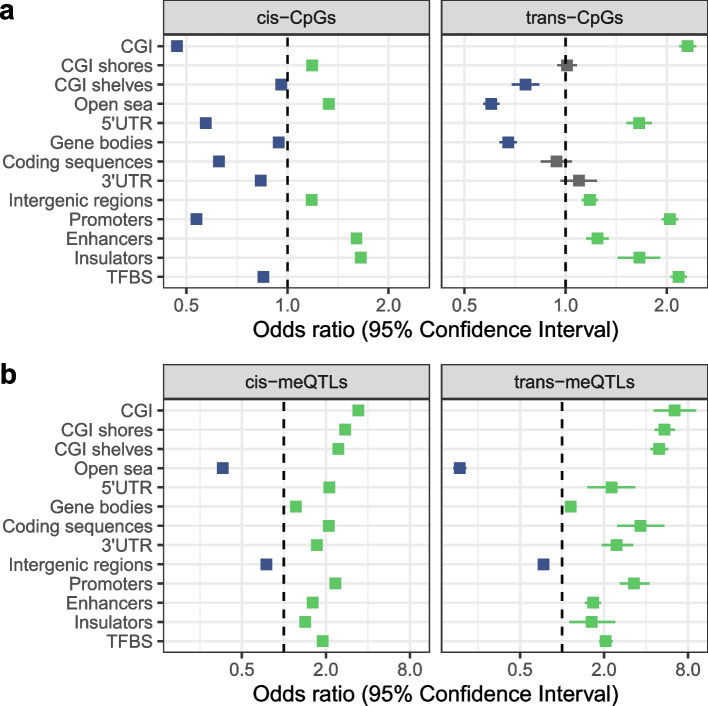
Enrichment in genomic annotations of meQTL SNPs and their CpGs. The x-axis indicates the odds ratio and its 95% confidence interval (in logarithmic scale) for a CpGs with meQTLs or b meQTL SNPs, located within a specific genomic annotation. Significant enrichment is marked in green, depletion in blue, and non-significant genomic annotations in grey
Fig. 5
Fig. 5
Underlying mechanisms of meQTL SNPs. a Example of a cis-meQTL mechanism. The disruption of a TFBS (e.g. CTCF binding site) by a genetic variant (rs79197902), leads to reduced protein binding affinity, which changes local methylation (cg03916490, cg18402987). b Example of an ‘eQTL-mediation mechanism’ for trans-meQTLs. SNP rs520558 that is an eQTL for a gene involved in DNA methylation regulation (SENP7) indirectly affects distal CpG sites (cg24214260). Dashed lines represent associations for which there is suggestive, but not conclusive, evidence of directionality. c Example of a ‘cis-meQTL-mediation mechanism’ for trans-meQTLs. SNP rs28711261 is associated with a nearby CpG (cg16218405), which in turn is associated with a gene involved in DNA methylation regulation (ACD gene of TPP1), and indirectly affects distal CpG sites (cg14343953)
Fig. 6
Fig. 6
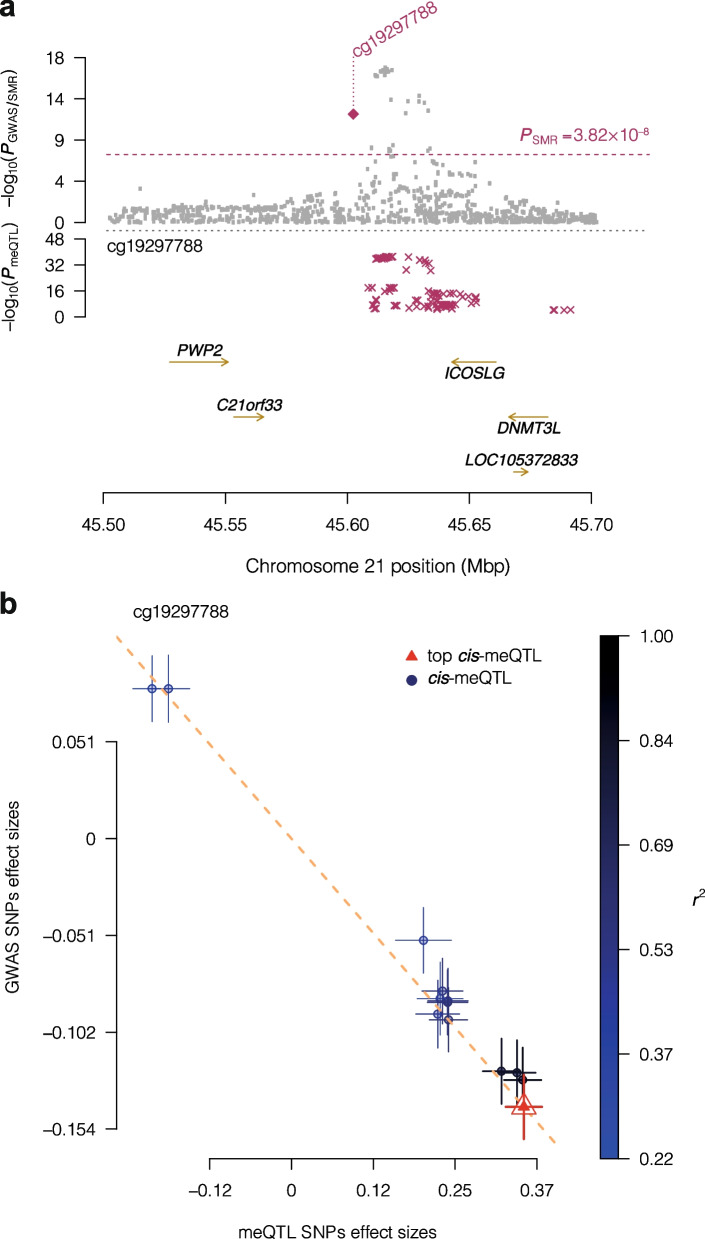
Association between IBD and DNA methylation at site cg19297788. a Locus association plot. The grey dots represent the P-values of the SNPs from the IBD GWAS [56], the violet diamond the P-value of the SMR test, and the violet crosses the P-values of the meQTLs of cg19297788. b Effect sizes of IBD GWAS SNPs vs. effect sizes of meQTLs of cg19297788, for SNPs used in the HEIDI test. The slope of the dashed line represents the βSMR estimate at the co-localised SNP. Error bars represent standard errors of estimated SNP effects. SNPs in LD with the top co-localised meQTL are expected to have a consistent effect under the causality/pleiotropy scenario

References

    1. Pervjakova N, Kasela S, Morris AP, Kals M, Metspalu A, Lindgren CM, et al. Imprinted genes and imprinting control regions show predominant intermediate methylation in adult somatic tissues. Epigenomics. 2016;8(6):789–799. doi: 10.2217/epi.16.8. - DOI - PMC - PubMed
    1. Sharp AJ, Stathaki E, Migliavacca E, Brahmachary M, Montgomery SB, Dupre Y, et al. DNA methylation profiles of human active and inactive X chromosomes. Genome Res. 2011;21(10):1592–1600. doi: 10.1101/gr.112680.110. - DOI - PMC - PubMed
    1. Vilain A, Bernardino J, Gerbault-Seureau M, Vogt N, Niveleau A, Lefrancois D, et al. DNA methylation and chromosome instability in lymphoblastoid cell lines. Cytogenet Genome Res. 2000;90(1–2):93–101. doi: 10.1159/000015641. - DOI - PubMed
    1. Bourc’his D, Xu GL, Lin CS, Bollman B, Bestor TH. Dnmt3L and the establishment of maternal genomic imprints. Science. 2001;294(5551):2536–2539. doi: 10.1126/science.1065848. - DOI - PubMed
    1. Song J, Rechkoblit O, Bestor TH, Patel DJ. Structure of DNMT1-DNA complex reveals a role for autoinhibition in maintenance DNA methylation. Science. 2011;331(6020):1036–1040. doi: 10.1126/science.1195380. - DOI - PMC - PubMed

Publication types