. 2023 Aug 8;35(8):1373-1389.e8.
doi: 10.1016/j.cmet.2023.07.002. Epub 2023 Jul 31.

Hepatic levels of S-adenosylmethionine regulate the adaptive response to fasting

Alba Capelo-Diz  1 Sofía Lachiondo-Ortega  2 David Fernández-Ramos  3 Jorge Cañas-Martín  1 Naroa Goikoetxea-Usandizaga  2 Marina Serrano-Maciá  2 Maria J González-Rellan  4 Laura Mosca  5 Joan Blazquez-Vicens  1 Alberto Tinahones-Ruano  1 Marcos F Fondevila  6 Mason Buyan  2 Teresa C Delgado  2 Virginia Gutierrez de Juan  7 Paula Ayuso-García  1 Alejandro Sánchez-Rueda  1 Sergio Velasco-Avilés  1 Héctor Fernández-Susavila  1 Cristina Riobello-Suárez  1 Bartlomiej Dziechciarz  1 Cristina Montiel-Duarte  8 Fernando Lopitz-Otsoa  7 Maider Bizkarguenaga  7 Jon Bilbao-García  7 Ganeko Bernardo-Seisdedos  7 Ana Senra  9 Mario Soriano-Navarro  10 Oscar Millet  7 Ángel Díaz-Lagares  11 Ana B Crujeiras  12 Aida Bao-Caamano  13 Diana Cabrera  14 Sebastiaan van Liempd  14 Miguel Tamayo-Carro  15 Luigi Borzacchiello  5 Beatriz Gomez-Santos  16 Xabier Buqué  16 Diego Sáenz de Urturi  16 Francisco González-Romero  16 Jorge Simon  2 Rubén Rodríguez-Agudo  2 Asier Ruiz  17 Carlos Matute  17 Daniel Beiroa  18 Juan M Falcon-Perez  19 Patricia Aspichueta  20 Juan Rodríguez-Cuesta  21 Marina Porcelli  5 María A Pajares  22 Cristina Ameneiro  23 Miguel Fidalgo  23 Ana M Aransay  24 Tomas Lama-Díaz  25 Miguel G Blanco  26 Miguel López  6 Ricardo Villa-Bellosta  27 Timo D Müller  28 Rubén Nogueiras  29 Ashwin Woodhoo  30 María Luz Martínez-Chantar  31 Marta Varela-Rey  32
Affiliations

Hepatic levels of S-adenosylmethionine regulate the adaptive response to fasting

Alba Capelo-Diz et al. Cell Metab. .

Abstract

There has been an intense focus to uncover the molecular mechanisms by which fasting triggers the adaptive cellular responses in the major organs of the body. Here, we show that in mice, hepatic S-adenosylmethionine (SAMe)-the principal methyl donor-acts as a metabolic sensor of nutrition to fine-tune the catabolic-fasting response by modulating phosphatidylethanolamine N-methyltransferase (PEMT) activity, endoplasmic reticulum-mitochondria contacts, β-oxidation, and ATP production in the liver, together with FGF21-mediated lipolysis and thermogenesis in adipose tissues. Notably, we show that glucagon induces the expression of the hepatic SAMe-synthesizing enzyme methionine adenosyltransferase α1 (MAT1A), which translocates to mitochondria-associated membranes. This leads to the production of this metabolite at these sites, which acts as a brake to prevent excessive β-oxidation and mitochondrial ATP synthesis and thereby endoplasmic reticulum stress and liver injury. This work provides important insights into the previously undescribed function of SAMe as a new arm of the metabolic adaptation to fasting.

Keywords: S-adenosylmethionine; adipose tissue; caloric restriction; endoplasmic reticulum stress; fasting; liver; methionine adenosyltransferase a1; mitochondria-associated-membranes; phosphatidylethanolamine methyltransferase; β-oxidation.


Conflict of interest statement

Declaration of interests M.L.M.-C. advises for Mitotherapeutix.

Figures

Figure 1
Figure 1
Nutrient stress leads to an increased usage of SAMe in the liver (A and B) SAMe, Met, and SAH levels in total liver extracts from male C57BL/6 mice (A) fasted for the indicated times and re-fed for 2 h after fasting (n = 5 per time point) and (B) maintained under 60% of CR over a 5-day period (n = 3–5). (C–F) qRT-PCR of Mat1a mRNA expression and immunoblotting analyses of MAT1A protein levels in (C) male C57BL/6 mice fasted from 6 to 24 h (n = 5 per time point), (D) fasted for 36 h (n = 3–5), (E) maintained under 60% of CR over a 5-day period (n = 5), and (F) in mouse primary hepatocytes treated with glucagon (n = 3). (G) RT-qPCR analysis of Mat1a mRNA in livers from 16-h-fasted Gcgr-WT and -KO mice treated with glucagon in vivo for 30 min (n = 9–10 for Gcgr-WT, and n = 6–7 for Gcgr-KO). Results are presented as mean ± SEM; p < 0.05, ∗∗p < 0.01, ∗∗∗p < 0.001, and ∗∗∗∗p < 0.0001 by one-way ANOVA in (A), by two-way ANOVA in (C), or Student’s t test in (B) and (D)–(G). f.c., denoted fold change. See also Figure S1.
Figure 2
Figure 2
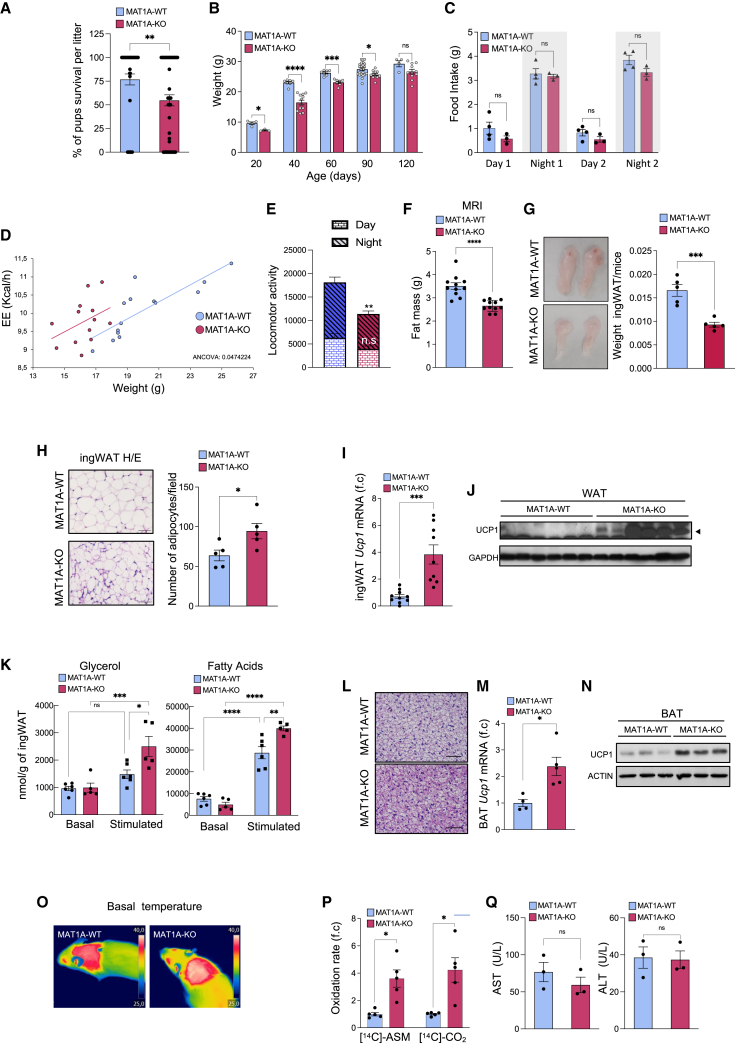
Chronic MAT1A hepatic ablation increases weight lost, energy expenditure, and postnatal mortality (A–Q) Male mice were fed ad libitum. (A and B) (A) Percentage of mice pups surviving at weaning (n = 48–57) and (B) weight of male mice (n = 3–23). (C–Q) 50- to 60-day-old mice. (C–H) (C) Food intake (n = 3–4), (D) accumulated energy expenditure (EE) (n = 13–14), (E) locomotor activity (counts of beam breaks) (n = 6), (F) fat mass by MRI (n = 11), (G) macroscopic pictures and ingWAT/mice weights (n = 5), and (H) quantification of density of adipocytes and representative pictures of hematoxylin and eosin (H&E)-stained sections (scale bars, 50 μm) (n = 5). (I and J) (I) Ucp-1 mRNA (n = 9–10) and (J) protein levels (n = 6–7) in ingWAT. (K) Basal and stimulated (100 nM isoproterenol) lipolysis, as measured by glycerol (left) and fatty acids (right) released by explants of ingWAT (n = 5–6). (L) Representative pictures of H&E-stained BAT sections (scale bars, 50 μm). (M and N) (M) RT-qPCR (n = 4–5) and (N) immunoblot analysis (n = 3–5) of Ucp-1 mRNA and protein levels in BAT. (O) Termal pictures from BAT interscapular temperatures. (P and Q) (P) Incomplete and complete fatty acid (palmitate) oxidation, evaluated by measuring the release of [14C]-acid-soluble metabolites (ASMs) and [14C]-CO2 (n = 5), and (Q) serum transaminases (n = 3). Results are presented as mean ± SEM. p < 0.05, ∗∗p < 0.01, ∗∗∗p < 0.001, and ∗∗∗∗p < 0.0001 by two-way ANOVA in (B), (C), and (K), by ANCOVA analysis in (D), or Student’s t test in (A), (E)–(I), (M), (P) and (Q). f.c., denoted fold change. See also Figure S1.
Figure 3
Figure 3
Chronic MAT1A hepatic ablation during fasting exacerbates weight loss and induces liver damage (A–C) 50- to 60-day-old male MAT1A-KO mice were fasted. (A) Graph showing more pronounced weight loss in mice fasted over a 36-h period (n = 3–8). (B) Measurement of fat mass by MRI (n = 6) and (C) macroscopic pictures and ingWAT/mice weights (n = 3–5) in mice fasted during 36 h. (D) Lipolysis measured by glycerol released to the culture medium in explants of ingWAT from WT and MAT1A-KO male mice fasted over 24 h (n = 4). (E) Accumulated energy expenditure (EE) during the first 8 h of fasting in MAT1A-KO mice (n = 9–10). (F) Representative pictures of H&E-stained sections of BAT from 24- to 36-h-fasted mice (scale bars, 50 μm). (G) Immunoblot analysis of UCP1 and MAT1A protein levels in BAT from mice fasted during 24 and 36 h (n = 3–5). (H) Incomplete and complete fatty acid (palmitate) oxidation in 36-h-fasted mice (n = 4). (I) ATP levels under basal conditions and after glucagon treatment (10 nM, 24 h) in primary hepatocytes from 36-h-fasted mice (n = 3). (J and K) Primary MAT1A-KO hepatocytes obtained from 24-h-fasted mice, which were treated with vehicle or 4 mM SAMe for 4 h and compared with untreated MAT1A-WT hepatocytes. (J) Cellular respiration parameters (n = 6–8) and (K) fatty acid oxidation rate (n = 6). (L) Serum transaminases in 24 h of fasted mice (n = 4–5). (M–O) Immunoblot analysis of ER stress proteins from liver extracts; (M) fasted for 36 h (n = 4–5 biological replicates for each strain) or (N) fed during 2 months with 40% of CR (n = 5) or (O) ADF (n = 3). Results are presented as mean ± SEM. p < 0.05, ∗∗p < 0.01, ∗∗∗p < 0.001, and ∗∗∗∗p < 0.0001 by two-way ANOVA in (A), (I), and (J), one-way ANOVA in (K), by ANCOVA analysis in (E), or Student’s t test in (B)–(D), (H), and (L). f.c., denoted fold change. See also Figures S2 and S3.
Figure 4
Figure 4
Chronic MAT1A hepatic ablation reduces FGF21 promoter methylation and FGF21 transcription, enhancing energy expenditure (A and B) Serum FGF21 and Fgf21 mRNA levels in (A) fed and (B) fasted male MAT1A-KO mice (n = 5–9). (C and D) Graphs showing percentage of DNA methylation levels of 5 consecutive CGs (CG1 to CG5) of Fgf21 in livers from (C) fed (n = 7) and (D) fasted MAT1A-KO mice (n = 9–11). (E) FGF21 serum levels (n = 3–5). (F–L) (F) Fat mass by MRI (n = 7), (G) ingWAT/mice weights and macroscopic pictures, (H) quantification of density of adipocytes (n = 4–7) and representative pictures of H&E-stained sections (scale bars, 50 μm), (I) accumulated energy expenditure (EE) (n = 4–5), (J) incomplete fatty acid (palmitate) oxidation (n = 3–6), (K) p-eIF2α in total liver extracts (n = 5), and (L) serum transaminases (AST, ALT) (n = 6–7) in 36-h-fasted MAT1A-KO mice after silencing of FGF21. Results are presented as mean ± SEM. p < 0.05, ∗∗p < 0.01, ∗∗∗p < 0.001, and ∗∗∗∗p < 0.0001 by one-way ANOVA in (E), (F), and (J), two-way ANOVA in (B)–(D), or Student’s t test in (A), (G)–(I), and (K). f.c., denoted fold change. See also Figure S3.
Figure 5
Figure 5
Methionine cycle fluxes during fasting toward SAMe and PC synthesis (A and B) (A) Schematic representation of Met flux through one-carbon metabolism, tricarboxylic acid cycle (TCA) cycle, and gluconeogenesis, and (B) relative fold change (log2) in the hepatic content of 13C label of the Met-derived metabolites in 24-h-fasted MAT1A-KO mice, as compared with WT mice (blue and red indicate upregulated and downregulated, respectively) (n = 7). (C) PC and PE hepatic content and PC/PE ratio in livers from fed and 24-h-fasted WT and MAT1A-KO mice (n = 7). (D–K) (D) RT-qPCR of hepatic Pemt gene (n = 5), (E) PC hepatic content (n = 5) and PC/PE ratio (n = 5–6), (F) percentage of loss of weight (n = 5), (G) ratios of ingWAT/mice weights (n = 5), (H) hepatic Fgf21 mRNA and serum FGF21 levels (n = 5), (I) hepatic fatty acid (palmitate) oxidation (n = 5), (J) hepatic eIF2α protein phosphorylation (n = 5), and (K) serum transaminases (AST, ALT) (n = 5) in Pemt-silenced mice after 36 h of fasting. Results are presented as the mean ± SEM. p < 0.05, ∗∗p < 0.01, ∗∗∗p < 0.001, and ∗∗∗∗p < 0.0001 by Student’s t test. f.c., denoted fold change. See also Figure S4.
Figure 6
Figure 6
MAT1A localizes at MAMs during fasting (A) Representative electron microscopy images, and (B) graph showing the percentage of ER adjacent to mitochondria (n = 309–423), in fixed liver sections from fed and 24-h-fasted MAT1A-WT and -KO mice (from n = 3 biological replicas for each condition). Mitochondrial perimeter is denoted by green lines and ER-mitochondrial contact points by blue lines. (C) Model of phospholipid synthesis and trafficking at MAMs. (D and E) Immunoblot analysis showing an increase in MAT1A protein expression in membrane/organelles and cytosolic fractions isolated from n = 4 livers of C57BL/6 mice after (D) 24 h of fasting or acute CR (60% for 5 days) and (E) ADF or chronic CR (40% for 2 months). Controls of purity for membrane/organelles are shown. (F and G) Homogenates and subcellular fractions from 6- and 24-h-fasted livers of (F) C57BL/6 mice or (G) from WT and MAT1A-KO mice over a 36-h period of fasting (n = 1–2). Controls of purity for homogenates (H), nuclear (N), crude mitochondria (Mc), pure mitochondria (MP), MAMs, and endoplasmic reticulum (ER) extracts are shown. (H and I) Ultra-performance liquid chromatography (UPLC) analysis of SAMe in (H) total liver extracts (n = 3–5), and (I) crude mitochondrial extracts from WT and MAT1A-KO mice (n = 4) (please see STAR Methods for detailed protocol). Results are presented as mean ± SEM. p < 0.05, ∗∗p < 0.01, ∗∗∗p < 0.001, and ∗∗∗∗p < 0.0001 by two-way ANOVA in (B) and (H) or Student’s t test in (I). See also Figure S4.

References

    1. Longo V.D., Mattson M.P. Fasting: molecular mechanisms and clinical applications. Cell Metab. 2014;19:181–192. doi: 10.1016/j.cmet.2013.12.008. - DOI - PMC - PubMed
    1. Geisler C.E., Hepler C., Higgins M.R., Renquist B.J. Hepatic adaptations to maintain metabolic homeostasis in response to fasting and refeeding in mice. Nutr. Metab. (Lond.) 2016;13:62. doi: 10.1186/s12986-016-0122-x. - DOI - PMC - PubMed
    1. Rui L. Energy metabolism in the liver. Compr. Physiol. 2014;4:177–197. doi: 10.1002/cphy.c130024. - DOI - PMC - PubMed
    1. Sakata S.F., Okumura S., Matsuda K., Horikawa Y., Maeda M., Kawasaki K., Chou J.Y., Tamaki N. Effect of fasting on methionine adenosyltransferase expression and the methionine cycle in the mouse liver. J. Nutr. Sci. Vitaminol. (Tokyo) 2005;51:118–123. doi: 10.3177/jnsv.51.118. - DOI - PubMed
    1. Pascale R.M., Feo C.F., Calvisi D.F., Feo F. Deregulation of methionine metabolism as determinant of progression and prognosis of hepatocellular carcinoma. Transl. Gastroenterol. Hepatol. 2018;3:36. doi: 10.21037/tgh.2018.06.04. - DOI - PMC - PubMed

Publication types

MeSH terms

Substances