


Early Vascular Ageing in adolescents with migraine with aura: a community-based study
- PMID: 37528337
- PMCID: PMC10394858
- DOI: 10.1186/s12872-023-03409-2
Early Vascular Ageing in adolescents with migraine with aura: a community-based study
Abstract
Background: Migraine with aura is associated with an increased risk of cardiovascular disease, yet the pathophysiology is unknown. Suggested underlying mechanisms of aura formation point into the direction of an abnormal vasoreactivity that also extends to the extracranial vasculature.
Methods: In the Early Vascular Ageing Tyrol study, a community-based non-randomized controlled trial conducted in 45 schools and companies in Tyrol (Austria) and South-Tyrol (Italy) between May 2015 and September 2018 aiming to increase cardiovascular health in adolescents, headache syndromes were classified according to the International Classification of Headache Disorders in a face-to-face interview. Carotid-femoral pulse-wave-velocity was measured by applanation tonometry and carotid intima-media-thickness by high-resolution ultrasound of the distal common carotid arteries. Differences in pulse-wave-velocity and carotid intima-media-thickness in youngsters with migraine with aura were compared respectively to those without headache and with other headaches by multivariable linear regression analysis.
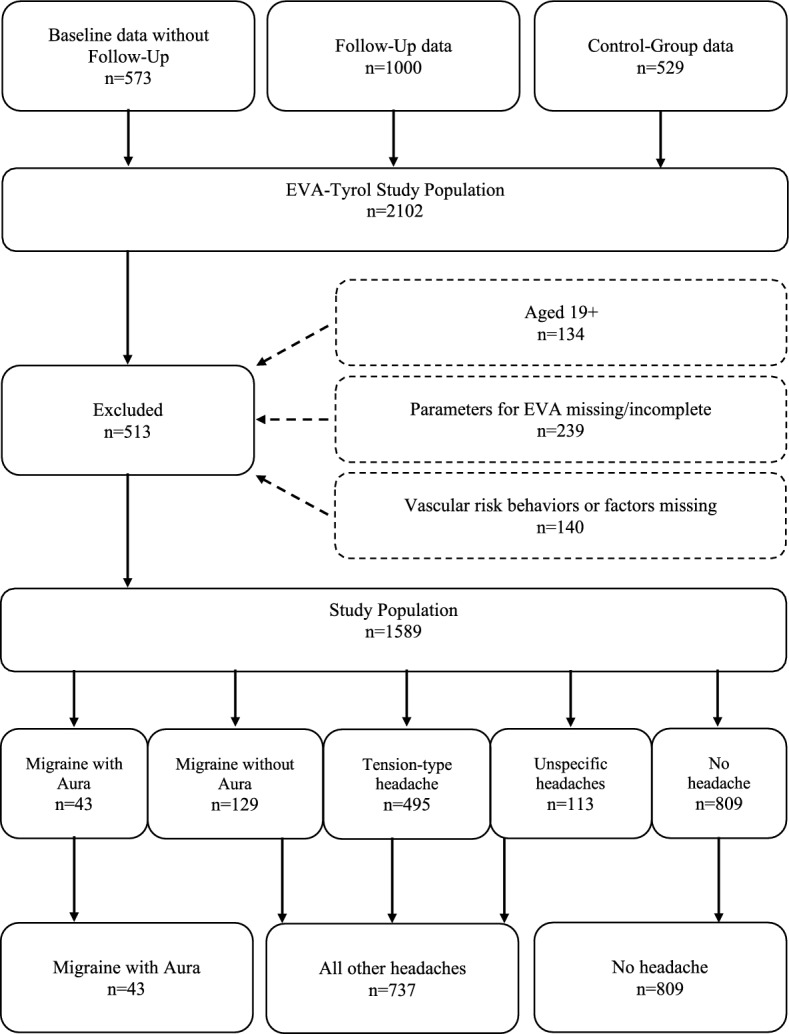
Results: Of the 2102 study participants 1589 were aged 14 to 19 (mean 16.8) years and had complete data. 43 (2.7%) reported migraine with aura and 737 (46.4%) other headaches. Mean pulse-wave-velocity was 6.17 m/s (± 0.85) for migraine with aura, 6.06 m/s (± 0.82) for all other headaches and 6.15 (0.95) m/s for participants without headaches. Carotid intima-media-thickness was 411.3 µm (± 43.5) for migraine with aura, 410.9 µm (± 46.0) for all other headaches and 421.6 µm (± 48.4) for participants without headaches. In multivariable linear regression analysis, we found no differences in carotid-femoral pulse-wave-velocity or carotid intima-media-thickness in young subjects with migraine with aura, all other headaches, or no headaches.
Conclusions: In line with previous large-scale studies in adults, we could not demonstrate relevant associations of migraine with aura with markers of arterial stiffness or subclinical atherosclerosis making early vascular ageing an unlikely pathophysiological link between migraine with aura and cardiovascular diseases.
Trial registration: First registered on ClinicalTrials.gov 29/04/2019 (NCT03929692).
Keywords: Adolescents; Carotid intima-media-thickness; EVA-Tyrol study; Early vascular ageing; Headache; Migraine with aura; Pulse-wave velocity.
© 2023. The Author(s).
Conflict of interest statement
Benoît Bernar – Disclosure none –
Nina Gande – Disclosure none –
Anna Katharina Stock – Disclosure none –
Anna Staudt – Disclosure none –
Raimund Pechlaner – Disclosure none –
Christoph Hochmayr – Disclosure none –
Katharina Kaltseis – Disclosure none –
Bernhard Winder – Disclosure none –
Sophia Zollner-Kiechl – Disclosure none –
Gregor Broessner has recieved unrestricted grants, honoraria, personal fees, and travel grants from: Allergan, AMGEN, Menarini, Pfizer, Linde AG, Astra Zeneca, St. Jude Medical, Reckitt Benkiser, Novartis, TEVA, Fresenius, Janssen Cilag, and Lilly.
Ralf Geiger – Disclosure none –
Stefan Kiechl – Disclosure none –
Ursula Kiechl-Kohlendorfer – Disclosure none –
Michael Knoflach has received honoraria and personal fees from Pfizer and Novartis.
Figures
References
-
- World Health Organization (WHO). Headache-disorders. 2016. Webpage visited 30.06.2021. https://www.who.int/news-room/fact-sheets/detail/headache-disorders.
-
- Rizzoli P, Mullally WJ. Headache. Am J Med. 2018;131(1):17–24. 10.1016/j.amjmed.2017.09.005. - PubMed
-
- Wang X, Zhou HB, Sun JM, Xing YH, Zhu YL, Zhao YS. The prevalence of migraine in university students: a systematic review and meta-analysis. Eur J Neurol. 2016;23(3):464–75. 10.1111/ene.12784. - PubMed
-
- Vgontzas A, Burch R. Episodic migraine with and without aura: key differences and implications for pathophysiology, management, and assessing risks. Curr Pain Headache Rep. 2018;22(12):78. 10.1007/s11916-018-0735-z. Published 2018 Oct 5. - PubMed
-
- GBD 2016 Disease and Injury Incidence and Prevalence Collaborators. Global, regional, and national incidence, prevalence, and years lived with disability for 328 diseases and injuries for 195 countries, 1990–2016: a systematic analysis for the Global Burden of Disease Study 2016. Lancet. 2017;390:1211–59. 10.1016/S0140-6736(17)32154-2. https://www.thelancet.com/journals/lancet/article/PIIS0140-6736(17)32154.... - PMC - PubMed
Publication types
MeSH terms
Associated data
LinkOut - more resources
Full Text Sources
Medical
Miscellaneous
