


Changes of migraine aura with advancing age of patients
- PMID: 37528414
- PMCID: PMC10394819
- DOI: 10.1186/s10194-023-01642-w
Changes of migraine aura with advancing age of patients
Erratum in
-
Correction: Changes of migraine aura with advancing age of patients.J Headache Pain. 2023 Aug 14;24(1):107. doi: 10.1186/s10194-023-01647-5. J Headache Pain. 2023. PMID: 37580677 Free PMC article. No abstract available.
Abstract
Aim: Given the similar presentation of migraine aura and acute ischemic stroke, advancing patient age might change the characteristics of migraine with aura (MA) and be clinically important. Clinical data, however, are limited. Experimental studies indicate a decrease in the magnitude of cortical spreading depression (CSD), the pathophysiological correlate of migraine aura, with advancing age. Our study aimed to assess the influence of age on the clinical features of MA.
Methods: Three hundred and forty-three patients were interviewed using a structured questionnaire. The questions covered the headache characteristics and symptom types including the characteristics of the C-criterion, as defined by the International Classification of Headache Disorders 3rd Edition. The association of age with MA characteristics was assessed.
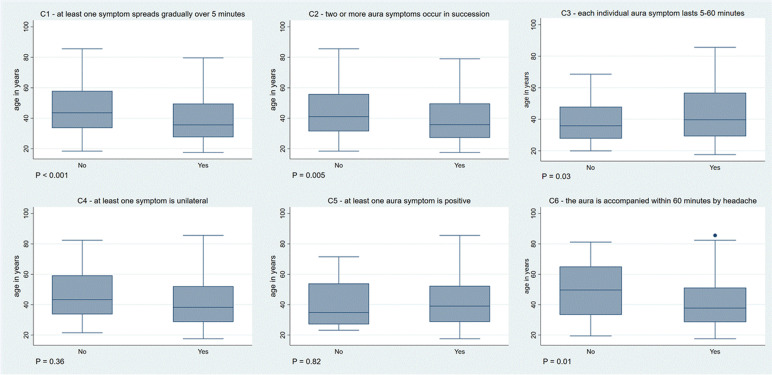
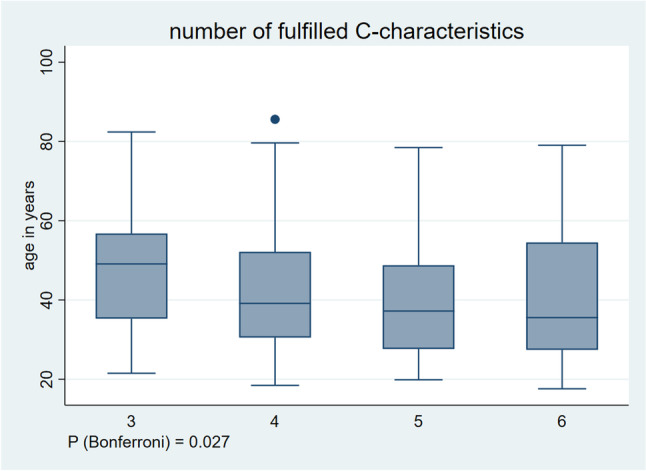
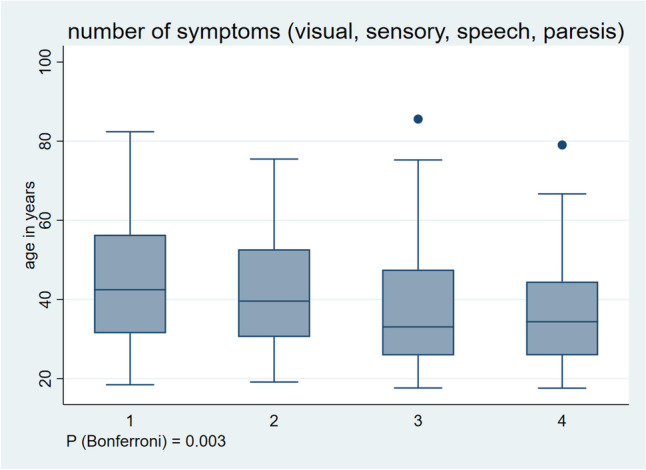
Results: The median age was 29 (IQR 28-52) and 235 of the 343 patients were women (69%). Individual symptoms of the C-criterion such as gradual aura spreading over longer than 5 min (P < 0.001), two or more aura symptoms occurring in succession (P = 0.005), duration of at least one MA symptom for longer than 60 min (P = 0.004), and associated headache (P = 0.01) were more frequent in younger patients. The number of symptoms including the C-characteristics decreased with increasing age (P < 0.001). Patients with sensory (P < 0.001), motor (P = 0.004) and speech disturbance (P = 0.02) were younger, and older patients with headache had less photophobia (P = 0.04) and phonophobia (P = 0.03). Sensitivity analyses yielded similar results.
Conclusion: The frequency of typical characteristics of migraine aura and migraine headache including photophobia and phonophobia decreases with advancing patient age. This might have potentially difficult implications for the diagnosis of MA in the elderly.
Keywords: Cortical spreading depression; Differential diagnosis of migraine with aura and ischemic stroke in elderly; Migraine with aura.
© 2023. The Author(s).
Conflict of interest statement
HD, NS, MB, JL, FR: none; AS and SJ report research support from the Swiss Heart Foundation. AK has received research support from the Bangerter-Rhyner Foundation. UF: consulting for Medtronic, Stryker, CSL Behring. Advisory boards for Portola/Alexion (money paid to institution). MA reports personal fees from AstraZeneca, Bayer, Bristol Myers Squibb, Covidien, Daiichy Sankyo, Medtronic, Novartis, Pfizer, and Amgen. HPM: Grants from Abbott for the PC and PRIMA trials and from Cerenovus for the ARISE studies. Personal and speaker fees from Cerenovus, Bayer, Servier, Medtronic and Stryker. CJS: consulting, advisory boards, speaker, travel support for/from Novartis, Eli Lilly, TEVA Pharmaceuticals, Allergan, Almirall, Amgen, Lundbeck, MindMed, Grünenthal. Part-time-employee at Zynnon.
Figures
References
-
- (2018) Headache Classification Committee of the International Headache Society [IHS]. The international classification of headache disorders, 3rd edition. Cephalalgia 38:1–211. PMID: 29368949 - PubMed
-
- Amos JF, Fleming JB. Clinical description and review of migraine aura without headache. Optometry. 2000;71:372–380. - PubMed
MeSH terms
Grants and funding
LinkOut - more resources
Full Text Sources
Medical
Miscellaneous
