. 2023 Apr 21;16(8):1330-1354.
doi: 10.1093/ckj/sfad087. eCollection 2023 Aug.

The ERA Registry Annual Report 2020: a summary

Affiliations

The ERA Registry Annual Report 2020: a summary

Megan E Astley et al. Clin Kidney J. .

Abstract

Background: The European Renal Association (ERA) Registry collects data on kidney replacement therapy (KRT) in patients with ESKD. This paper is a summary of the ERA Registry Annual Report 2020, also including comparisons among primary renal disease (PRD) groups.

Methods: Data were collected from 52 national and regional registries from 34 European countries and countries bordering the Mediterranean Sea: 35 registries from 18 countries providing individual level data and 17 registries from 17 countries providing aggregated data. Using this data, KRT incidence and prevalence, kidney transplantation rates, expected remaining lifetimes and survival probabilities were calculated.

Results: A general population of 654.9 million people was covered by the ERA Registry in 2020. The overall incidence of KRT was 128 per million population (p.m.p.). In incident KRT patients, 54% were older than 65 years, 63% were men and the most common PRD was diabetes mellitus (21%). Regarding initial treatment modality in incident patients, 85% received haemodialysis (HD), 11% received peritoneal dialysis (PD) and 4% received a pre-emptive kidney transplant. On 31 December 2020, the prevalence of KRT was 931 p.m.p. In prevalent patients, 45% were older than 65 years, 60% were men and glomerulonephritis was the most common PRD (18%). Of these patients, 58% were on HD, 5% on PD and 37% were living with a kidney transplant. The overall kidney transplantation rate in 2020 was 28 p.m.p., with a majority of kidney grafts from deceased donors (71%). The unadjusted 5-year survival, based on incident dialysis patient from 2011-15, was 41.8%. For patients having received a deceased donor transplant, the unadjusted 5-year survival probability was 86.2% and for patients having received a living donor transplant it was 94.4%. When comparing data by PRD group, differences were found regarding the distribution of age groups, sex and treatment modality received.

Keywords: ESKD; dialysis; epidemiology; kidney transplantation; patient survival.


Conflict of interest statement

A.O. is the previous Editor-in-Chief of CKJ.

Figures
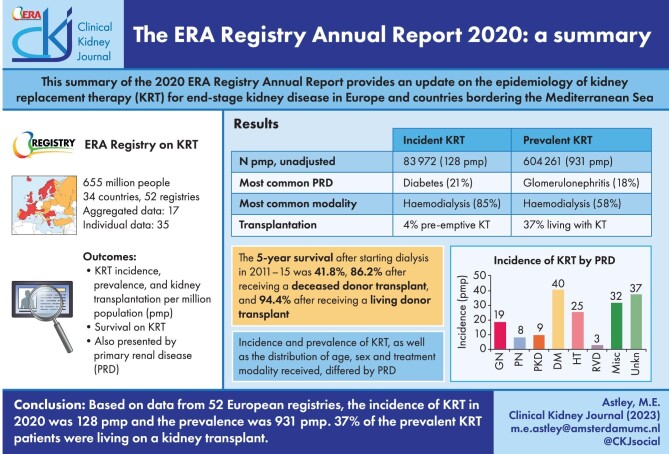
Graphical Abstract
Graphical Abstract
Figure 1:
Figure 1:
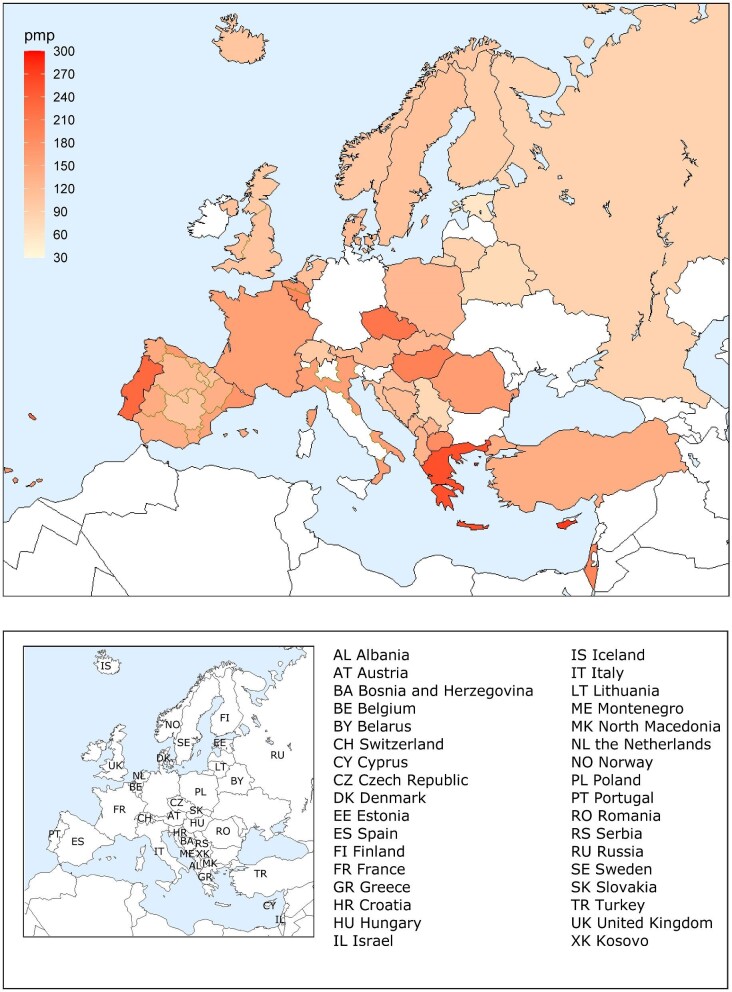
Incidence of KRT in 2020 on Day 1 by country or region, unadjusted.
Figure 2:
Figure 2:
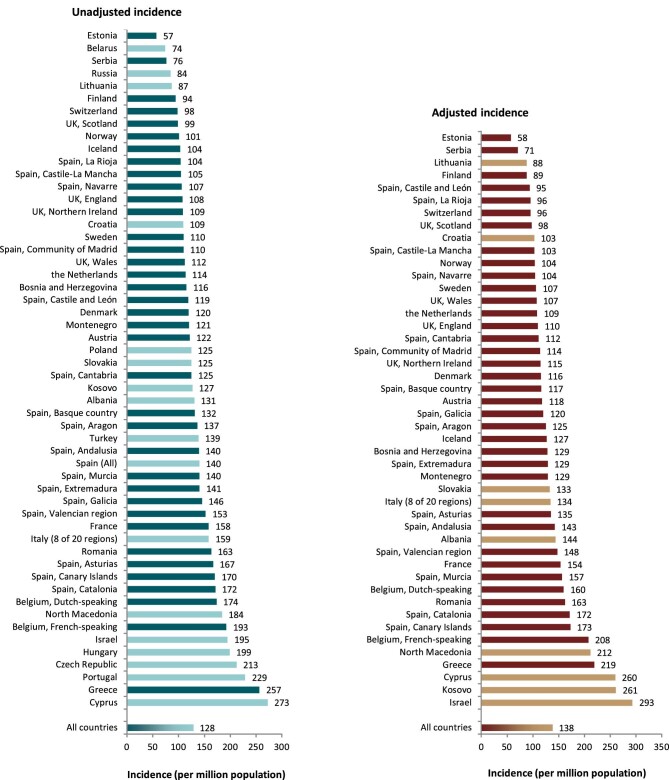
Incidence of KRT in 2020 on Day 1 by country or region, unadjusted (left panel) and adjusted (right panel). Registries providing individual patient data are shown as dark bars, and registries providing aggregated data as light bars. See Appendix 1 for a list of countries and regions providing individual patient data or aggregated data. Adjustment of the incidence was performed by standardizing the incidence to the age and sex distribution of the EU28 population.
Figure 3:
Figure 3:
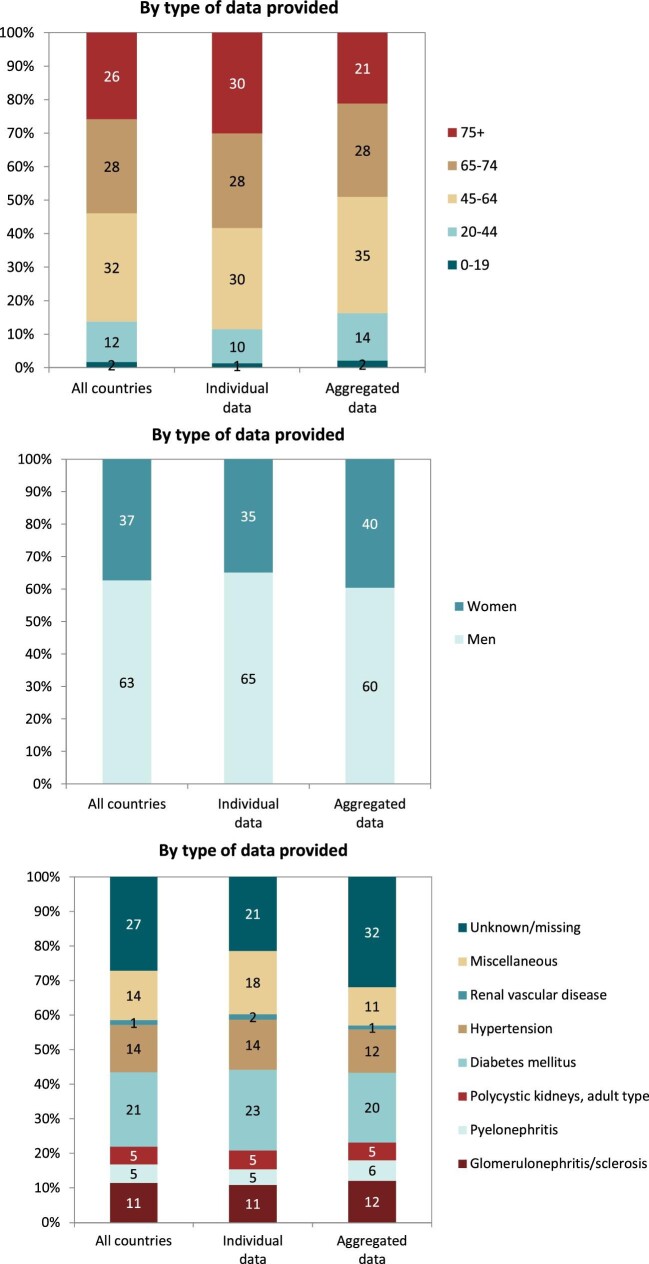
Distribution of (A) age, (B) sex and (C) PRD by type of data provided for incident patients accepted for KRT in 2020, on Day 1, unadjusted.
Figure 4:
Figure 4:
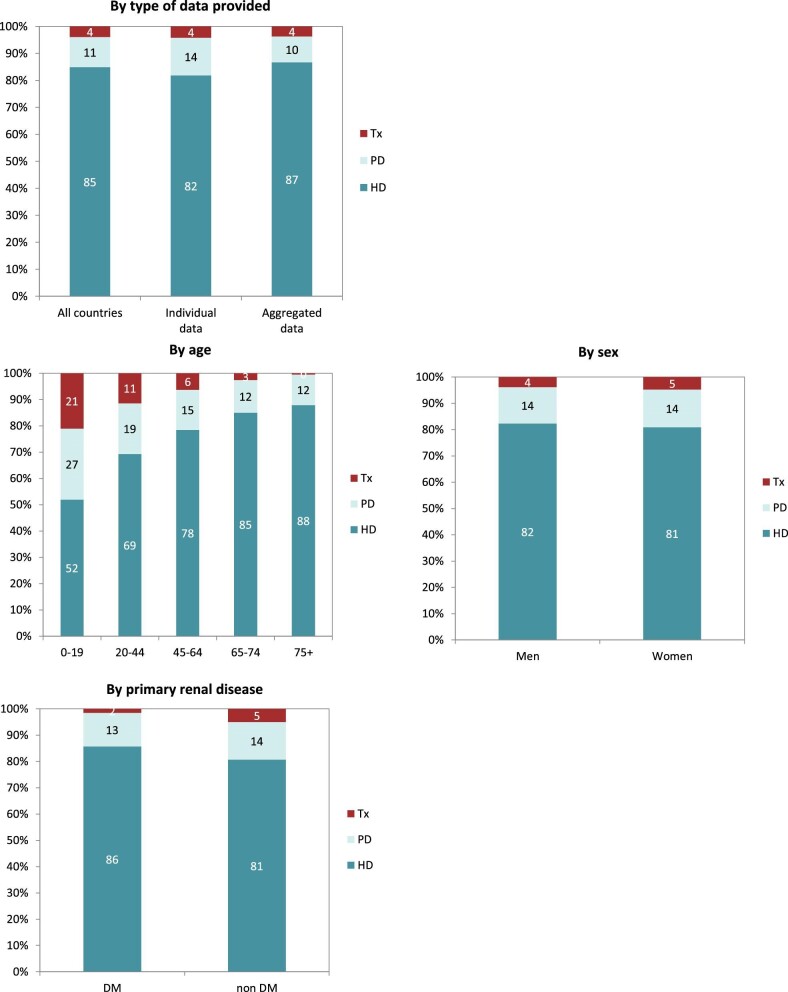
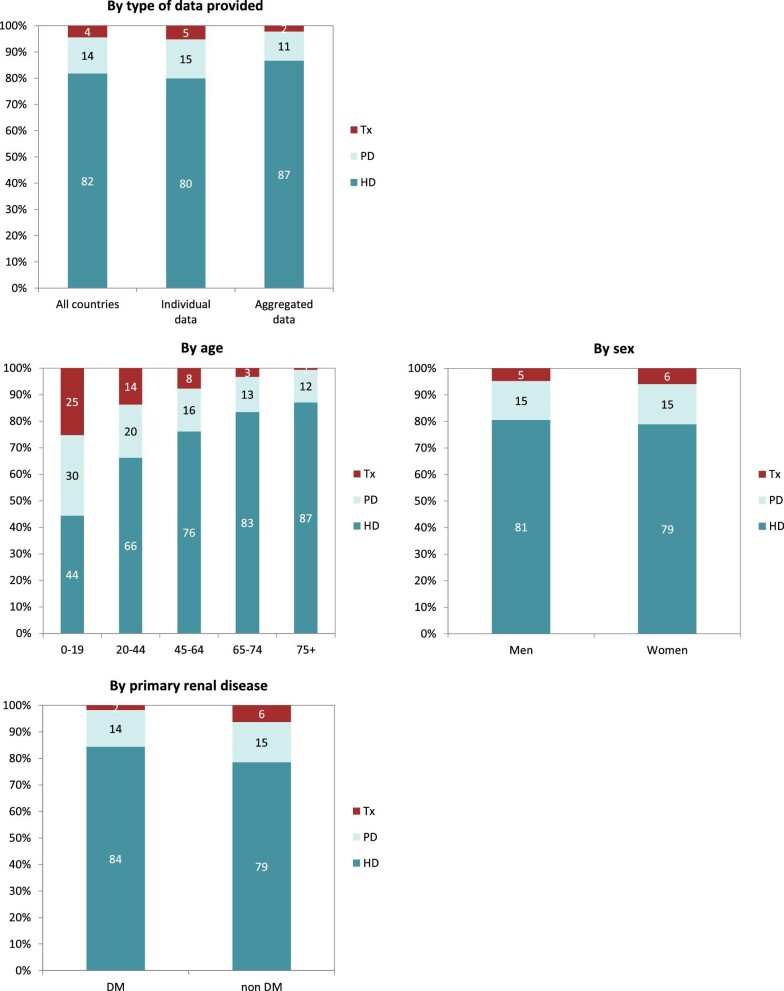
Distribution of treatment modality by (A) type of data provided, (B) age, (C) sex and (D) PRD (DM and non-DM) for incident patients accepted for KRT in 2020, on Day 1, unadjusted. Panels (B), (C) and (D) are only based on the data from registries providing individual patient data. See Appendix 1 for a list of countries and regions providing individual patient data or aggregated data. Abbreviations: Tx: transplant.
Figure 5:
Figure 5:
Distribution of treatment modality by (A) type of data provided, (B) age, (C) sex and (D) PRD (DM and non-DM) for incident patients accepted for KRT in 2020, on Day 91, unadjusted. Panels (B), (C) and (D) are only based on the data from registries providing individual patient data. See Appendix 1 for a list of countries and regions providing individual patient data or aggregated data. Abbreviations: Tx: transplant.
Figure 6:
Figure 6:
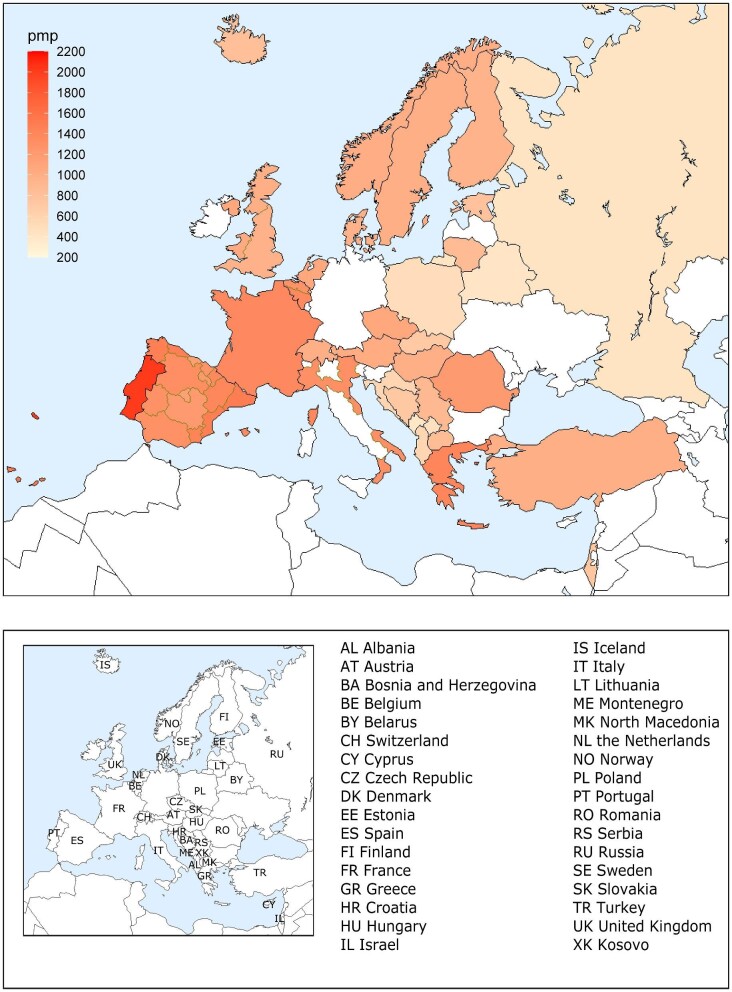
Prevalence of KRT on 31 December 2020 by country or region, unadjusted.
Figure 7:
Figure 7:
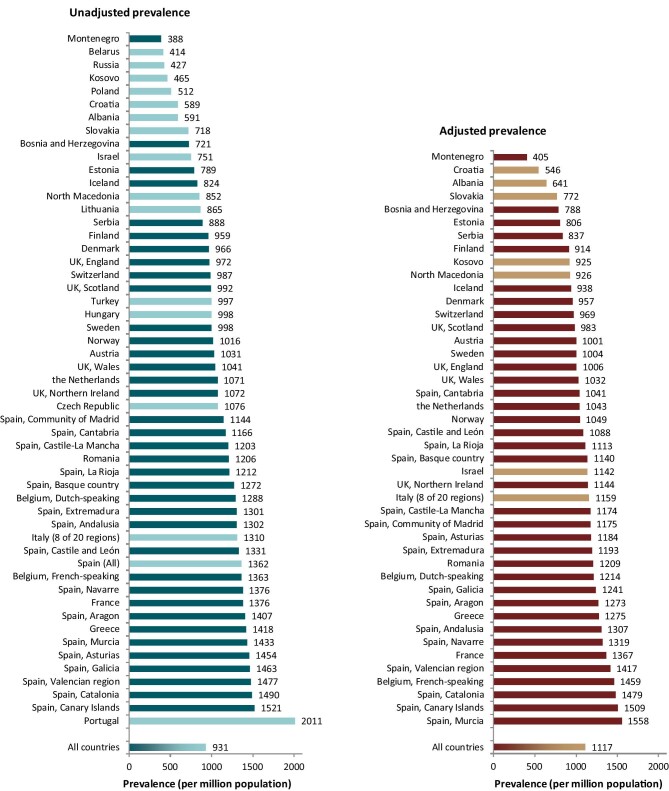
Prevalence of KRT on 31 December 2020 by country/region, unadjusted (left panel) and adjusted (right panel).
Figure 8:
Figure 8:
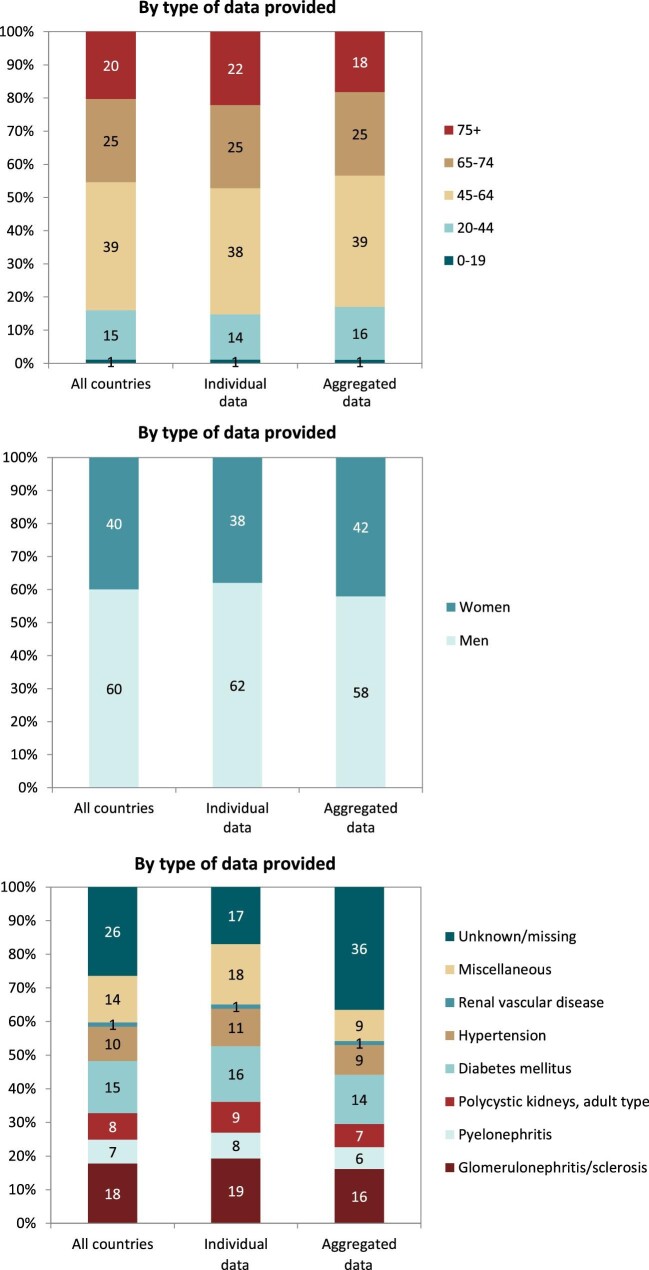
Distribution of (A) age, (B) sex and (C) PRD by type of data provided for prevalent patients on KRT on 31 December 2020, unadjusted.
Figure 9:
Figure 9:
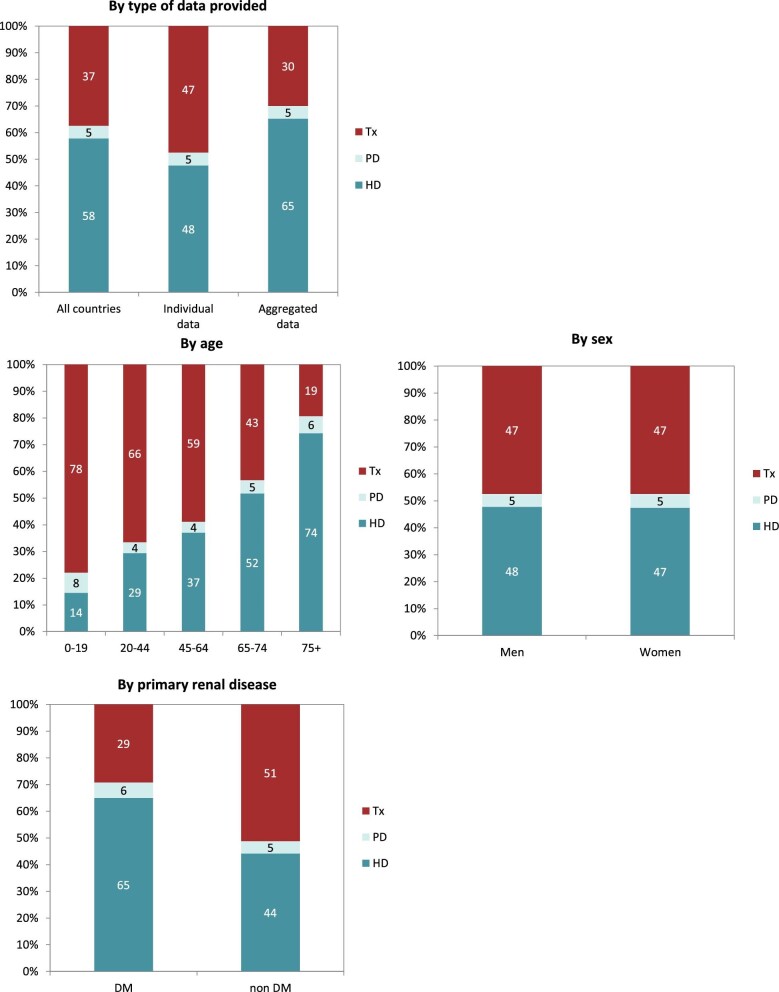
Distribution of treatment modality by (A) type of data provided, (B) age, (C) sex and (D) PRD (DM and non-DM) for prevalent patients on KRT on 31 December 2020, unadjusted. Panels (B), (C) and (D) are only based on the data from registries providing individual patient data. See Appendix 1 for a list of countries and regions providing individual patient data or aggregated data. Abbreviations: Tx: transplant.
Figure 10:
Figure 10:
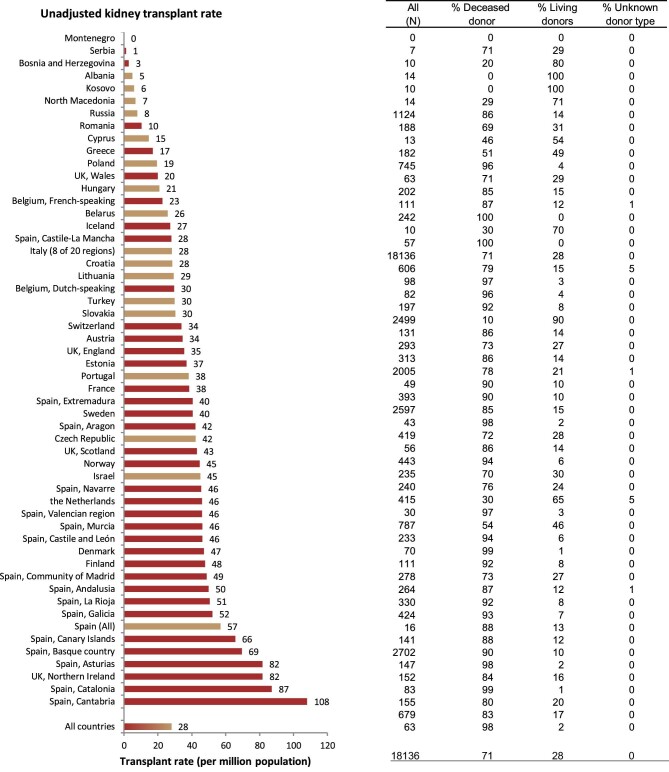
Kidney transplantations performed in 2020 by country or region, unadjusted. Registries providing individual patient data are shown as red bars, and registries providing aggregated data as orange bars.
Figure 11:
Figure 11:
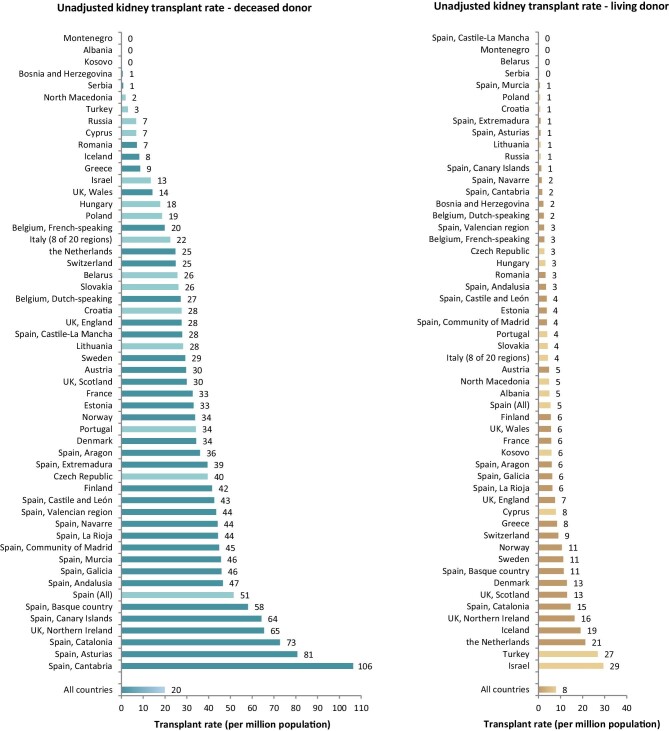
Kidney transplantations performed in 2020 for deceased donor (left panel) and living donor (right panel) transplantations, unadjusted. Registries providing individual patient data are shown as dark bars, and registries providing aggregated data as light bars.
Figure 12:
Figure 12:
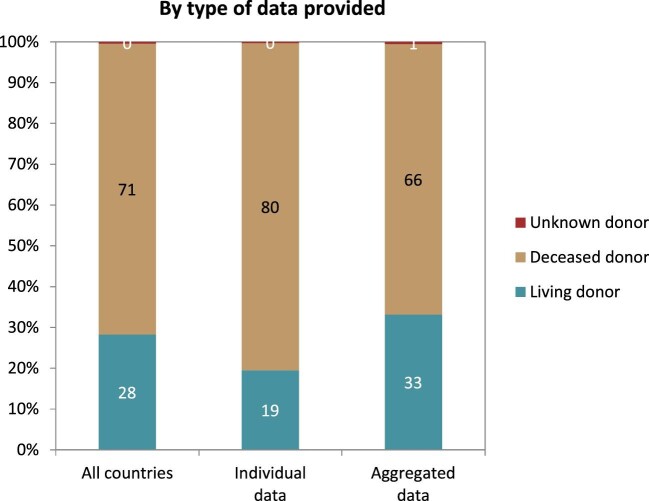
Distribution of donor type by type of data provided for kidney transplantations performed in 2020, unadjusted.
Figure 13:
Figure 13:
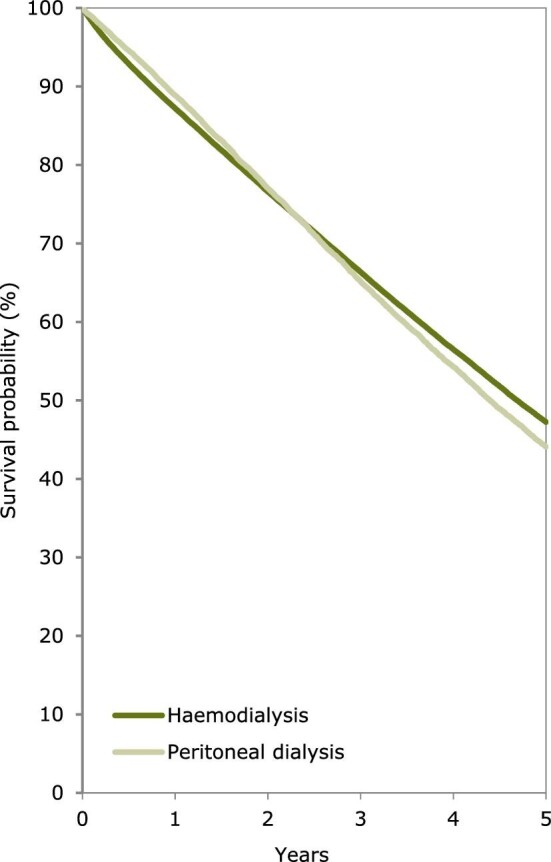
Patient survival by modality, either HD or PD, in incident dialysis patients from Day 91. Survival was adjusted using fixed values for age (67 years), sex (63% men) and PRD (24% diabetes mellitus, 19% hypertension/renal vascular disease, 11% glomerulonephritis and 46% other causes). This figure is based on patients starting dialysis between 2011 and 2015 from the following registries providing individual patient data: Austria, Belgium (Dutch-speaking), Belgium (French-speaking), Bosnia and Herzegovina, Denmark, Estonia, Finland, France, Greece, Iceland, Norway, Spain (Andalusia), Spain (Aragon), Spain (Asturias), Spain (Basque country), Spain (Cantabria), Spain (Castile and León), Spain (Castile-La Mancha), Spain (Catalonia), Spain (Community of Madrid), Spain (Extremadura), Spain (Galicia), Spain (Murcia), Spain (Valencian Region), Sweden, the Netherlands, the UK (England/Northern Ireland/Wales) and the UK (Scotland).
Figure 14:
Figure 14:
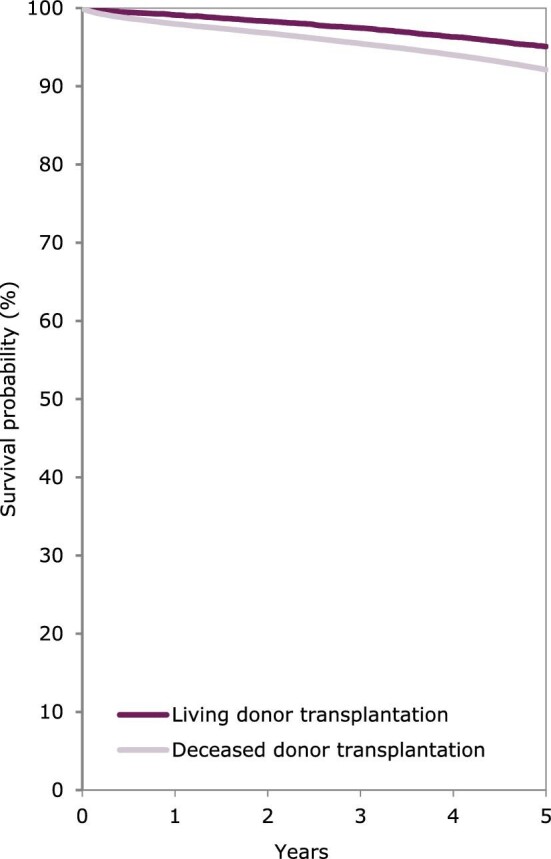
Patient survival in kidney transplant recipients by donor type, either deceased or living donors, from day of transplantation. Survival was adjusted using fixed values for age (50 years), sex (63% men) and PRD (14% diabetes mellitus, 10% hypertension/renal vascular disease, 23% glomerulonephritis and 53% other causes). This figure is based on patients receiving a kidney transplant between 2011 and 2015 from the following registries providing individual patient data: Austria, Belgium (Dutch-speaking), Belgium (French-speaking), Bosnia and Herzegovina, Denmark, Estonia, Finland, France, Greece, Iceland, Norway, Spain (Andalusia), Spain (Aragon), Spain (Asturias), Spain (Basque country), Spain (Cantabria), Spain (Castile and León), Spain (Castile-La Mancha), Spain (Catalonia), Spain (Community of Madrid), Spain (Extremadura), Spain (Galicia), Spain (Murcia), Spain (Valencian Region), Sweden, the Netherlands, the UK (England/Northern Ireland/Wales) and the UK (Scotland).
Figure 15:
Figure 15:
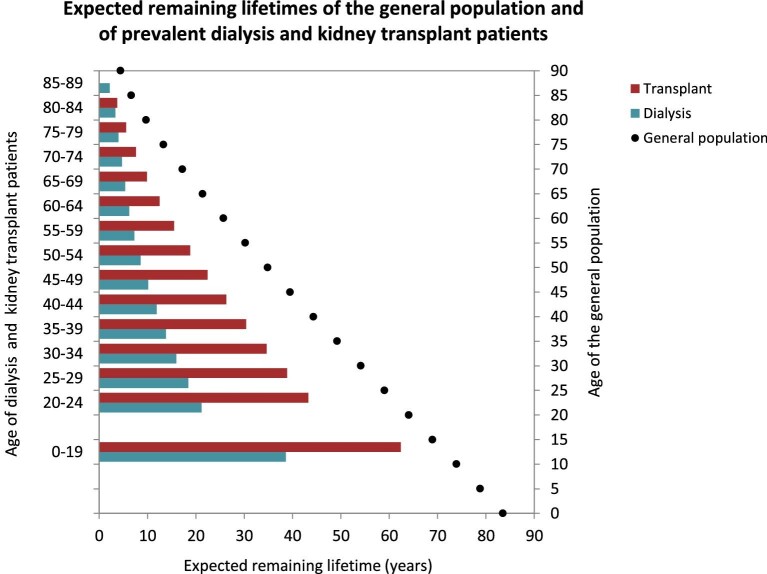
Expected remaining lifetime, in years, of the general population (cohort 2016–20) and of prevalent dialysis and kidney transplant patients (cohort 2016–20) by age. This figure is based on data from the following registries providing individual patient data: Austria, Belgium (Dutch-speaking), Belgium (French-speaking), Bosnia and Herzegovina, Denmark, Estonia, Finland, France, Greece, Iceland, Norway, Spain (Andalusia), Spain (Aragon), Spain (Asturias), Spain (Basque country), Spain (Cantabria), Spain (Castile and León), Spain (Castile-La Mancha), Spain (Catalonia), Spain (Community of Madrid), Spain (Extremadura), Spain (Galicia), Spain (Murcia), Spain (Valencian Region), Sweden, the Netherlands, the UK (England/Northern Ireland/Wales) and the UK (Scotland).
Figure 16:
Figure 16:
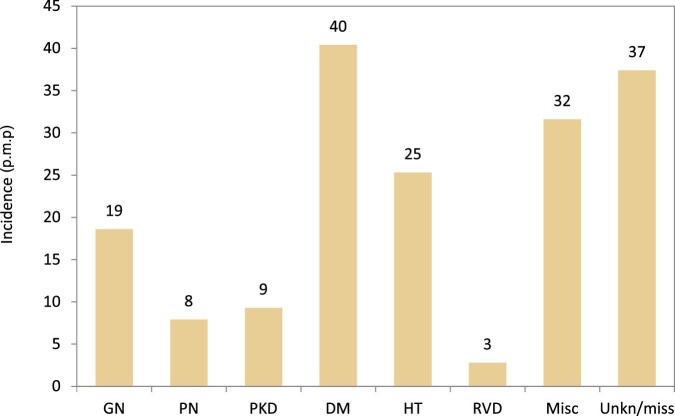
Incidence of KRT in 2020 on Day 1 by PRD, unadjusted. Abbreviations: Misc: miscellaneous; Unkn/miss: unknown/missing.
Figure 17:
Figure 17:
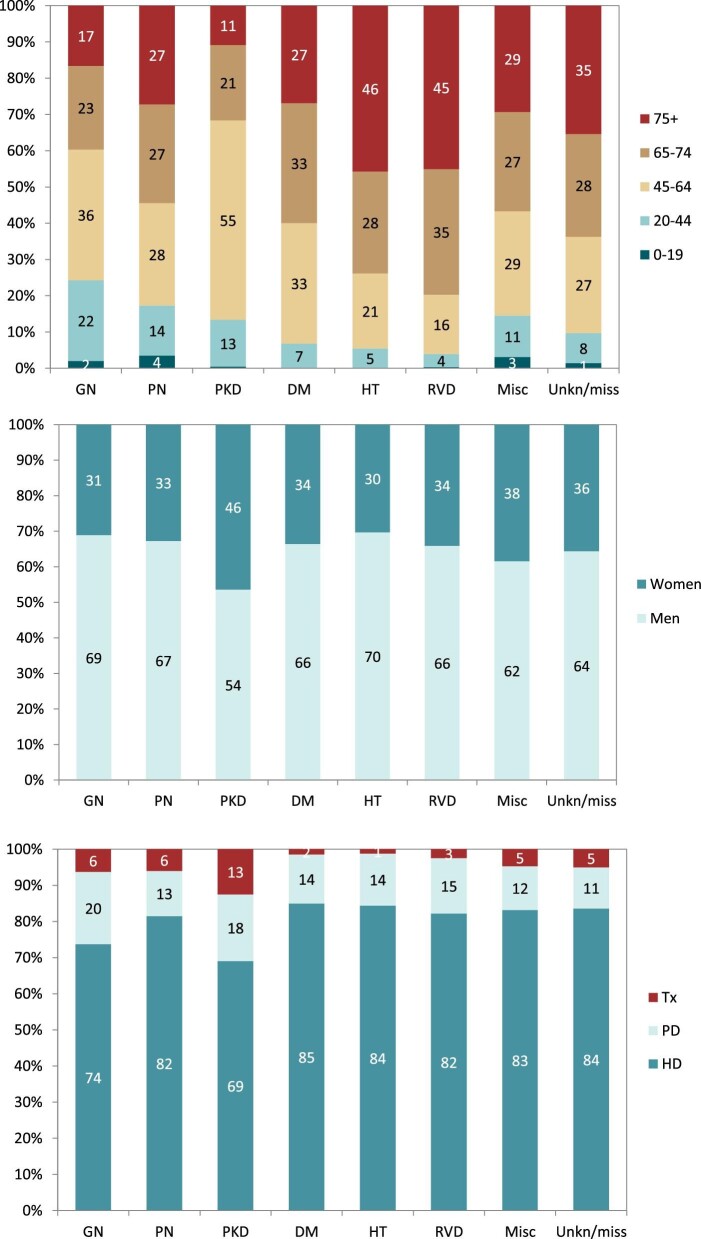
Distribution of (A) age, (B) sex and (C) treatment modality by PRD for incident patients accepted for KRT in 2020, on Day 1, unadjusted. Abbreviations: Misc: miscellaneous; Unkn/miss: unknown/missing; Tx: transplant.
Figure 18:
Figure 18:
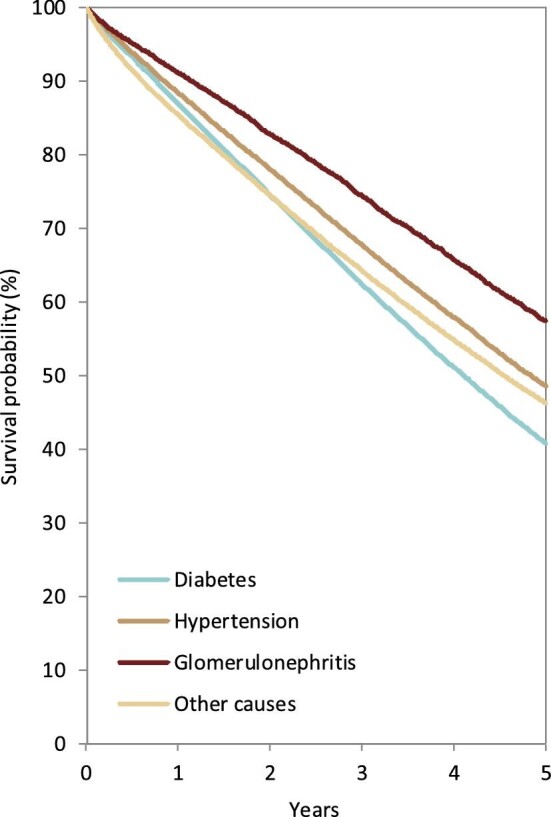
Patient survival by PRD in incident dialysis patients from Day 91. Survival was adjusted using fixed values for age (67 years) and sex (63% men). This figure is based on patients starting dialysis between 2011 and 2015 from the following registries providing individual patient data: Austria, Belgium (Dutch-speaking), Belgium (French-speaking), Bosnia and Herzegovina, Denmark, Estonia, Finland, France, Greece, Iceland, Norway, Spain (Andalusia), Spain (Aragon), Spain (Asturias), Spain (Basque country), Spain (Cantabria), Spain (Castile and León), Spain (Castile-La Mancha), Spain (Catalonia), Spain (Community of Madrid), Spain (Extremadura), Spain (Galicia), Spain (Murcia), Spain (Valencian Region), Sweden, the Netherlands, the UK (England/Northern Ireland/Wales) and the UK (Scotland).
Figure 19:
Figure 19:
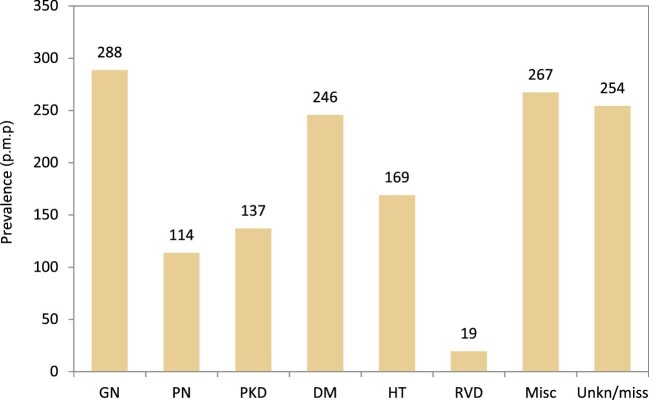
Prevalence of KRT on 31 December 2020 by PRD, unadjusted. Abbreviations: Misc: miscellaneous; Unkn/miss: unknown/missing.
Figure 20:
Figure 20:
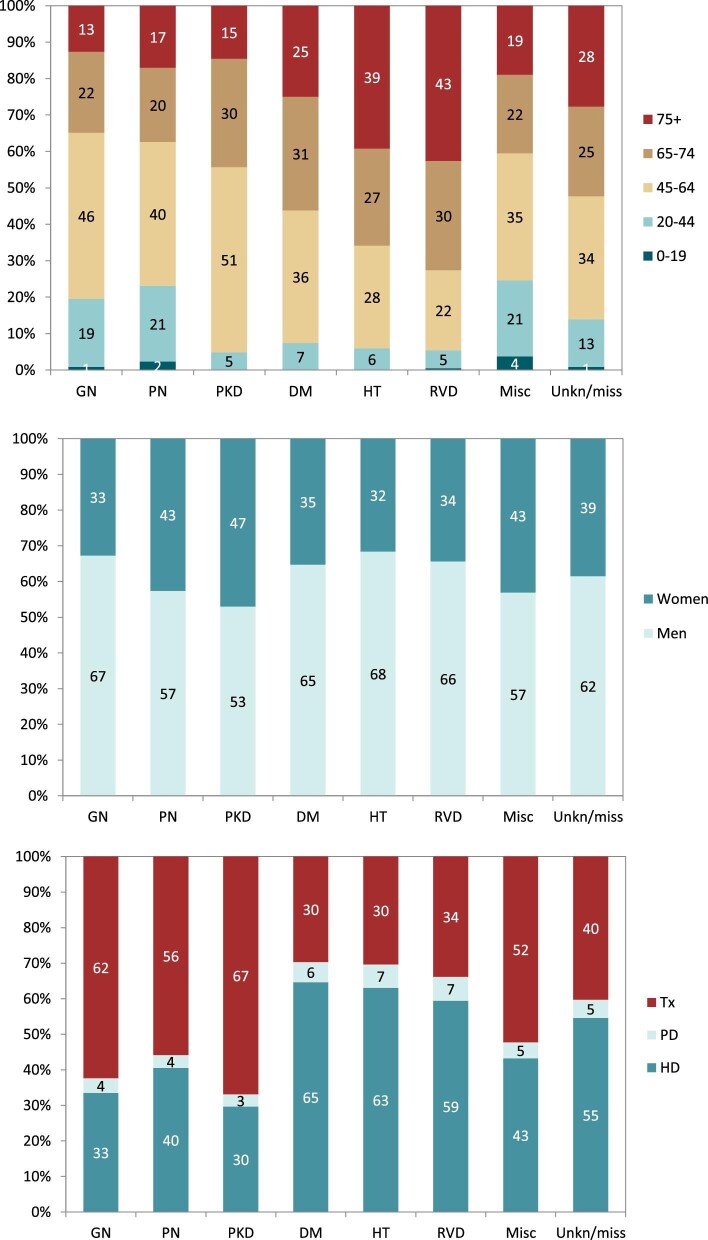
Distribution of (A) age, (B) sex and (C) treatment modality distribution by PRD in prevalent patients on KRT on 31 December 2020, unadjusted. Abbreviations: Misc: miscellaneous; Unkn/miss: unknown/missing; Tx: transplant.
Figure 21:
Figure 21:
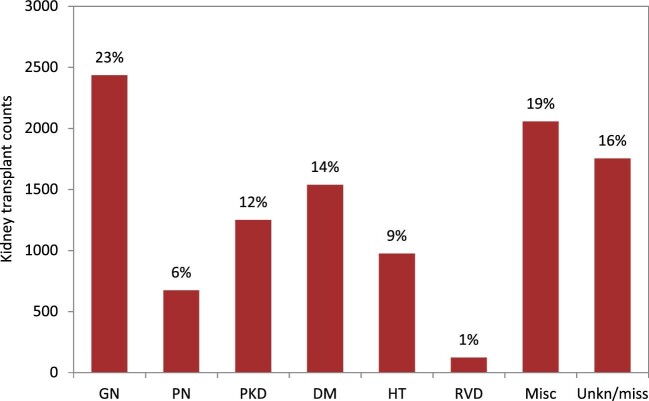
Kidney transplantations in both prevalent and incident KRT patients performed in 2020 by PRD, unadjusted. The percentages in this figure sum up to 100% for all PRD groups together. Abbreviations: Misc: miscellaneous; Unkn/miss: unknown/missing.
Figure 22:
Figure 22:
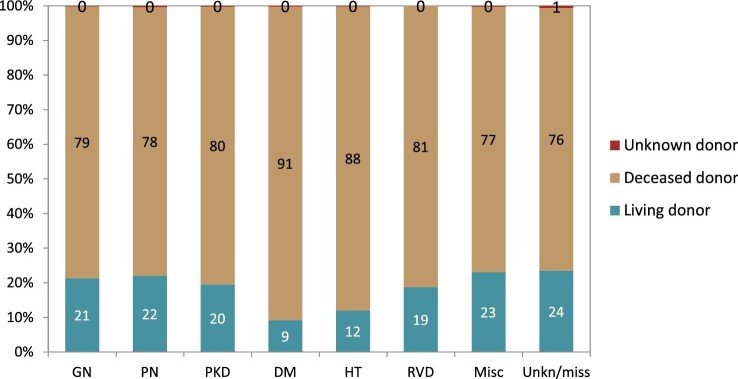
Distribution of donor type by PRD for kidney transplantations performed in 2020, unadjusted. Abbreviations: Misc: miscellaneous; Unkn/miss: unknown/missing.
Figure 23:
Figure 23:
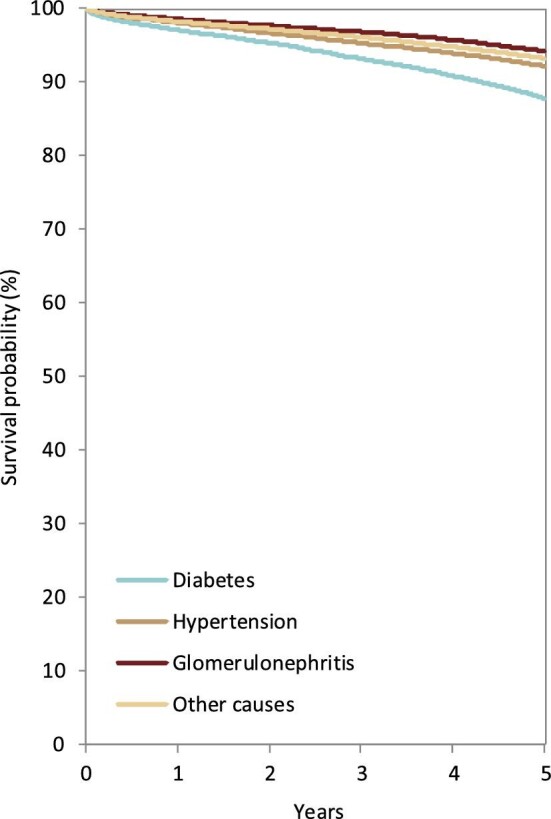
Patient survival by PRD in kidney transplant recipients from day of transplantation. Survival was adjusted using fixed values for age (50 years) and sex (63% men). This figure is based on patients receiving a kidney transplant between 2011 and 2015 from the following registries providing individual patient data: Austria, Belgium (Dutch-speaking), Belgium (French-speaking), Bosnia and Herzegovina, Denmark, Estonia, Finland, France, Greece, Iceland, Norway, Spain (Andalusia), Spain (Aragon), Spain (Asturias), Spain (Basque country), Spain (Cantabria), Spain (Castile and León), Spain (Castile-La Mancha), Spain (Catalonia), Spain (Community of Madrid), Spain (Extremadura), Spain (Galicia), Spain (Murcia), Spain (Valencian Region), Sweden, the Netherlands, the UK (England/Northern Ireland/Wales) and the UK (Scotland).

References

    1. ERA Registry: ERA Registry Annual Report 2020. Amsterdam, The Netherlands:Amsterdam UMC, location AMC, Department of Medical Informatics, 2022.
    1. Eurostat . Available from: www.ec.europa.eu/eurostat/data/database (14 March 2022, date last accessed).