Review
. 2023 Apr 25;3(1):e220094.
doi: 10.1530/EO-22-0094. eCollection 2023 Jan 1.

Exploring genetic loci of type 2 diabetes and cancer: a review

Affiliations
Review

Exploring genetic loci of type 2 diabetes and cancer: a review

Molly Endicott et al. Endocr Oncol. .

Abstract

Diabetes and cancer are two heterogenous diseases which are rapidly increasing in prevalence globally. A link between these two non-communicable diseases was first identified over 100 years ago; however, recent epidemiological studies and advances in genomic research have provided greater insight into the association between diabetes and cancer. Epidemiological studies have suggested that individuals with diabetes have an increased risk of several types of cancer (including liver, pancreas, colorectal, breast, and endometrial) and an increased risk of cancer mortality. However, this increased risk is not observed in all cancers, for example, there is a reduced risk of prostate cancer in individuals with diabetes. It has also been observed that cancer patients have an increased risk of developing diabetes, highlighting that the relationship between these diseases is not straightforward. Evidence of a shared genetic aetiology along with numerous lifestyle and clinical factors have made it challenging to establish if the relationship between the two diseases is causal or a result of confounding factors. This review takes a pan-cancer approach to highlight the complexities of the interactions between type 2 diabetes and cancer development, indicating where advances in genomic research have enabled a greater insight into these two diseases.

Keywords: carcinoma; diabetes; molecular genetics.


Conflict of interest statement

No conflict of interest.

Figures
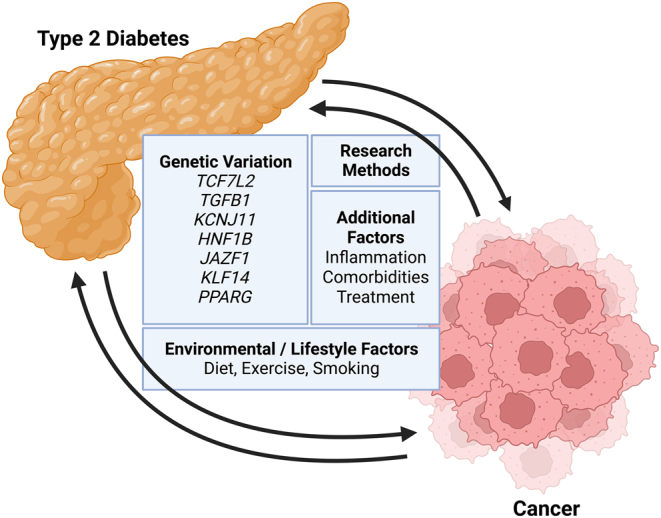
Figure 1
Figure 1
Review overview. This diagram depicts the multiple factors impacting the complex relationship between type 2 diabetes (T2D) and cancer. Focusing on the genetic overlap, this review covers seven genes which provide a plausible explanation for the interactions between T2D and cancer. It is important to note that this relationship is not limited to genetics and strongly influenced by environmental/lifestyle factors, treatments, comorbidities, and metabolic alterations such as inflammation. The review also discusses a range of research methods from observational epidemiological studies to Mendelian randomisation. Advancing genomic technologies and in silico methods are enabling a greater insight into the interactions between T2D and cancer (data fromLeedy et al. 2022).
Figure 2
Figure 2
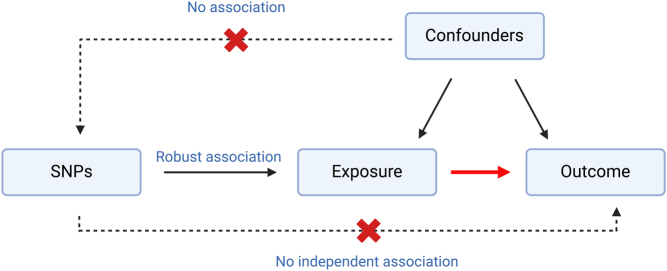
Summary schematic of Mendelian randomisation (MR). Single-nucleotide polymorphisms (SNPs) are selected as an instrumental variable to look at the causal relationship between an exposure and an outcome indicated by the red arrow. The method of MR relies on three assumptions indicated by the blue text. Assumption 1: There must be a robust association between the chosen SNPs and exposure variable. Assumption 2: The chosen SNPs must be independent of any confounding factors. Assumption 3: There must be no independent association between the SNPs and outcome variable. Any violation of these assumptions invalidates the study and can limit the method of MR (data from Gala & Tomlinson 2020).

References

    1. Adams JD & Vella A. 2018What can diabetes-associated genetic variation in TCF7L2 teach us about the pathogenesis of type 2 diabetes? Metabolic Syndrome and Related Disorders 16383–389. (10.1089/met.2018.0024) - DOI - PMC - PubMed
    1. Baena-Díez JM, Peñafiel J, Subirana I, Ramos R, Elosua R, Marín-Ibañez A, Guembe MJ, Rigo F, Tormo-Díaz MJ, Moreno-Iribas C, et al.2016Risk of cause-specific death in individuals with diabetes: a competing risks analysis. Diabetes Care 391987–1995. (10.2337/dc16-0614) - DOI - PubMed
    1. Barroso I & McCarthy MI. 2019The genetic basis of metabolic disease. Cell 177146–161. (10.1016/j.cell.2019.02.024) - DOI - PMC - PubMed
    1. Carstensen B Jørgensen ME & Friis S. 2014The epidemiology of diabetes and cancer. Current Diabetes Reports 14535. (10.1007/s11892-014-0535-8) - DOI - PubMed
    1. Cheng I, Caberto CP, Lum-Jones A, Seifried A, Wilkens LR, Schumacher FR, Monroe KR, Lim U, Tiirikainen M, Kolonel LN, et al.2011Type 2 diabetes risk variants and colorectal cancer risk: the Multiethnic Cohort and PAGE studies. Gut 601703–1711. (10.1136/gut.2011.237727) - DOI - PMC - PubMed

LinkOut - more resources