


Behavioral metabolomics: how behavioral data can guide metabolomics research on neuropsychiatric disorders
- PMID: 37530897
- PMCID: PMC10397151
- DOI: 10.1007/s11306-023-02034-6
Behavioral metabolomics: how behavioral data can guide metabolomics research on neuropsychiatric disorders
Abstract
Introduction: Metabolomics produces vast quantities of data but determining which metabolites are the most relevant to the disease or disorder of interest can be challenging.
Objectives: This study sought to demonstrate how behavioral models of psychiatric disorders can be combined with metabolomics research to overcome this limitation.
Methods: We designed a preclinical, untargeted metabolomics procedure, that focuses on the determination of central metabolites relevant to substance use disorders that are (a) associated with changes in behavior produced by acute drug exposure and (b) impacted by repeated drug exposure. Untargeted metabolomics analysis was carried out on liquid chromatography-mass spectrometry data obtained from 336 microdialysis samples. Samples were collected from the medial striatum of male Sprague-Dawley (N = 21) rats whilst behavioral data were simultaneously collected as part of a (±)-3,4-methylenedioxymethamphetamine (MDMA)-induced behavioral sensitization experiment. Analysis was conducted by orthogonal partial least squares, where the Y variable was the behavioral data, and the X variables were the relative concentrations of the 737 detected features.
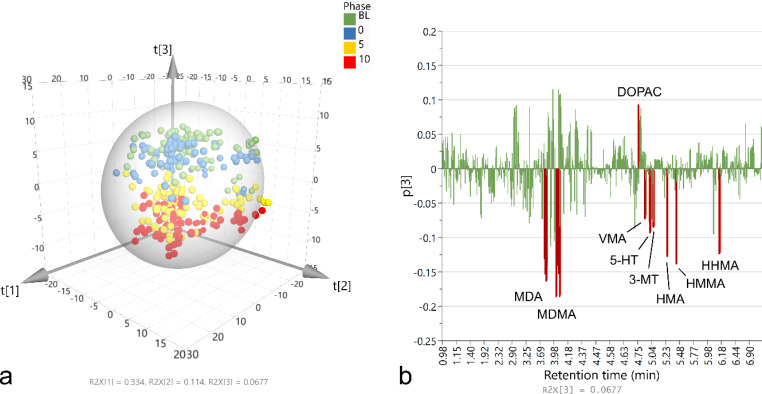
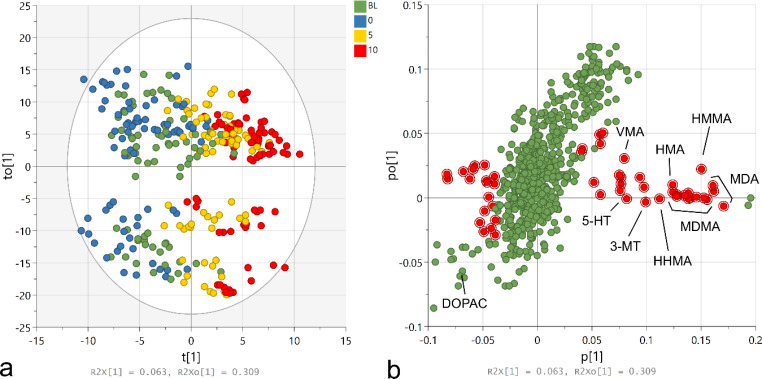
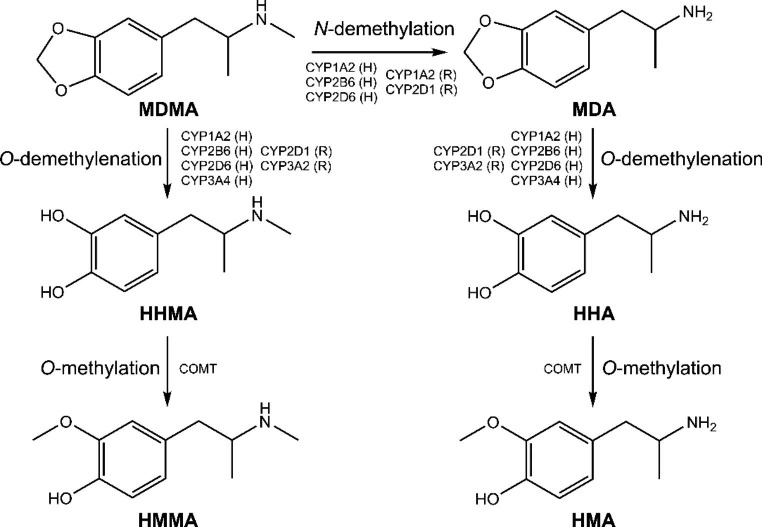
Results: MDMA and its derivatives, serotonin, and several dopamine/norepinephrine metabolites were the greatest predictors of acute MDMA-produced behavior. Subsequent univariate analyses showed that repeated MDMA exposure produced significant changes in MDMA metabolism, which may contribute to the increased abuse liability of the drug as a function of repeated exposure.
Conclusion: These findings highlight how the inclusion of behavioral data can guide metabolomics data analysis and increase the relevance of the results to the phenotype of interest.
Keywords: Addiction; Behavior; LCMS; MDMA; Metabolomics; Sensitization.
© 2023. The Author(s).
Conflict of interest statement
The authors have no relevant financial or non-financial interests to disclose.
Figures


References
-
- Álvarez-Sánchez B, Priego-Capote F, de Castro MDL. Metabolomics analysis II. Preparation of biological samples prior to detection. TrAC Trends in Analytical Chemistry. 2010;29(2):120–127. doi: 10.1016/J.TRAC.2009.12.004. - DOI
-
- Álvarez-Sánchez B, Priego-Capote F, de Luque MD. Metabolomics analysis I. Selection of biological samples and practical aspects preceding sample preparation. TrAC Trends in Analytical Chemistry. 2010;29(2):111–119. doi: 10.1016/J.TRAC.2009.12.003. - DOI
-
- Ball KT, Wellman CL, Fortenberry E, Rebec G. Sensitizing regimens of (±)3, 4-methylenedioxymethamphetamine (ecstasy) elicit enduring and differential structural alterations in the brain motive circuit of the rat. Neuroscience. 2009;160(2):264–274. doi: 10.1016/J.NEUROSCIENCE.2009.02.025. - DOI - PMC - PubMed
Publication types
MeSH terms
Substances
LinkOut - more resources
Full Text Sources
Medical