. 2023 Nov 1;34(11):1863-1874.
doi: 10.1681/ASN.0000000000000194. Epub 2023 Aug 3.

Discrepant Outcomes between National Kidney Transplant Data Registries in the United States

Affiliations

Discrepant Outcomes between National Kidney Transplant Data Registries in the United States

Miko Yu et al. J Am Soc Nephrol. .

Abstract

Significance statement: Effects of reduced access to external data by transplant registries to improve accuracy and completeness of the collected data are compounded by different data management processes at three US organizations that maintain kidney transplant-related datasets. This analysis suggests that the datasets have large differences in reported outcomes that vary across different subsets of patients. These differences, along with recent disclosure of previously missing outcomes data, raise important questions about completeness of the outcome measures. Differences in recorded deaths seem to be increasing in recent years, reflecting the adverse effects of restricted access to external data sources. Although these registries are invaluable sources for the transplant community, discrepancies and incomplete reporting risk undermining their value for future analyses, particularly when used for developing national transplant policy or regulatory measures.

Background: Central to a transplant registry's quality are accuracy and completeness of the clinical information being captured, especially for important outcomes, such as graft failure or death. Effects of more limited access to external sources of death data for transplant registries are compounded by different data management processes at the United Network for Organ Sharing (UNOS), the Scientific Registry of Transplant Recipients (SRTR), and the United States Renal Data System (USRDS).

Methods: This cross-sectional registry study examined differences in reported deaths among kidney transplant candidates and recipients of kidneys from deceased and living donors in 2000 through 2019 in three transplant datasets on the basis of data current as of 2020. We assessed annual death rates and survival estimates to visualize trends in reported deaths between sources.

Results: The UNOS dataset included 77,605 deaths among 315,346 recipients and 61,249 deaths among 275,000 nonpreemptively waitlisted candidates who were never transplanted. The SRTR dataset included 87,149 deaths among 315,152 recipients and 60,042 deaths among 259,584 waitlisted candidates. The USRDS dataset included 89,515 deaths among 311,955 candidates and 63,577 deaths among 238,167 waitlisted candidates. Annual death rates among the prevalent transplant population show accumulating differences across datasets-2.31%, 4.00%, and 4.03% by 2019 from UNOS, SRTR, and USRDS, respectively. Long-term survival outcomes were similar among nonpreemptively waitlisted candidates but showed more than 10% discordance between USRDS and UNOS among transplanted patients.

Conclusions: Large differences in reported patient outcomes across datasets seem to be increasing, raising questions about their completeness. Understanding the differences between these datasets is essential for accurate, reliable interpretation of analyses that use these data for policy development, regulatory oversight, and research.

Podcast: This article contains a podcast at https://dts.podtrac.com/redirect.mp3/www.asn-online.org/media/podcast/JASN/2023_10_24_JASN0000000000000194.mp3.


Conflict of interest statement

A.M. Huml reports Advisory or Leadership Role: Cleveland Minority Organ and Tissue Transplant Education Program (MOTTEP) Advisory Board Co-Chair, Chairperson for IPRO ESKD Network of the Ohio River Valley Medical Review Board, Member of the Medical Director Advisory Council for The National Forum of ESKD Networks. S.A. Husain reports Research Funding: Nelson family foundation; and Honoraria: Fresenius. S. Mohan receives grant funding from Kidney Transplant Collaborative and the NIH, and personal fees from Kidney International Reports and Health Services Advisory Group outside of the submitted work. S. Mohan also reports Consultancy: eGenesis and HSAG; Patents or Royalties: Columbia University; Advisory or Leadership Role: Chair of UNOS Data advisory committee, Deputy Editor of Kidney International Reports (ISN), Member of ASN Quality committee, Member of SRTR Review Committee, and National Faculty Chair of ETCLC. R.E. Patzer reports Employer: Vital (spouse); Ownership Interest: Vital Software (spouse has ownership); Advisory or Leadership Role: Editorial board of American Journal of Transplantation, CJASN editorial board, Chair of United Network for Organ Sharing Data Advisory Board; and Other Interests or Relationships: Vital ER—husband is a chief medical officer. J.D. Schold reports Consultancy: eGenesis and Sanofi Corporation; Research Funding: One Legacy Foundation; Honoraria: eGenesis and Sanofi Inc.; Advisory or Leadership Role: Data Safety Monitoring Board Member—Bristol Myers Squibb and Vice Chair UNOS Data Advisory Committee; and Speakers Bureau: Sanofi. The remaining author has nothing to disclose.

Figures

None
Graphical abstract
Figure 1
Figure 1
Flow diagram of data sources and registries to research data files produced by each organization, available to researchers as of 2022. Dotted arrows represent flows of information that is available to the OPTN for internal use but are not shared externally with researchers. Processes that have not been described or clearly disclosed are represented in black boxes with white text. Recent changes in what data have been included in publicly available datasets are represented in red. *No external verification for graft failure for return to dialysis. Limited internal/policy development use. CMS, Center for Medicare & Medicaid Services; EQRS, End-Stage Renal Disease Quality Reporting System; FFS, fee for service; HRSA, Health Resources and Services Administration; NIH, National Institutes of Health; OPO, organ procurement organization; OPTN, Organ Procurement and Transplantation Network; SAF, Standard Analysis File; SRTR, Scientific Registry of Transplant Recipient; STAR, standard transplant analysis and research; TIEDI, transplant information electronic data interchange; UNOS, United Network for Organ Sharing; USRDS, United States Renal Data System.
Figure 2
Figure 2
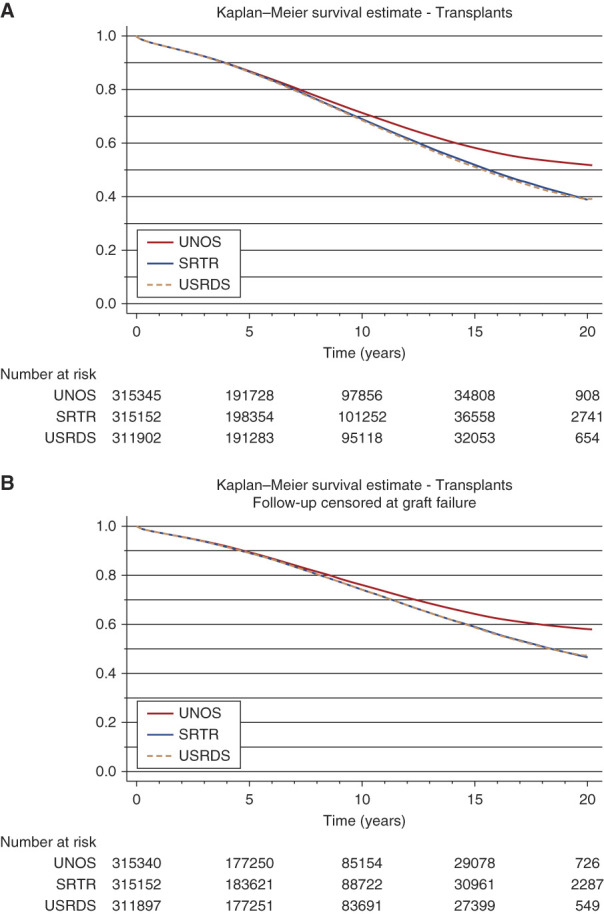
Unadjusted Kaplan-Meier curves of transplant patient survival 2000-2019, by data source. (A) Overall transplant patient survival. (B) Transplant patient survival with follow-up censored at graft failure. SRTR, Scientific Registry of Transplant Recipient; UNOS, United Network for Organ Sharing; USRDS, United States Renal Data System.
Figure 3
Figure 3
Annual number of transplant deaths recorded by UNOS, SRTR, and USRDS, by year of death in 2000–2019, showing the extent of differences between data captured by each source. Solid lines indicate transplant deaths recorded in 2020 analysis files. Dashed lines indicate transplant deaths recorded in June 2022 analysis files. Vertical line marks the date of change in SSDMF availability. SRTR, Scientific Registry of Transplant Recipient; SSDMF, Social Security Death Master File; UNOS, United Network for Organ Sharing; USRDS, United States Renal Data System.
Figure 4
Figure 4
Unadjusted Kaplan-Meier curves of waitlist patient survival 2000-2019, by data source. (A) Overall waitlist patient survival. (B) Waitlist patient survival, excluding preemptively waitlisted candidates. SRTR, Scientific Registry of Transplant Recipient; UNOS, United Network for Organ Sharing; USRDS, United States Renal Data System.
Figure 5
Figure 5
Annual number of waitlist deaths from 2000 to 2019, identified in in UNOS STAR (dated March 20, 2020), SRTR SAF (dated September 2, 2020), and USRDS (dated March 13, 2020), showing the differences and incomplete data capture of each source. SAF, Standard Analysis File; SRTR, Scientific Registry of Transplant Recipient; STAR, standard transplant analysis and research; UNOS, United Network for Organ Sharing; USRDS; United States Renal Data System.

References

    1. Kshirsagar AV Weiner DE Mendu ML, et al. Keys to driving implementation of the new kidney care models. Clin J Am Soc Nephrol. 2022;17(7):1082–1091. doi: 10.2215/CJN.10880821 - DOI - PMC - PubMed
    1. Formica RN, Jr. Perspectives on the strengths and weaknesses of the national kidney allocation system. Clin J Am Soc Nephrol. 2017;12(12):2056. doi: 10.2215/CJN.08640817 - DOI - PMC - PubMed
    1. Israni A Wey A Thompson B, et al. New kidney and pancreas allocation policy: moving to a circle as the first unit of allocation. J Am Soc Nephrol. 2021;32(7):1546–1550. doi: 10.1681/ASN.2020121679 - DOI - PMC - PubMed
    1. Israni AK Salkowski N Gustafson S, et al. New national allocation policy for deceased donor kidneys in the United States and possible effect on patient outcomes. J Am Soc Nephrol. 2014;25(8):1842–1848. doi: 10.1681/ASN.2013070784 - DOI - PMC - PubMed
    1. Tsapepas D, King KL, Husain SA, Mohan S. Evaluation of kidney allocation critical data validity in the OPTN registry using dialysis dates. Am J Transplant. 2020;20(1):318–319. doi: 10.1111/ajt.15616 - DOI - PubMed

Publication types

LinkOut - more resources