Contemporary enterovirus-D68 isolates infect human spinal cord organoids
- PMID: 37535397
- PMCID: PMC10470749
- DOI: 10.1128/mbio.01058-23
Contemporary enterovirus-D68 isolates infect human spinal cord organoids
Abstract
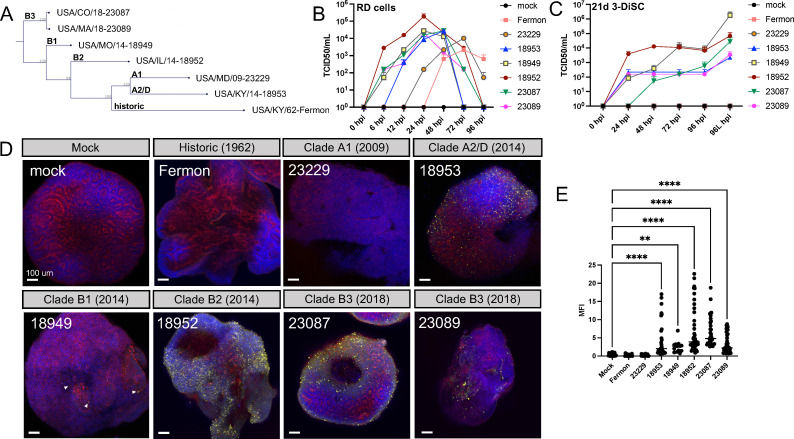
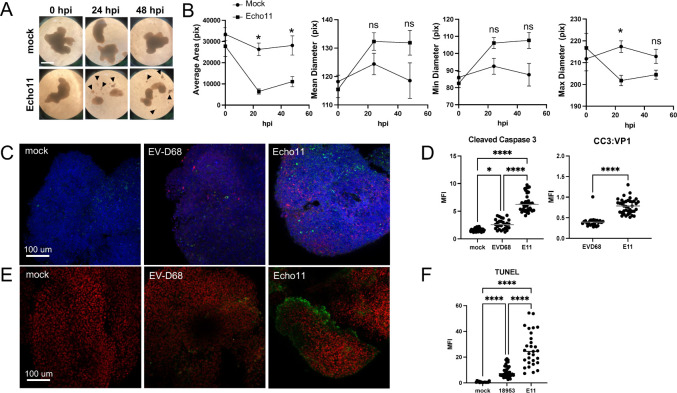
Enterovirus D68 (EV-D68) is a nonpolio enterovirus associated with severe respiratory illness and acute flaccid myelitis (AFM), a polio-like illness causing paralysis in children. AFM outbreaks have been associated with increased circulation and genetic diversity of EV-D68 since 2014, although the virus was discovered in the 1960s. The mechanisms by which EV-D68 targets the central nervous system are unknown. Since enteroviruses are human pathogens that do not routinely infect other animal species, establishment of a human model of the central nervous system is essential for understanding pathogenesis. Here, we describe two human spinal cord organoid (hSCO)-based models for EV-D68 infection derived from induced, pluripotent stem cell (iPSC) lines. One hSCO model consists primarily of spinal motor neurons, while the another model comprises multiple neuronal cell lineages, including motor neurons, interneurons, and glial cells. These hSCOs can be productively infected with contemporary strains, but not a historic strain, of EV-D68 and produce extracellular virus for at least 2 weeks without appreciable cytopathic effect. By comparison, infection with hSCO with another enterovirus, echovirus 11, causes significant structural destruction and apoptosis. Together, these findings suggest that EV-D68 infection is not the sole mediator of neuronal cell death in the spinal cord in those with AFM and that secondary injury from the immune response likely contributes to pathogenesis. IMPORTANCE AFM is a rare condition that causes significant morbidity in affected children, often contributing to life-long sequelae. It is unknown how EV-D68 causes paralysis in children, and effective therapeutic and preventative strategies are not available. Mice are not native hosts for EV-D68, and thus, existing mouse models use immunosuppressed or neonatal mice, mouse-adapted viruses, or intracranial inoculations. To complement existing models, we report two hSCO models for EV-D68 infection. These three-dimensional, multicellular models comprised human cells and include multiple neural lineages, including motor neurons, interneurons, and glial cells. These new hSCO models for EV-D68 infection will contribute to understanding how EV-D68 damages the human spinal cord, which could lead to new therapeutic and prophylactic strategies for this virus.
Keywords: acute flaccid myelitis (AFM); enterovirus; enterovirus D68 (EV-D68); human model systems; induced pluripotent stem cells; organoids; spinal cord organoids.
Conflict of interest statement
J.V.W serves on advisory committees for GlaxoSmithKline and Quidel, which did not impact the work contained in this paper. Other authors are without conflicts.
Figures
References
-
- Shah MM, Perez A, Lively JY, Avadhanula V, Boom JA, Chappell J, Englund JA, Fregoe W, Halasa NB, Harrison CJ, Hickey RW, Klein EJ, McNeal MM, Michaels MG, Moffatt ME, Otten C, Sahni LC, Schlaudecker E, Schuster JE, Selvarangan R, Staat MA, Stewart LS, Weinberg GA, Williams JV, Ng TFF, Routh JA, Gerber SI, McMorrow ML, Rha B, Midgley CM. 2021. Enterovirus D68-associated acute respiratory illness ─ new vaccine surveillance network, United States, July-November 2018-2020. MMWR Morb Mortal Wkly Rep 70:1623–1628. doi: 10.15585/mmwr.mm7047a1 - DOI - PMC - PubMed
-
- Olsen SJ, Winn AK, Budd AP, Prill MM, Steel J, Midgley CM, Kniss K, Burns E, Rowe T, Foust A, Jasso G, Merced-Morales A, Davis CT, Jang Y, Jones J, Daly P, Gubareva L, Barnes J, Kondor R, Sessions W, Smith C, Wentworth DE, Garg S, Havers FP, Fry AM, Hall AJ, Brammer L, Silk BJ. 2021. Changes in influenza and other respiratory virus activity during the COVID-19 pandemic - United States, 2020-2021. MMWR Morb Mortal Wkly Rep 70:1013–1019. doi: 10.15585/mmwr.mm7029a1 - DOI - PMC - PubMed
Publication types
MeSH terms
Supplementary concepts
Grants and funding
LinkOut - more resources
Full Text Sources
Miscellaneous