Adherence to the World Cancer Research Fund/American Institute for Cancer Research and Korean Cancer Prevention Guidelines and cancer risk: a prospective cohort study from the Health Examinees-Gem study
- PMID: 37536716
- PMCID: PMC10667577
- DOI: 10.4178/epih.e2023070
Adherence to the World Cancer Research Fund/American Institute for Cancer Research and Korean Cancer Prevention Guidelines and cancer risk: a prospective cohort study from the Health Examinees-Gem study
Abstract
Objectives: The purpose of this study was to explore the association between adherence to 2 cancer prevention recommendations and cancer risk.
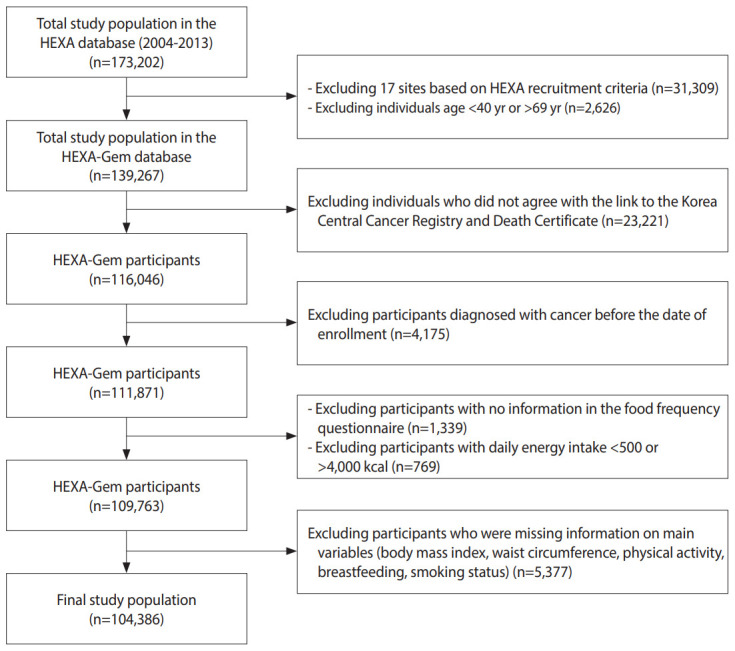
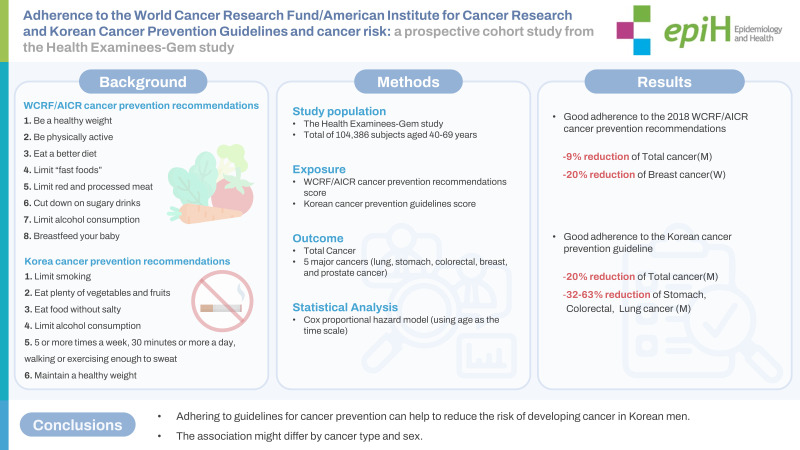
Methods: In total, 104,386 individuals aged 40-69 years old who were recruited between 2004 and 2013 in the Health Examinees-Gem study were included. Adherence scores were constructed based on 8 items from the World Cancer Research Fund/American Institute for Cancer Research (WCRF/AICR) cancer prevention recommendations, including body weight, physical activity, diet, alcohol consumption and breastfeeding, and on 6 items from the Korean cancer prevention guidelines (smoking status, eating vegetables and fruits, salty foods, alcohol intake, physical activity, and body weight). A Cox proportional hazards model was used to estimate the associations between adherence scores and the risk of total and 5 major cancers.
Results: The multivariable hazard ratio (HR) for total cancer with the high adherence score versus the lowest score (4.25-7.00 vs. 0.00-3.25) for the WCRF/AICR guidelines was 0.91 (95% confidence interval [CI], 0.82 to 1.00) in men. A reduced breast cancer risk was observed among women with the highest score. Men within the highest category of the Korean cancer prevention guideline score (3.25-6.00) had an HR of 0.80 (95% CI, 0.73 to 0.88) for developing total cancer compared to men within the lowest score (0.00-2.50). The higher adherence group among men showed lower risks of developing stomach, colorectal, and lung cancers.
Conclusions: Adhering to guidelines for cancer prevention can help to reduce the risk of developing cancer in Korean men. The association might differ by cancer type and gender.
Keywords: Cancer; Guideline; Korea.
Conflict of interest statement
The authors have no conflicts of interest to declare for this study.
Figures
References
-
- World Cancer Research Fund/American Institute for Cancer Research Diet, nutrition, physical activity and cancer: a global perspective: a summary of the third expert repot. 2018. [cited 2022 Sep 19]. Available from: https://www.wcrf.org/wp-content/uploads/2021/02/Summary-of-Third-Expert-....
-
- Doll R, Peto R. The causes of cancer: quantitative estimates of avoidable risks of cancer in the United States today. J Natl Cancer Inst. 1981;66:1191–1308. - PubMed
-
- Rock CL, Thomson C, Gansler T, Gapstur SM, McCullough ML, Patel AV, et al. American cancer society guideline for diet and physical activity for cancer prevention. CA Cancer J Clin. 2020;70:245–271. - PubMed
-
- Schüz J, Espina C, Villain P, Herrero R, Leon ME, Minozzi S, et al. European Code against cancer 4th edition: 12 ways to reduce your cancer risk. Cancer Epidemiol. 2015;39 Suppl 1:S1–S10. - PubMed
-
- Sasazuki S, Inoue M, Shimazu T, Wakai K, Naito M, Nagata C, et al. Evidence-based cancer prevention recommendations for Japanese. Jpn J Clin Oncol. 2018;48:576–586. - PubMed
MeSH terms
LinkOut - more resources
Full Text Sources
Medical
Research Materials