Dysthyroidism during immune checkpoint inhibitors is associated with improved overall survival in adult cancers: data mining of 1385 electronic patient records
- PMID: 37536938
- PMCID: PMC10401250
- DOI: 10.1136/jitc-2023-006786
Dysthyroidism during immune checkpoint inhibitors is associated with improved overall survival in adult cancers: data mining of 1385 electronic patient records
Abstract
Background: Dysthyroidism (DT) is a common toxicity of immune checkpoint inhibitors (ICIs) and prior work suggests that dysthyroidism (DT) might be associated with ICI efficacy.
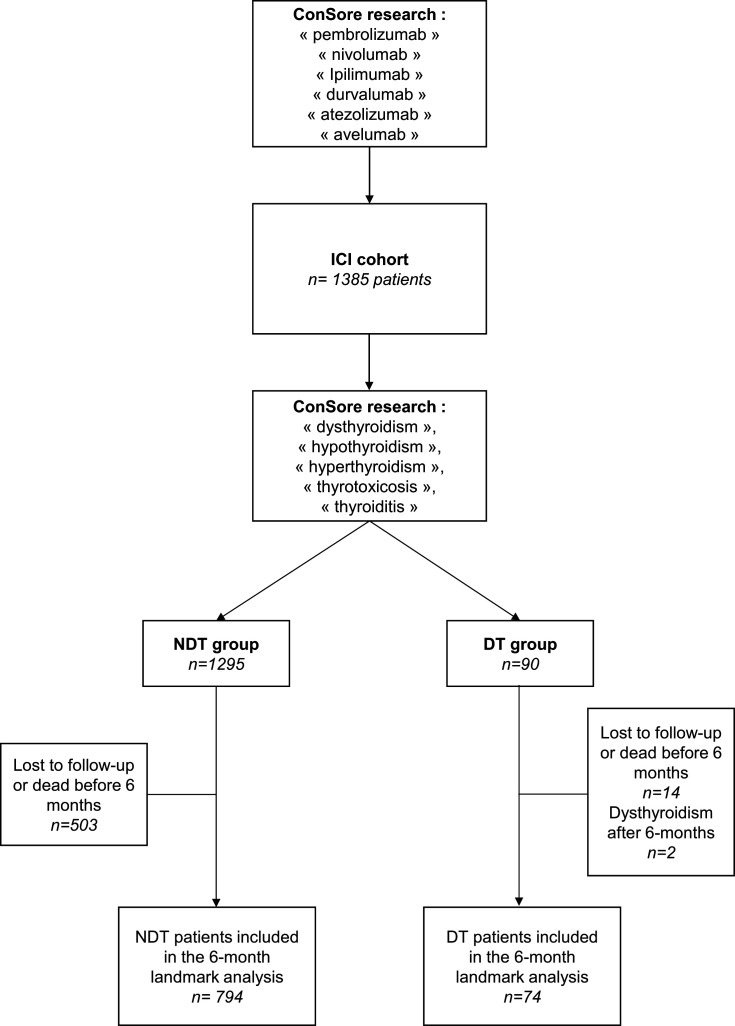
Patients and methods: ConSoRe, a new generation data mining solution, was used in this retrospective study, to extract data from electronic patient records of adult cancer patients treated with ICI at Institut Paoli-Calmettes (Marseille, France). Every DT was verified and only ICI-induced DT was retained. Survival analyses were performed by Kaplan-Meier method (log-rank test) and Cox model. To account for immortal time bias, a conditional landmark analysis was performed (2 months and 6 months), together with a time-varying Cox model.
Results: Data extraction identified 1385 patients treated with ICI between 2011 and 2021. DT was associated with improved overall survival (OS) (HR 0.46, (95% CI 0.33 to 0.65), p<0.001), with a median OS of 35.3 months in DT group vs 15.4 months in non-DT group (NDT). Survival impact of DT was consistent using a 6-month landmark analysis with a median OS of 36.7 months (95% CI 29.4 to not reported) in the DT group vs 25.5 months (95% CI 22.8 to 27.8) in the NDT group. In multivariate analysis, DT was independently associated with improved OS (HR 0.49, 95% CI 0.35 to 0.69, p=0.001). After adjustment in time-varying Cox model, this association remained significant (adjusted HR 0.64, 95% CI 0.45 to 0.90, p=0.010). Moreover, patients with DT and additional immune-related adverse event had increased OS compared with patients with isolated DT, with median OS of 38.8 months vs 21.4 months, respectively.
Conclusion: Data mining identified a large number of patients with ICI-induced DT, which was associated with improved OS accounting for immortal time bias.
Keywords: Immune Checkpoint Inhibitors; Immunotherapy.
© Author(s) (or their employer(s)) 2023. Re-use permitted under CC BY-NC. No commercial re-use. See rights and permissions. Published by BMJ.
Conflict of interest statement
Competing interests: Pr Olive is co-founder and shareholder of Imcheck Therapeutics, Alderaan Biotechnology and Emergence Therapeutics and has research funds from Imcheck Therapeutics, Alderaan Biotechnology, Cellectis and Emergence Therapeutics. PR reports funds to his institution from Novartis, BMS, and Consultant/Advisory Board from AstraZeneca and GSK. AEL reports the following: Company: Boston Scientific, Immediate family member (wife); Stock (<5% equity), Company: Boston Scientific, Immediate family member (wife); Commercial Research Grants: Daiichi Sankyo, Calithera, Biosciences, AstraZeneca, DracenPharmaceuticals, WindMIL, eFFECTOR Therapeutics; Compensated Consultant/Advisory Board : AstraZeneca, Bristol-Myers Squibb, Leica Biosystems, Jazz Pharmaceuticals, Novocure, Pfizer, MorphoSys, Eli-Lilly, Oncocyte, Novartis; Regeneron, Janssen oncology, Sanofi group of companies, G1 Therapeutics, Molecular Axiom, Amgen, IQVIA.
Figures


References
-
- Cortes J, Cescon DW, Rugo HS, et al. Pembrolizumab plus chemotherapy versus placebo plus chemotherapy for previously untreated locally recurrent inoperable or metastatic triple-negative breast cancer (KEYNOTE-355): a randomised, placebo-controlled, double-blind, phase 3 clinical trial. Lancet 2020;396:1817–28. 10.1016/S0140-6736(20)32531-9 - DOI - PubMed
Publication types
MeSH terms
Substances
Grants and funding
LinkOut - more resources
Full Text Sources
Medical