. 2023 Aug 3;14(8):495.
doi: 10.1038/s41419-023-06027-0.

FDW028, a novel FUT8 inhibitor, impels lysosomal proteolysis of B7-H3 via chaperone-mediated autophagy pathway and exhibits potent efficacy against metastatic colorectal cancer

Affiliations

FDW028, a novel FUT8 inhibitor, impels lysosomal proteolysis of B7-H3 via chaperone-mediated autophagy pathway and exhibits potent efficacy against metastatic colorectal cancer

Mengmeng Wang et al. Cell Death Dis. .

Abstract

Metastatic colorectal cancer (mCRC) is a major cause of cancer-related mortality due to the absence of effective therapeutics. Thus, it is urgent to discover new drugs for mCRC. Fucosyltransferase 8 (FUT8) is a potential therapeutic target with high level in most malignant cancers including CRC. FUT8 mediates the core fucosylation of CD276 (B7-H3), a key immune checkpoint molecule (ICM), in CRC. FUT8-silence-induced defucosylation at N104 on B7-H3 attracts heat shock protein family A member 8 (HSPA8, also known as HSC70) to bind with 106-110 SLRLQ motif and consequently propels lysosomal proteolysis of B7-H3 through the chaperone-mediated autophagy (CMA) pathway. Then we report the development and characterization of a potent and highly selective small-molecule inhibitor of FUT8, named FDW028, which evidently prolongs the survival of mice with CRC pulmonary metastases (CRPM). FDW028 exhibits potent anti-tumor activity by defucosylation and impelling lysosomal degradation of B7-H3 through the CMA pathway. Taken together, FUT8 inhibition destabilizes B7-H3 through CMA-mediated lysosomal proteolysis, and FDW028 acts as a potent therapeutic candidate against mCRC by targeting FUT8. FDW028, an inhibitor specifically targeted FUT8, promotes defucosylation and consequent HSC70/LAMP2A-mediated lysosomal degradation of B7-H3, and exhibits potent anti-mCRC activities.


Conflict of interest statement

The authors declare no competing interests.

Figures
None
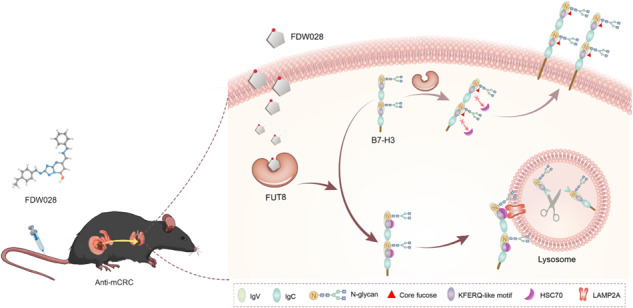
FDW028, an inhibitor specifically targeted FUT8, promotes defucosylation and consequent HSC70/LAMP2A-mediated lysosomal degradation of B7-H3, and exhibits potent anti-mCRC activities.
Fig. 1
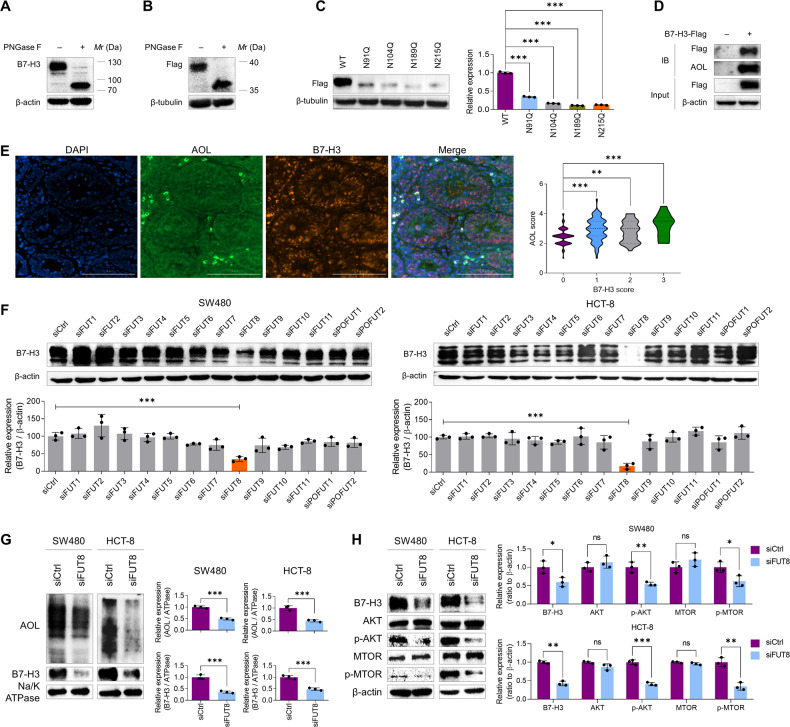
Fig. 1. B7-H3 is N-glycosylated and core fucosylated in CRC cells.
A Immunoblots of B7-H3 treated with or without PNGase F at 37 °C for 3 h. B Immunoblots of truncated B7-H3 containing the first IgV-IgC domain (aa1-258) treated with or without PNGase F at 37 °C for 3 h. C Immunoblots of truncated B7-H3 containing N91Q, N104Q, N189Q or N215Q mutation. D AOL blot of Flag-B7-H3 immunoprecipitated by anti-Flag beads. E IHC stains of AOL and B7-H3 in CRC tissues. F Immunoblots of B7-H3 in SW480 and HCT-8 cells upon knockdown of each fucosyltransferase. G Immunoblots of membranous AOL and B7-H3 in SW480 and HCT-8 cells upon FUT8 knockdown. H Immunoblots of B7-H3 and its downstream AKT/MTOR pathway molecules in SW480 and HCT-8 cells upon FUT8 knockdown. All experiments were performed in technical triplicates and are displayed as mean ± s.d.; ns no significance; *P < 0.05, **P < 0.01, ***P < 0.001.
Fig. 2
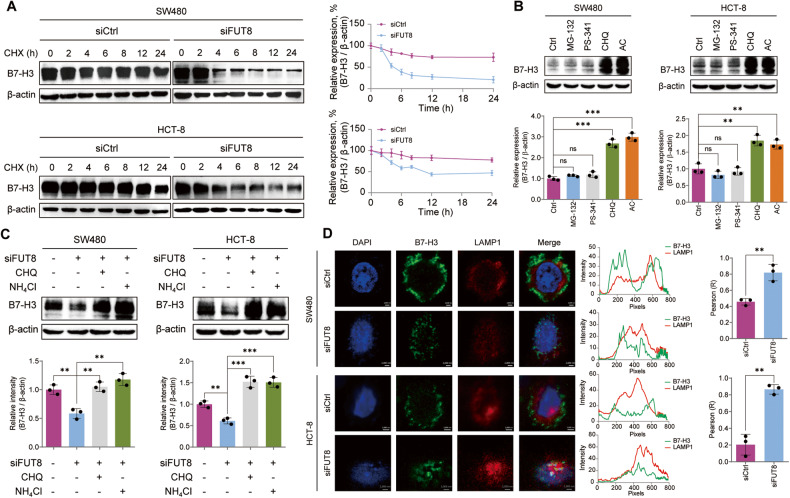
Fig. 2. Defucosylation-promoted lysosomal degradation of B7-H3.
A Immunoblots of B7-H3 protein in SW480 and HCT-8 cells that were treated with 100 μM CHX for the indicated time after FUT8 knockdown or not. B Immunoblots of B7-H3 protein in SW480 and HCT-8 cells that were treated with MG-132 (20 μM), PS-341 (50 nM), CHQ (50 μM), and AC (100 μM), respectively. C Immunoblots of B7-H3 protein in SW480 and HCT-8 cells that were treated with CHQ (50 μM) or AC (100 μM) after FUT8 knockdown. D Immunofluorescence shows the colocalization of B7-H3 and LAMP1 upon FUT8 knockdown. The intensity profiles of B7-H3 and LAMP1 are plotted in the middle panel. The statistical results of colocalization factor (Pearson’s R value) are shown on the right panel. All experiments were performed in technical triplicates and are displayed as mean ± s.d.; ns no significance; **P < 0.01, ***P < 0.001.
Fig. 3
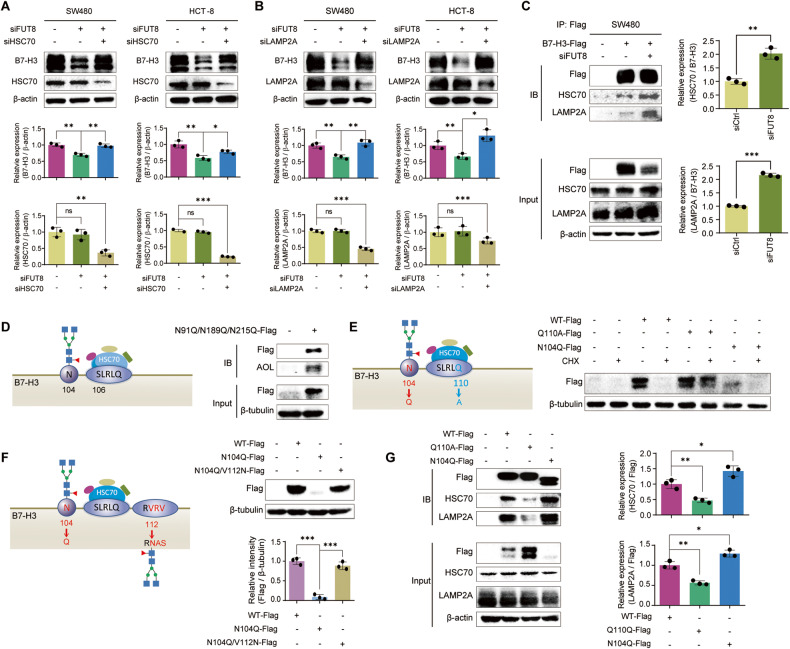
Fig. 3. Defucosylation-promoted CMA degradation of B7-H3.
A Immunoblots of B7-H3 protein in SW480 and HCT-8 cells after knockdown of FUT8 and / or HSC70. B Immunoblots of B7-H3 protein in SW480 and HCT-8 cells after knockdown of FUT8 and / or LAMP2A. C Co-IP assays showed the effects of FUT8 knockdown on the interaction between B7-H3 and HSC70 or LAMP2A. D Schematics of truncated B7-H3 (aa 1-258) with the N104 glycosylation site and 106-110SLRLQ motif for HSC70 binding, and AOL blots of the co-IP B7-H3 protein with wildtype N104 and N91Q/N189Q/N215Q mutations. E Schematics of truncated B7-H3 (aa 1-258) with N104Q or Q110A mutation, and immunoblots of truncated B7-H3 in SW480 cells that were treated with 100 μM CHX after transfection of B7-H3 expression plasmids containing N104Q or Q110A mutation. F Schematics of truncated B7-H3 (aa 1-258) with N104Q or VRV112-114NAS mutation, and immunoblots of truncated B7-H3 containing N104Q and / or VRV112-114NAS mutation in SW480 cells. G Co-IP assays showed the interaction between the truncated B7-H3 containing N104Q or Q110A mutation and HSC70 or LAMP2A. All experiments were performed in technical triplicates and are displayed as mean ± s.d.; ns no significance; *P < 0.05, **P < 0.01, ***P < 0.001.
Fig. 4
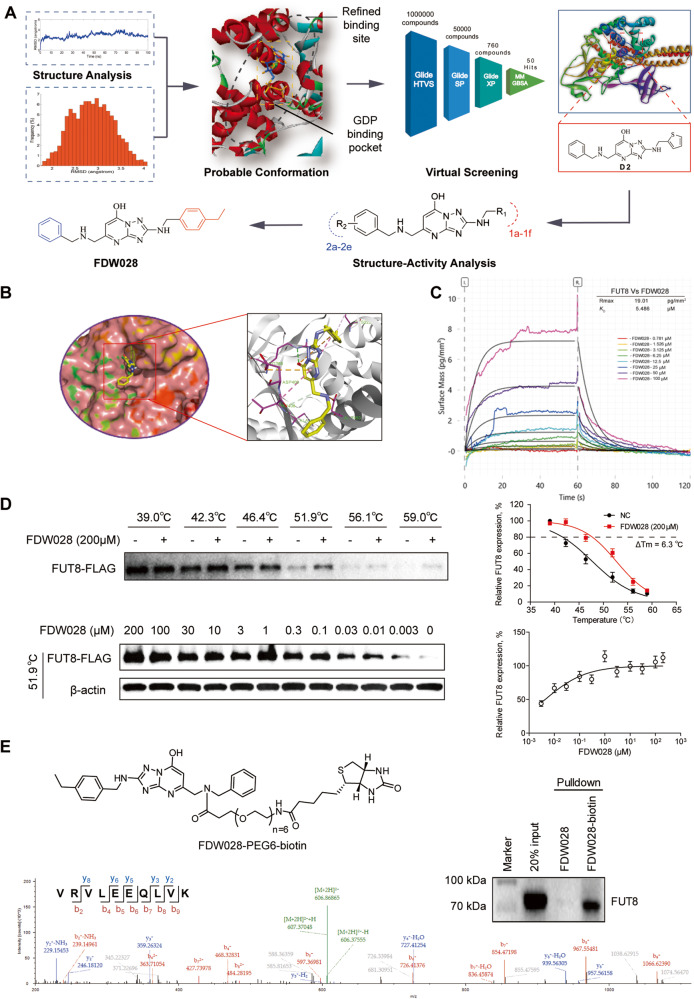
Fig. 4. Discovery of FUT8 inhibitor FDW028.
A Strategies for [1, 2, 4] triazolo [1,5-a] pyrimidin-7-ol skeleton discovery. B Docking prediction of FDW028 binding to FUT8. C Binding kinetics for FUT8 versus FDW028 obtained from GCI experiments. Sensograms are shown in multiple color with the respective fits in black, and include table summaries of the dissociation constant KD. D Protein thermal shift assay curves for FUT8 with 200 μM FDW028 at gradient temperatures from 39.0 to 59.0 °C (up), or with the indicated concentration of FDW028 at 51.9 °C [45]. E The immunoblots (up) and LC–MS/MS spectrum [45] of FUT8 that was pulled down by FDW028-biotin. The structure of FDW028-biotin is also shown.
Fig. 5
Fig. 5. Anti-CRC activities of FDW028.
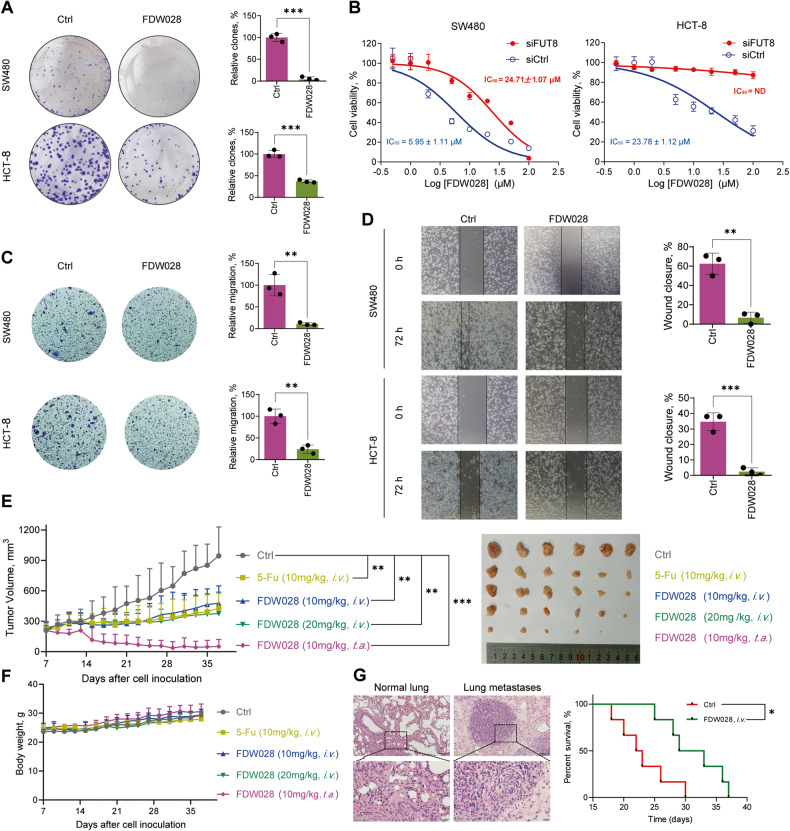
A The colony formation abilities of SW480 and HCT-8 cells treated with FDW028 at 50 μM for 14 days. B The viabilities of SW480 and HCT-8 cells upon the treatment of FDW028 at the indicated concentrations for 72 h, with or without FUT8 knockdown. Transwell assays (C) and wound-healing assays (D) for showing the migration abilities of SW480 and HCT-8 cells treated with FDW028 at 50 μM for 72 h. E Growth curves and photos of SW480 xenografts treated with FDW028 (10 or 20 mg/kg) or 5-Fu (10 mg/kg). F The body weights of tumor-bearing mice with the administration of FDW028 or 5-Fu. G The survival of CRPM mice after i.v. injection of FDW028 at 20 mg/kg once the other day. HE stains of the lung of normal and tumor-bearing mice are shown. i.v. intravenously; t.a. tumor-aside; *P < 0.05, **P < 0.01, ***P < 0.001.
Fig. 6
Fig. 6. FDW028 promoted defucosylation and CMA degradation of B7-H3.
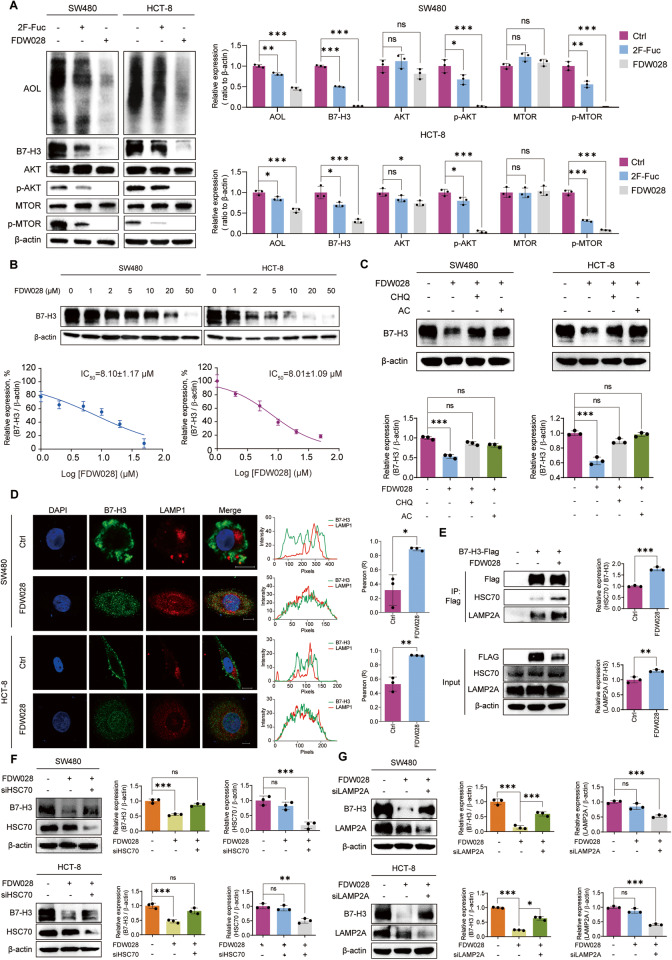
A Immunoblots of AOL, B7-H3, and AKT/MTOR pathway molecules in SW480 and HCT-8 cells treated with FDW028 or 2F-Fuc at 50 μM for 72 h. B Immunoblots of B7-H3 in SW480 and HCT-8 cells treated with FDW028 at the indicated concentrations for 72 h. C Immunoblots of B7-H3 in SW480 and HCT-8 cells after the treatment of FDW028 (50 μM) with or without following CHQ (50 μM) or AC (100 μM). D Immunofluorescence shows the colocalization of B7-H3 and LAMP1 upon the treatment of FDW028. The intensity profiles of B7-H3 and LAMP1 are plotted in the middle panel. The statistical results of colocalization factor (Pearson’s R value) are shown on the right panel. E Co-IP assays showed the effects of FDW028 on the interaction between B7-H3 and HSC70 or LAMP2A. F Immunoblots of B7-H3 in SW480 and HCT-8 cells treated by FDW028 (50 μM) with or without HSC70 siRNA for 72 h. G Immunoblots of B7-H3 in SW480 and HCT-8 cells treated by FDW028 (50 μM) with or without LAMP2A siRNA for 72 h. All experiments were performed in technical triplicates and are displayed as mean ± s.d.; ns no significance; *P < 0.05, **P < 0.01, ***P < 0.001.
Fig. 7
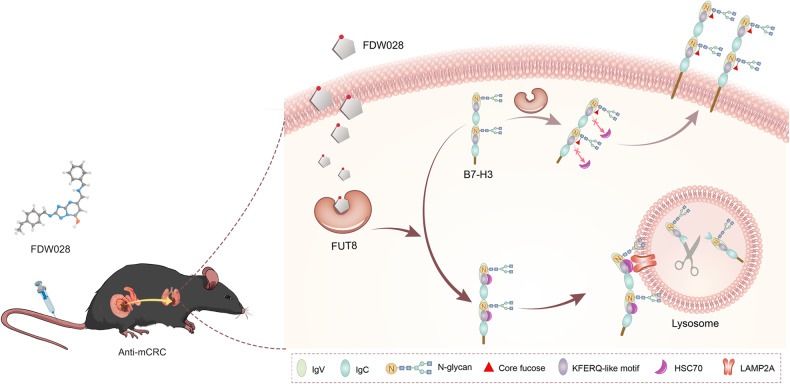
Fig. 7. Schematic diagram showing the pharmacological mechanism of FDW028.
FDW028, an inhibitor specifically targeted FUT8, promotes defucosylation and consequent HSC70/LAMP2A-mediated lysosomal degradation of B7-H3, and exhibits potent anti-mCRC activities.

References

    1. Siegel RL, Miller KD, Fuchs HE, Jemal A. Cancer statistics, 2022. CA Cancer J Clin. 2022;72:7–33. doi: 10.3322/caac.21708. - DOI - PubMed
    1. Ciardiello F, Ciardiello D, Martini G, Napolitano S, Tabernero J, Cervantes A. Clinical management of metastatic colorectal cancer in the era of precision medicine. CA Cancer J Clin. 2022;72:372–401. doi: 10.3322/caac.21728. - DOI - PubMed
    1. Zhang S, Sun K, Zheng R, Zeng H, He J. Cancer incidence and mortality in China, 2015. J Natl Cancer Cent. 2021;1:2–11. doi: 10.1016/j.jncc.2020.12.001. - DOI - PMC - PubMed
    1. Akimoto N, Ugai T, Zhong R, Hamada T, Fujiyoshi K, Giannakis M, et al. Rising incidence of early-onset colorectal cancer - a call to action. Nat Rev Clin Oncol. 2021;18:230–43. doi: 10.1038/s41571-020-00445-1. - DOI - PMC - PubMed
    1. Pinho SS, Reis CA. Glycosylation in cancer: mechanisms and clinical implications. Nat Rev Cancer. 2015;15:540–55. doi: 10.1038/nrc3982. - DOI - PubMed

Publication types