. 2023 Aug 3;13(1):12581.
doi: 10.1038/s41598-023-39440-8.

Gender disparities in lung cancer incidence in the United States during 2001-2019

Affiliations

Gender disparities in lung cancer incidence in the United States during 2001-2019

Yu Fu et al. Sci Rep. .

Abstract

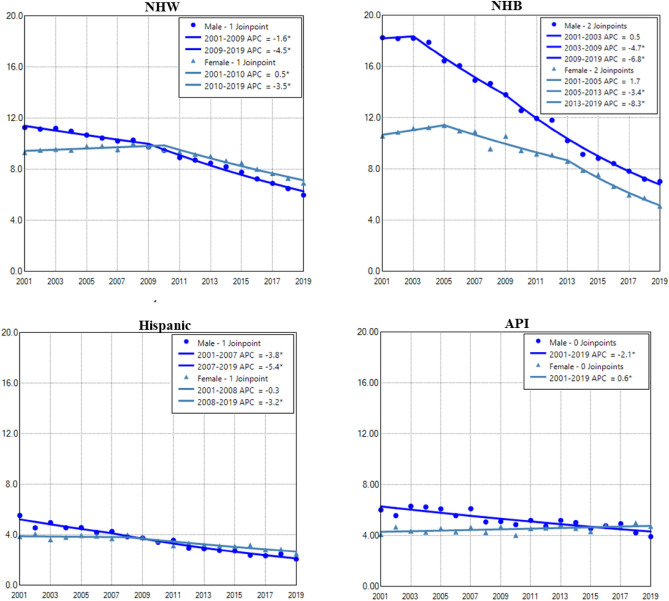
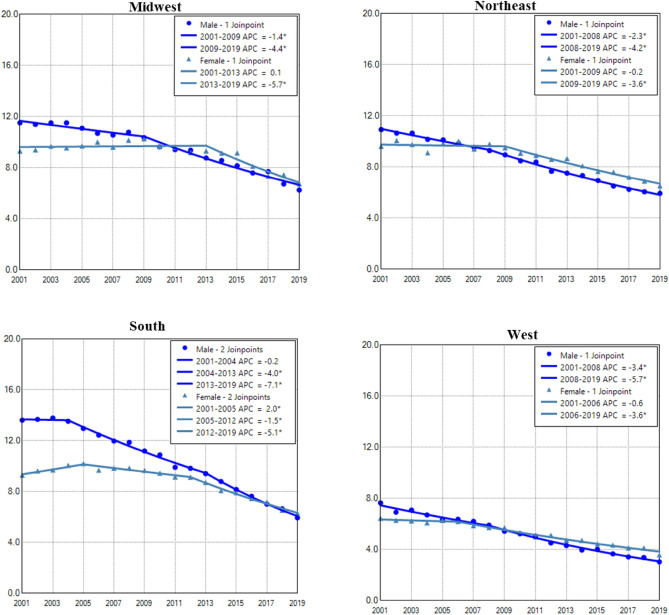
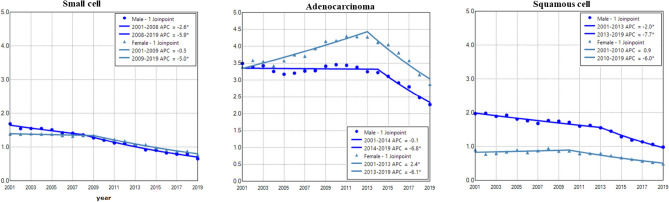
Lung cancer ranks as one of the top malignancies and the leading cause of cancer death in both males and females in the US. Using a cancer database covering the entire population, this study was to determine the gender disparities in lung cancer incidence during 2001-2019. Cancer patients were obtained from the National Program of Cancer Registries (NPCR) and Surveillance, Epidemiology and End Results (SEER) database. The SEER*Stat software was applied to calculate the age-adjusted incidence rates (AAIR). Temporal changes in lung cancer incidence were analyzed by the Joinpoint software. A total of 4,086,432 patients (53.3% of males) were diagnosed with lung cancer. Among them, 52.1% were 70 years or older, 82.7% non-Hispanic white, 39.7% from the South, and 72.6% non-small cell lung cancer (NSCLC). The AAIR of lung cancer continuously reduced from 91.0 per 100000 to 59.2 in males during the study period, while it increased from 55.0 in 2001 to 56.8 in 2006 in females, then decreased to 48.1 in 2019. The female to male incidence rate ratio of lung cancer continuously increased from 2001 to 2019. Gender disparities were observed among age groups, races, and histological types. In those aged 0-54 years, females had higher overall incidence rates of lung cancer than males in recent years, which was observed in all races (except non-Hispanic black), all regions, and adenocarcinoma and small cell (but not squamous cell). Non-Hispanic black females aged 0-54 years had a faster decline rate than males since 2013. API females demonstrated an increased trend during the study period. Lung cancer incidence continues to decrease with gender disparities among age groups, races, regions, and histological types. Continuous anti-smoking programs plus reduction of related risk factors are necessary to lower lung cancer incidence further.


Conflict of interest statement

The authors declare no competing interests.

Figures
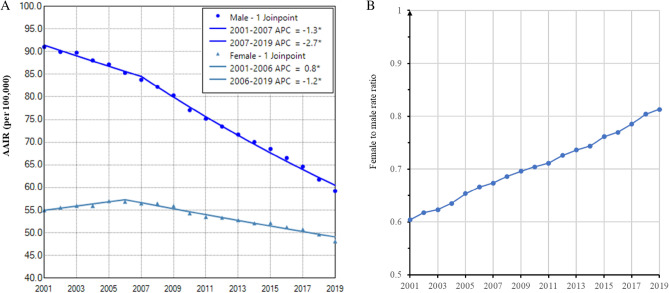
Figure 1
Figure 1
Temporal change of lung cancer incidence by gender during 2001–2019. (A). Change in AAIR by gender. (B). Female to male rate ratios of lung cancer incidence rate. AAIR: age adjusted incidence rate; APC: annual percentage change. *Indicates a significant change in APC.
Figure 2
Figure 2
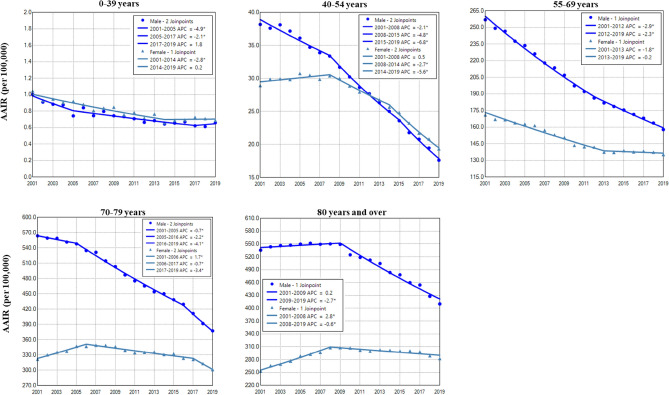
Temporal change of age adjusted incidence rate (AAIR) of lung cancer in males and females by age group during 2001–2019. AAIR: age adjusted incidence rate; APC: annual percentage change. *Indicates a significant change.
Figure 3
Figure 3
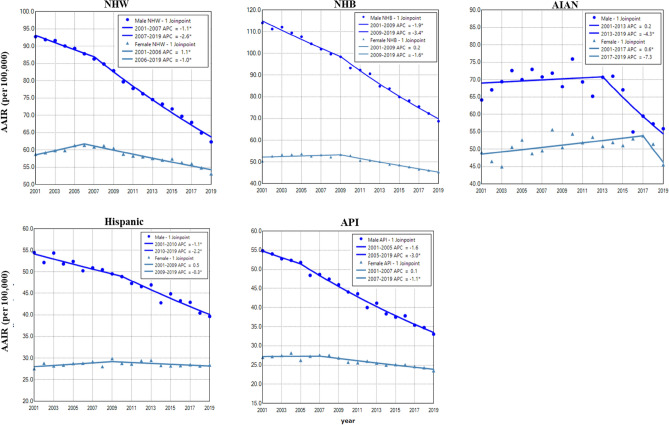
Temporal change of age adjusted incidence rate of lung cancer in males and females by race during 2001–2019. AAIR: age adjusted incidence rate; APC: annual percentage change. AIAN: non-Hispanic American Indian and Alaska Native; API: non-Hispanic Asian or Pacific Islander; NHB: non-Hispanic black; NHW: non-Hispanic white. *Indicates a significant change.
Figure 4
Figure 4
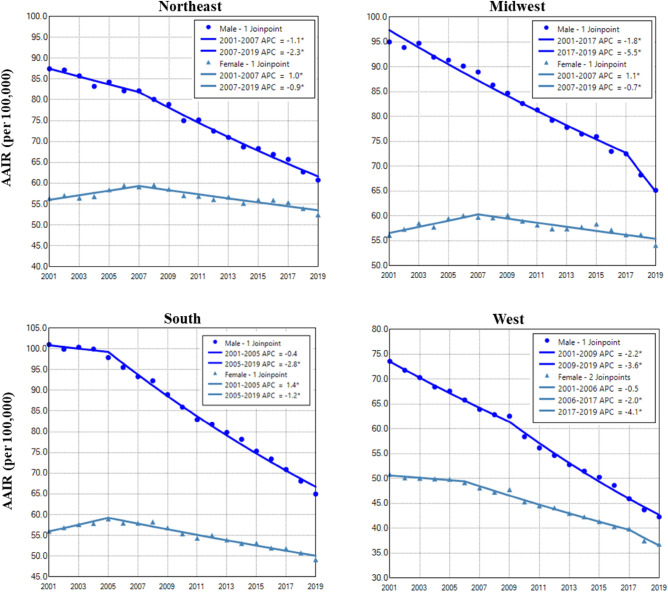
Temporal change of age adjusted incidence of lung cancer in males and females by region during 2001–2019. AAIR: age adjusted incidence rate; APC: annual percentage change. *Indicates a significant change in APC.
Figure 5
Figure 5
Temporal change of age adjusted incidence of lung cancer in males and females by histological type during 2001–2019. AAIR: age adjusted incidence rate; APC: annual percentage change. *Indicates a significant change in APC.
Figure 6
Figure 6
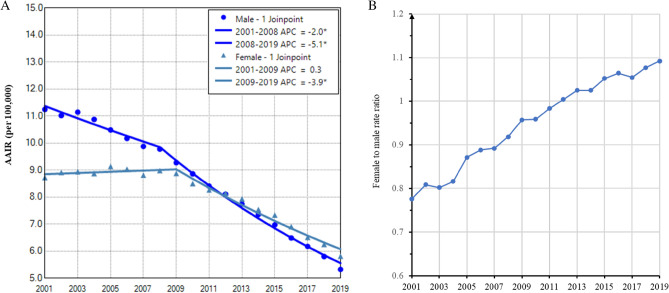
Temporal change of age adjusted incidence of lung cancer by gender in those aged 0–54 years during 2001–2019. (A). Change in AAIR by gender. (B). Female to male rate ratio of lung cancer incidence rate. AAIR: age adjusted incidence rate; APC: annual percentage change. *Indicates a significant change in APC.
Figure 7
Figure 7
Temporal change of age adjusted incidence of lung cancer in males and females aged 0–54 years by race during 2001–2019. AAIR, age adjusted incidence rate. APC, annual percentage change. *Indicates a significant change in APC.
Figure 8
Figure 8
Temporal change of age adjusted incidence of lung cancer in males and females aged 0–54 years by region during 2001–2019. AAIR, age adjusted incidence rate; APC: annual percentage change. *Indicates a significant change in APC.
Figure 9
Figure 9
Temporal change of age adjusted incidence of lung cancer in males and females aged 0–54 years by histological type during 2001–2019. AAIR: age adjusted incidence rate; APC: annual percentage change. *Indicates a significant change in APC.

References

    1. Siegel RL, Miller KD, Wagle NS, Jemal A. Cancer statistics, 2023. CA Cancer J. Clin. 2023;73:17–48. doi: 10.3322/caac.21763. - DOI - PubMed
    1. Lewis DR, Check DP, Caporaso NE, Travis WD, Devesa SS. US lung cancer trends by histologic type. Cancer. 2014;120:2883–2892. doi: 10.1002/cncr.28749. - DOI - PMC - PubMed
    1. Houston KA, Henley SJ, Li J, White MC, Richards TB. Patterns in lung cancer incidence rates and trends by histologic type in the United States, 2004–2009. Lung Cancer. 2014;86:22–28. doi: 10.1016/j.lungcan.2014.08.001. - DOI - PMC - PubMed
    1. Patel MI, et al. Lung cancer incidence trends in California by race/ethnicity, histology, sex, and neighborhood socioeconomic status: An analysis spanning 28 years. Lung Cancer. 2017;108:140–149. doi: 10.1016/j.lungcan.2017.03.014. - DOI - PubMed
    1. Tabatabai MA, et al. Racial and gender disparities in incidence of lung and bronchus cancer in the United States: A longitudinal analysis. PLoS One. 2016;11:e0162949. doi: 10.1371/journal.pone.0162949. - DOI - PMC - PubMed

Publication types