


Determining factors affecting the user's intention to disclose privacy in online health communities: a dual-calculus model
- PMID: 37538265
- PMCID: PMC10394383
- DOI: 10.3389/fpubh.2023.1109093
Determining factors affecting the user's intention to disclose privacy in online health communities: a dual-calculus model
Abstract
Background: As a new type of medical service application for doctor-patient interaction, online health communities (OHCs) have alleviated the imbalance between the supply and demand of medical resources in different regions and the problems of "difficult and expensive access to medical care", but also raised the concern of patients about the risk of disclosure of their health privacy information.
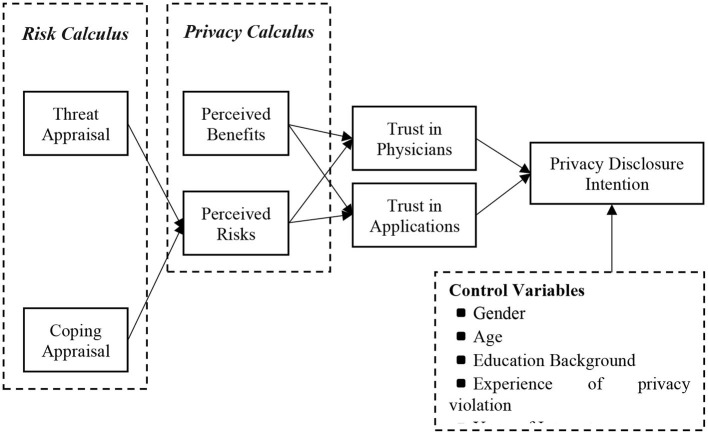
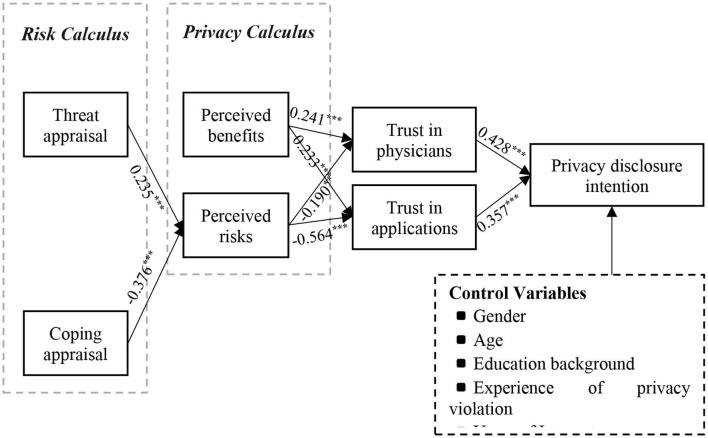
Methods: In this study, a dual-calculus model was developed to explore users' motivation and decision-making mechanism in disclosing privacy information in OHCs by combining risk calculus and privacy calculus theories.
Results: In OHCs, users' trust in physicians and applications is a prerequisite for their willingness to disclose health information. Meanwhile, during the privacy calculation, users' perceived benefits in OHCs had a positive effect on both trust in doctors and trust in applications, while perceived risks had a negative effect on both trusts in doctors and trust in applications. Furthermore, in the risk calculation, the perceived threat assessment in OHCs had a significant positive effect on perceived risk, while the response assessment had a significant negative effect on perceived risk, and the effect of users' trust in physicians far exceeded the effect of trust in applications. Finally, users' trust in physicians/applications is a mediating effect between perceived benefits/risks and privacy disclosure intentions.
Conclusion: We combine risk calculus and privacy calculus theories to construct a dual-calculus model, which divides trust into trust in physicians and trust in applications, in order to explore the intrinsic motivation and decision-making mechanism of users' participation in privacy disclosure in OHCs. On the one hand, this theoretically compensates for the fact that privacy computing often underestimates perceived risk, complements the research on trust in OHCs, and reveals the influencing factors and decision transmission mechanisms of user privacy disclosure in OHCs. On the other hand, it also provides guidance for developing reasonable privacy policies and health information protection mechanisms for platform developers of OHCs.
Keywords: dual-calculus model; online health communities; privacy calculus; privacy disclosure; risk calculus.
Copyright © 2023 Sun, Zang, Wang, Ge, Liu and Wang.
Conflict of interest statement
The authors declare that the research was conducted in the absence of any commercial or financial relationships that could be construed as a potential conflict of interest.
Figures
References
-
- National HC . China Health Statistics Yearbook 2021. China: Peking Union Medical College Press. (2021).
-
- Zhang J, Luximon Y, Li Q. Seeking medical advice in mobile applications: How social cue design and privacy concerns influence trust and behavioral intention in impersonal patient–physician interactions. Comput Hum Behav. (2022) 130:107178. 10.1016/j.chb.2021.107178 - DOI
-
- Bansal G, Gefen D. The impact of personal dispositions on information sensitivity, privacy concern and trust in disclosing health information online. Decis Support Syst. (2010) 49:138–50. 10.1016/j.dss.2010.01.010 - DOI
Publication types
MeSH terms
LinkOut - more resources
Full Text Sources
Research Materials
