. 2023 Aug 4;21(1):291.
doi: 10.1186/s12916-023-02920-9.

Neurodevelopmental risk and adaptation as a model for comorbidity among internalizing and externalizing disorders: genomics and cell-specific expression enriched morphometric study

Affiliations

Neurodevelopmental risk and adaptation as a model for comorbidity among internalizing and externalizing disorders: genomics and cell-specific expression enriched morphometric study

Nanyu Kuang et al. BMC Med. .

Abstract

Background: Comorbidity is the rule rather than the exception for childhood and adolescent onset mental disorders, but we cannot predict its occurrence and do not know the neural mechanisms underlying comorbidity. We investigate if the effects of comorbid internalizing and externalizing disorders on anatomical differences represent a simple aggregate of the effects on each disorder and if these comorbidity-associated cortical surface differences relate to a distinct genetic underpinning.

Methods: We studied the cortical surface area (SA) and thickness (CT) of 11,878 preadolescents (9-10 years) from the Adolescent Brain and Cognitive Development Study. Linear mixed models were implemented in comparative and association analyses among internalizing (dysthymia, major depressive disorder, disruptive mood dysregulation disorder, agoraphobia, panic disorder, specific phobia, separation anxiety disorder, social anxiety disorder, generalized anxiety disorder, post-traumatic stress disorder), externalizing (attention-deficit/hyperactivity disorder, oppositional defiant disorder, conduct disorder) diagnostic groups, a group with comorbidity of the two and a healthy control group. Genome-wide association analysis (GWAS) and cell type specificity analysis were performed on 4468 unrelated European participants from this cohort.

Results: Smaller cortical surface area but higher thickness was noted across patient groups when compared to controls. Children with comorbid internalizing and externalizing disorders had more pronounced areal reduction than those without comorbidity, indicating an additive burden. In contrast, cortical thickness had a non-linear effect with comorbidity: the comorbid group had no significant CT differences, while those patient groups without comorbidity had significantly higher thickness compare to healthy controls. Distinct biological pathways were implicated in regional SA and CT differences. Specifically, CT differences were associated with immune-related processes implicating astrocytes and oligodendrocytes, while SA-related differences related mainly to inhibitory neurons.

Conclusion: The emergence of comorbidity across distinct clusters of psychopathology is unlikely to be due to a simple additive neurobiological effect alone. Distinct developmental risk moderated by immune-related adaptation processes, with unique genetic and cell-specific factors, may contribute to underlying SA and CT differences. Children with the highest risk but lowest resilience, both captured in their developmental morphometry, may develop a comorbid illness pattern.

Keywords: Cortical surface area; Developmental; GWAS; Resilience; Thickness.


Conflict of interest statement

LP reports personal fees from Janssen Canada; Otsuka Canada; SPMM Course Limited, UK; Canadian Psychiatric Association; book royalties from Oxford University Press; and investigator-initiated educational grants from Janssen Canada, Sunovion, and Otsuka Canada outside the submitted work. All other authors report no biomedical financial interests or potential conflicts of interest. None of the above-listed companies or funding agencies has had any influence on the content of this article.

Figures
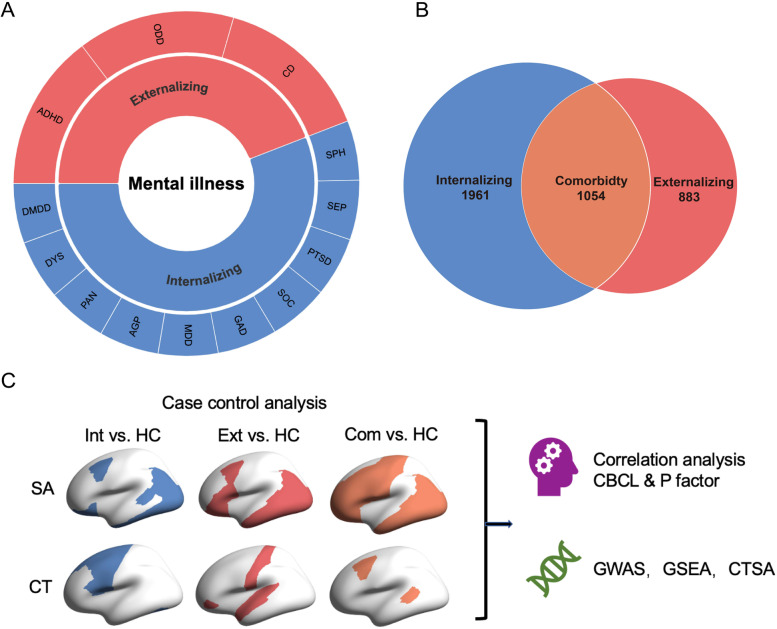
Fig. 1
Fig. 1
Components and comorbidity of externalizing and internalizing disorders. A Thirteen mental disorders (outer circle) were classified into two transdiagnostic categories (inner circle), i.e., externalizing and internalizing disorders. B Venn diagram depicting the overlap between the 2 transdiagnostic categories. Pure subsets of two transdiagnostic categories: externalizing disorder, red; internalizing disorder, blue. Comorbid between internalizing and externalizing disorders, orange. Children with thought disorder have been eliminated from membership of either external disorder or internal disorder. C An overview of all analysis. Abbreviations: ADHD, attention deficit hyperactivity disorder; CD, conduct disorder; ODD, oppositional defiant disorder; MDD, major depressive disorder; GAD, generalized anxiety disorder; SOC, social anxiety disorder; SEP, separation anxiety disorder; PTSD, post-traumatic stress disorder; AGP, agoraphobia; SPH, specific phobia; PAN, panic disorder; DYS, dysthymia; DMDD, disruptive mood dysregulation disorder; DEL, delusions; SA, surface area; CT, cortical thickness; Int, internalizing disorders; Ext, externalizing disorders; Com, comorbid between internalizing and externalizing disorders; HC, healthy control; CBCL, Child Behavior Checklist; GWAS, genome-wide association study; GSEA, gene set enrichment analysis; CTSA, cell type specificity analysis
Fig. 2
Fig. 2
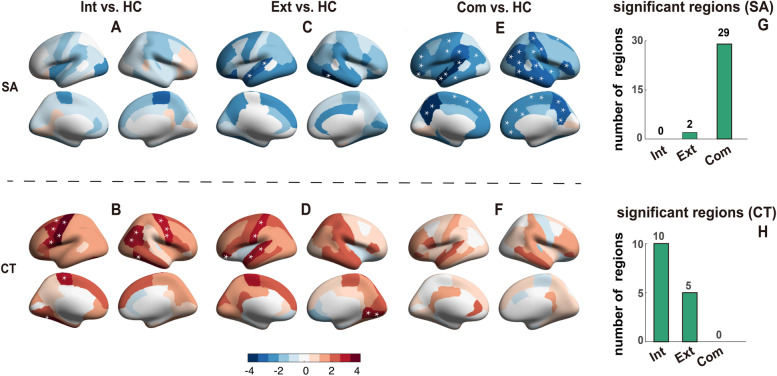
Brain regions with significant morphological alterations compared to the healthy controls in externalizing disorders group, internalizing disorders group, and the comorbidity group. The brain regions with significant morphological differences compared to the healthy controls in externalizing disorders group (A, B), internalizing disorders group (C, D), and comorbidity (E, F) in terms of cortical surface area (A, C, E) and cortical thickness (B, D, F). The color bars in AF represent the t value of the regression coefficient of the group variable from the linear mixed model (LMM). The regions with * represent p < 0.05, FDR corrected (FDR q = 0.05). The number of brain regions with significant alterations for each of the three transdiagnostic groups (externalizing, internalizing, and comorbidity groups) is shown for cortical surface area (G) and cortical thickness (H). Abbreviations: Int, internalizing disorders; Ext, externalizing disorders; Com, comorbid between internalizing and externalizing disorders; HC, healthy control
Fig. 3
Fig. 3
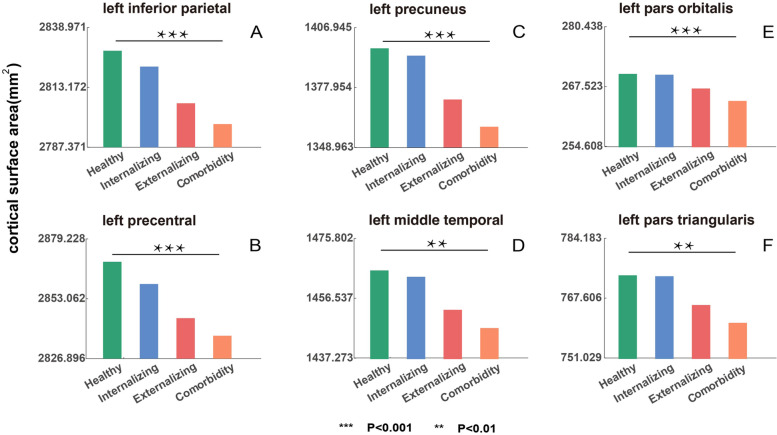
The comparison of mean cortical surface area (SA) in healthy controls, internalizing, externalizing, and comorbidity groups. The mean SA of controls, internalizing, externalizing, and comorbidity groups for regions with significant SA alterations in the comorbidity group (compared to controls). Only the top six regions with significant SA alterations in the comorbidity group were shown. Statistics of more brain regions can be found in Additional file 2: Table S8. The y-axis represents the mean SA. All p values passed FDR correction (FDR q = 0.05)
Fig. 4
Fig. 4
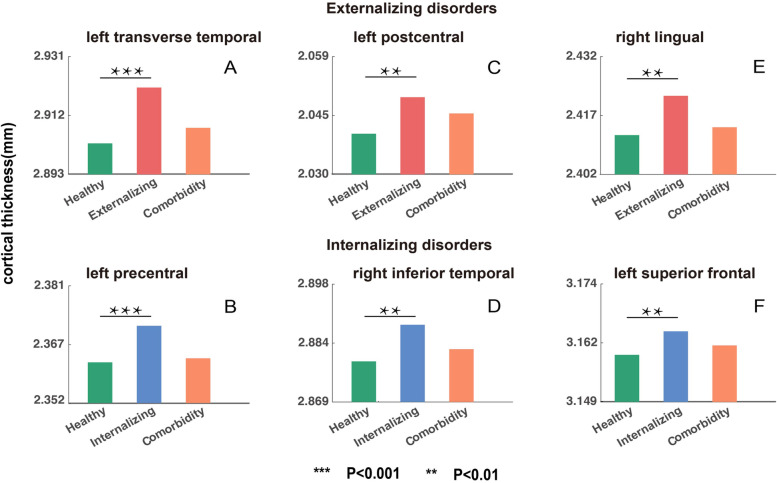
Comparison of regional cortical thickness (CT) in controls, internalizing, externalizing, and comorbidity groups. The mean CT of controls, externalizing, and comorbidity groups for regions with significant CT alterations in the externalizing group (compared to controls) (A, C, E). The mean CT of controls, internalizing, and comorbidity groups for the regions with significant CT alterations in the internalizing group (compared to controls) (B, D, F). Only the most significant 3 regions were shown for each disorder, with the rest of the brain regions shown in Additional file 2: Table S10. The y-axis represents the mean CT. All p values passed FDR correction (FDR q = 0.05)
Fig. 5
Fig. 5
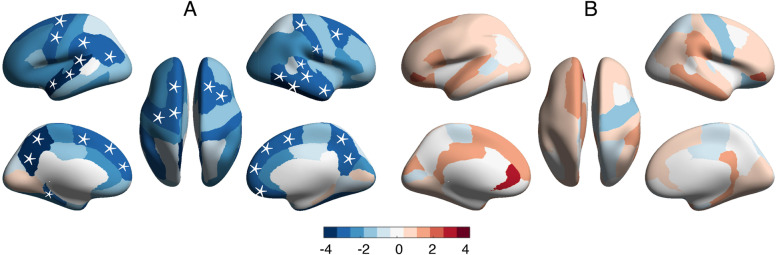
Correlation between 'p-factor' reflecting an overarching susceptibility to any mental disorder and SA and CT. Correlation between 'p-factor' and SA in comorbidity-specific regions (A) and correlation between p-factor and CT in externalizing-specific regions and internalizing-specific regions (B). The color bar represents the t value of the regression coefficient of the group variable from the linear mixed model (LMM). The asterisks (*) indicate p < 0.05, FDR correction (FDR q = 0.05)
Fig. 6
Fig. 6
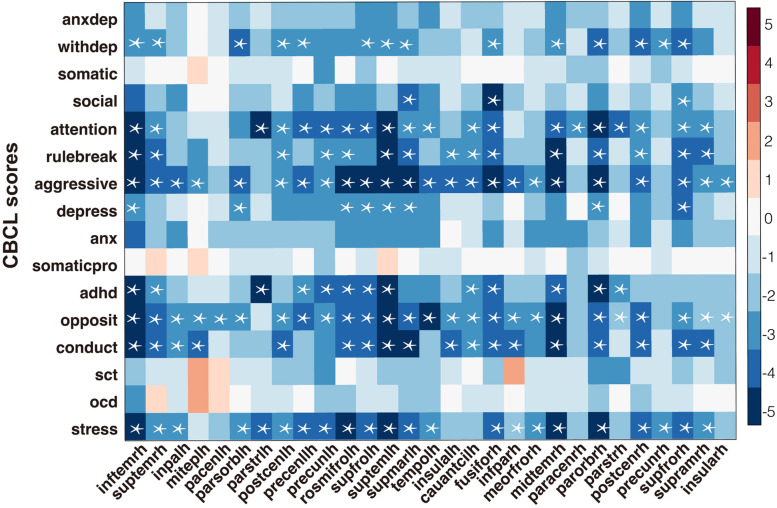
Associations between CBCL score and surface area of regions with significant alterations in patient groups. The color bar represents the t value of the regression coefficient from LMM. The asterisks (*) indicate p < 0.05, FDR correction (FDR q = 0.05). Abbreviations: AnxDep, anxious/depressed; WithDep, withdrawn/depressed; Somatic, somatic complaints; Social, social problems; Attention, attention problems; Rulebreak, rule-breaking behavior; Aggressive, aggressive behavior; Depress, depressive problems; Anx, anxiety disorders; Somaticpro, somatic problems; ADHD, attention deficit/hyperactivity problems; Opposit, oppositional defiant problems; Conduct, conduct problems; SCT, sluggish cognitive tempo; OCD, obsessive–compulsive problems; Stress, stress problems; inftemrh, right inferior temporal gyrus; suptemrh, right superior temporal gyrus; inpalh, left inferior parietal gyrus; miteplh, left middle temporal gyrus; pacenlh, left paracentral lobule; parsorblh, left pars orbitalis; parstrlh, left pars triangularis; postcenlh, left postcentral gyrus; precenllh, left precentral gyrus; precunlh, left precuneus; rosmifrolh, left rostral middle frontal gyrus; supfrolh, left superior frontal gyrus; suptemlh, left superior temporal gyrus; supmarlh, left supramarginal; tempolh, left temporal pole; insulalh, left insula; cauantcirh, right caudal anterior cingulate; fusiforh, right fusiform; infparh, right inferior parietal gyrus; meorfrorh, right medial orbito frontal gyrus; midtemrh, right middle temporal gyrus; paracenrh, right paracentral lobule; parorbrh, right pars orbitalis; parstrh, right pars triangularis; postcenrh, right postcentral gyrus; precunrh, right precuneus; supfrorh, right superior frontal gyrus; supramrh, right supramarginal; insularh, right insula
Fig. 7
Fig. 7
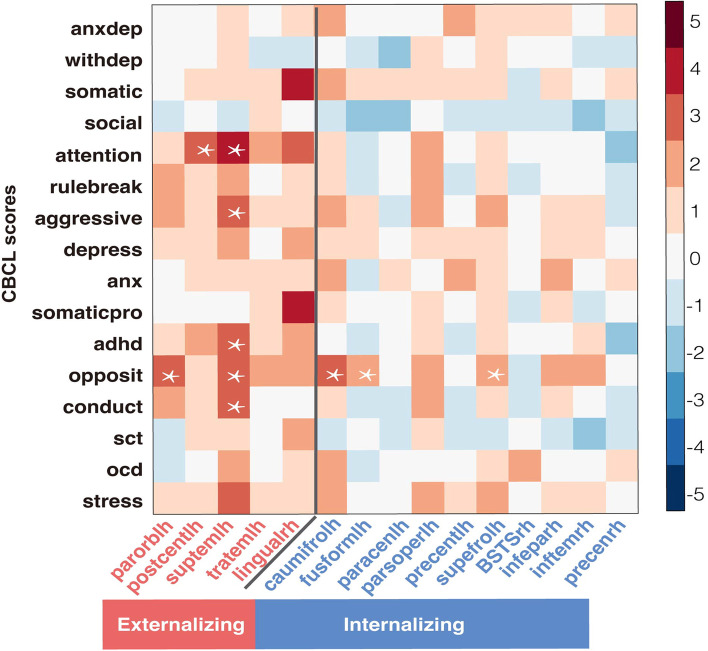
Associations between CBCL score and cortical thickness of regions with significant alterations in patient groups. The color bar represents the t value of the regression coefficient from LMM. The asterisks (*) indicate p < 0.05, FDR correction (FDR q = 0.05). Abbreviations: AnxDep, anxious/depressed; WithDep, withdrawn/depressed; Somatic, somatic complaints; Social, social problems; Attention, attention problems; Rulebreak, rule-breaking behavior; Aggressive, aggressive behavior; Depress, depressive problems; Anx, anxiety disorders; Somaticpro, somatic problems; ADHD, attention deficit/hyperactivity problems; Opposit, oppositional defiant problems; Conduct, conduct problems; SCT, sluggish cognitive tempo; OCD, obsessive–compulsive problems; Stress, stress problems; parorblh, left pars orbitalis; postcentlh, left postcentral gyrus; supetemlh, left superior temporal gyrus; lingualrh, right lingual; caumifrolh, left caudal middle frontal gyrus; fusformlh, left fusiform; paracenlh, left paracentral lobule; parsoperlh, left pars opercularis; precentlh, left precentral; supefrolh, left superior frontal gyrus; BSTSrh, right banks of superior temporal sulcus; infeparh, right inferior parietal gyrus; inftemrh, right inferior temporal gyrus; precenrh, right precentral gyrus

References

    1. Costello EJ, Mustillo S, Erkanli A, Keeler G, Angold A. Prevalence and development of psychiatric disorders in childhood and adolescence. Arch Gen Psychiatry. 2003;60(8):837–844. - PubMed
    1. Paus T, Keshavan M, Giedd JN. Why do many psychiatric disorders emerge during adolescence? Nat Rev Neurosci. 2008;9(12):947–957. - PMC - PubMed
    1. Uhlhaas PJ, McGorry PD, Wood SJ. Toward a paradigm for youth mental health. JAMA Psychiat. 2021;78(5):473–474. - PubMed
    1. Kotov R, Krueger RF, Watson D, Achenbach TM, Althoff RR, Bagby RM, et al. The Hierarchical Taxonomy of Psychopathology (HiTOP): a dimensional alternative to traditional nosologies. J Abnorm Psychol. 2017;126(4):454. - PubMed
    1. Melegari MG, Bruni O, Sacco R, Barni D, Sette S, Donfrancesco R. Comorbidity of attention deficit hyperactivity disorder and generalized anxiety disorder in children and adolescents. Psychiatry Res. 2018;270:780–785. - PubMed

Publication types

MeSH terms