. 2023 Jul 20:13:1232621.
doi: 10.3389/fonc.2023.1232621. eCollection 2023.

Diffuse alveolar hemorrhage after hematopoietic cell transplantation- response to treatments and risk factors for mortality

Affiliations

Diffuse alveolar hemorrhage after hematopoietic cell transplantation- response to treatments and risk factors for mortality

Michelle L Schoettler et al. Front Oncol. .

Abstract

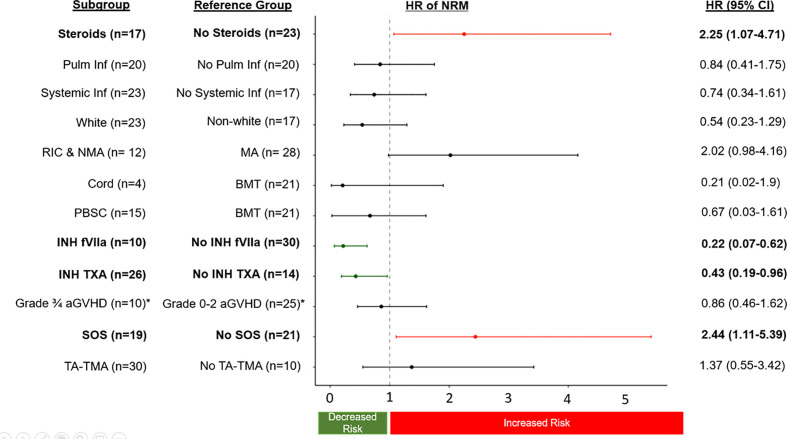
Diffuse alveolar hemorrhage (DAH) is a life-threatening complication of hematopoietic cellular therapy (HCT). This study aimed to evaluate the effect of DAH treatments on outcomes using data from consecutive HCT patients clinically diagnosed with DAH from 3 institutions between January 2018-August 2022. Endpoints included sustained complete response (sCR) defined as bleeding cessation without recurrent bleeding, and non-relapse mortality (NRM). Forty children developed DAH at a median of 56.5 days post-HCT (range 1-760). Thirty-five (88%) had at least one concurrent endothelial disorder, including transplant-associated thrombotic microangiopathy (n=30), sinusoidal obstructive syndrome (n=19), or acute graft versus host disease (n=10). Fifty percent had a concurrent pulmonary infection at the time of DAH. Common treatments included steroids (n=17, 25% sCR), inhaled tranexamic acid (INH TXA,n=26, 48% sCR), and inhaled recombinant activated factor VII (INH fVIIa, n=10, 73% sCR). NRM was 56% 100 days after first pulmonary bleed and 70% at 1 year. Steroid treatment was associated with increased risk of NRM (HR 2.25 95% CI 1.07-4.71, p=0.03), while treatment with INH TXA (HR 0.43, 95% CI 0.19- 0.96, p=0.04) and INH fVIIa (HR 0.22, 95% CI 0.07-0.62, p=0.005) were associated with decreased risk of NRM. Prospective studies are warranted to validate these findings.

Keywords: diffuse alveolar hemorrhage (DAH); inhaled recombinant activated factor VIIa (INH fVIIa); inhaled tranexamic acid (INH TXA); non-relapse related mortality; sinusoidal obstructive syndrome (SOS); steroids; transplant-associated thrombotic microangiopathy (TA-TMA).


Conflict of interest statement

MS is a consultant for Alexion and Omeros. MZ is a consultant for Sobi. CCD is a consultant for Alexion and Jazz. CH is a consultant for Omeros. MQ has honorarium from Novartis and Vertex. The remaining authors declare that the research was conducted in the absence of any commercial or financial relationships that could be construed as a potential conflict of interest.

Figures
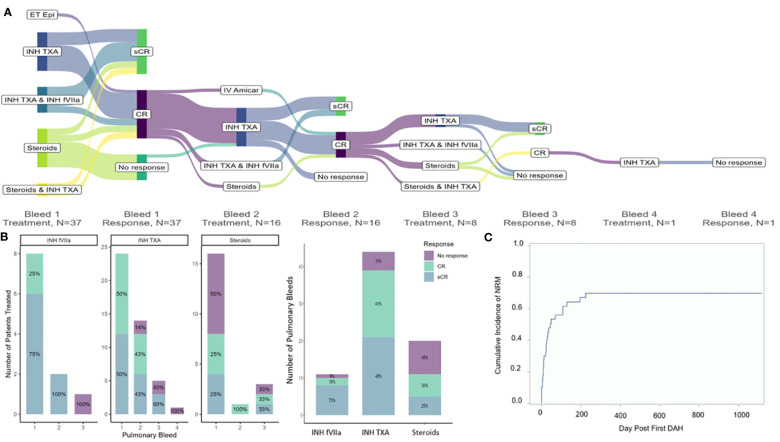
Figure 1
Figure 1
Treatment approaches (A), response of pulmonary bleeds (B) and non-relapse related mortality (C). (A) In this sankey diagram, combinations of treatments for DAH and the response of treatments are indicated for each pulmonary bleed. Not all bleeds were treated; 37 patients received treatment for first pulmonary bleed. Sustained complete response (sCR) was defined as cessation of bleeding without a rebleed. CR as cessation of bleeding for ≥24 hours, but with a recurrent bleed, and no response (NR) as continued bleeding or death with bleeding. (B) Response rates of each pulmonary bleed to each agent; notably, many patients received multiple agents. (C) Overall response to each agent. As above, multiple drugs were given concurrently; assessment of response was the same for all concurrently administered drugs.
Figure 2
Figure 2
The sub-distribution HR of NRM (relapse competing risk) of transplant complications and treatment approaches for DAH. HR greater than 1 are associated with an increased risk of NRM, and less than 1 associated with a decreased risk of NRM. *only allogeneic patients were at risk and used in the analysis (n=35).
Figure 3
Figure 3
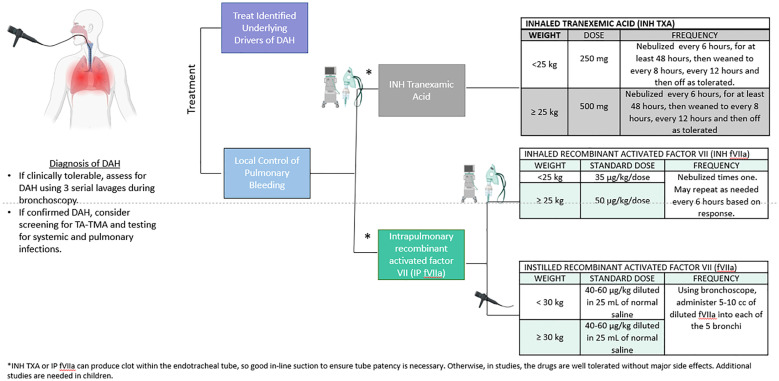
Proposed diagnosis and treatment schema with doses supported by our findings and previous literature. The ideal diagnostic approach includes bronchoscopy and evidence of persistent bleeding after 3 washes. Once DAH is confirmed, consider screening for TA-TMA, pulmonary and systemic infections and treating all identified drivers of DAH. Our data and others support treatment with INH TXA and INH or instilled recombinant active factor VIIa at the doses on the right side of the panel. While there are limited data of appropriate doses for INH TXA and intrapulmonary fVIIa for DAH, these doses were used in published in a small single center clinical trial (19) and are reported in the pediatric HCT population (17, 18, 21). In this study, only INH fVIIa was given (19), but instilled factor VIIa via a bronchoscope is also described (17, 18). While the data are limited, there are not severe side effects of these drugs reported in the literature. However, intrapulmonary administration of INH TXA or IP fVIIa can result in clot formation, so if patients are intubated, vigilance and intervention to ensure the tube remains patent are important.

References

    1. Heggen J, West C, Olson E, Olson T, Teague G, Fortenberry J, et al. . Diffuse alveolar hemorrhage in pediatric hematopoietic cell transplant patients. Pediatrics (2002) 109(5):965–71. doi: 10.1542/peds.109.5.965 - DOI - PubMed
    1. Wu J, Fu H-X, He Y, Mo X-D, Liu X, Cai X, et al. . Risk factors and outcomes of diffuse alveolar haemorrhage after allogeneic haematopoietic stem cell transplantation. Bone Marrow Transpl (2021) 56(9):2097–107. doi: 10.1038/s41409-021-01293-y - DOI - PMC - PubMed
    1. Raptis A, Mavroudis D, Suffredini AF, Molldrem J, Van Rhee F, Childs R, et al. . High-dose corticosteroid therapy for diffuse alveolar hemorrhage in allogeneic bone marrow stem cell transplant recipients. Bone Marrow Transpl (1999) 24(8):879–83. doi: 10.1038/sj.bmt.1701995 - DOI - PubMed
    1. Wells J, Frankel SK. Alveolar hemorrhage. In: Cottin V, Cordier J-F, Richeldi L, editors. Orphan lung dis a clin guid to rare lung dis (2014) (Orphan Lung Diseases). p. 155–75. doi: 10.1007/978-1-4471-2401-6_10 - DOI
    1. Srivastava A, Gottlieb D, Bradstock KF. Diffuse alveolar haemorrhage associated with microangiopathy after allogeneic bone marrow transplantation. Bone Marrow Transpl (1995) 15(6):863–7. - PubMed