. 2023 Jul 24;8(30):26816-26827.
doi: 10.1021/acsomega.3c01232. eCollection 2023 Aug 1.

Facile One-Step Pyrolysis of ZnO/Biochar Nanocomposite for Highly Efficient Removal of Methylene Blue Dye from Aqueous Solution

Affiliations

Facile One-Step Pyrolysis of ZnO/Biochar Nanocomposite for Highly Efficient Removal of Methylene Blue Dye from Aqueous Solution

Nguyen Thi Luyen et al. ACS Omega. .

Abstract

In this work, we developed a facile one-step pyrolysis method for preparing porous ZnO/biochar nanocomposites (ZBCs) with a large surface area to enhance the removal efficiency of dye from aqueous solution. Peanut shells were pyrolyzed under oxygen-limited conditions with a molten salt ZnCl2, which played the roles of the activating agent and precursor for the formation of nanoparticles. The effects of the mass ratio between the molten salt ZnCl2 and peanut shells as well as pyrolysis temperature on the formation of ZBCs were investigated. Characterization results revealed that the as-synthesized ZBCs exhibited a highly porous structure with a specific surface area of 832.12 m2/g, suggesting a good adsorbent for efficient removal of methylene blue (MB). The maximum adsorption capacity of ZBCs on MB was 826.44 mg/g, which surpassed recently reported adsorbents. The formation mechanism of ZnO nanoparticles on the biochar surface was due to ZnCl2 vaporization and reaction with water molecules extracted from the lignocellulosic structures. This study provides a basis for developing a simple and large-scale synthesis method for wastewater with a high adsorption capacity.


Conflict of interest statement

The authors declare no competing financial interest.

Figures

Figure 1
Figure 1
XRD patterns of samples obtained at different (a) mass ratios of ZnCl2 and peanut shells; and (b) pyrolysis temperatures. The crystal structure of graphitic carbon is labeled GC.
Figure 2
Figure 2
Raman spectra of samples obtained at different (a) mass ratios of ZnCl2 and peanut shells and (b) pyrolysis temperatures.
Figure 3
Figure 3
FTIR spectra of samples obtained at different (a) mass ratios of ZnCl2 and peanut shells and (b) pyrolysis temperatures.
Figure 4
Figure 4
FE-SEM images of BC, ZBC-2, ZBC-3, ZBC-600, and ZBC-700.
Figure 5
Figure 5
(a) N2 isotherms at −196 °C for the ZBCs, and biochar; (b) magnified view of biochar.
Figure 6
Figure 6
Pore size distribution curves of the biochar, and ZBCs.
Scheme 1
Scheme 1. Illustration of the Formation of ZnO/Biochar Nanocomposites
Figure 7
Figure 7
Removal efficiency and adsorption capacity of (a) samples synthesized at different (a) mass ratios of ZnCl2 and peanut shells and (b) pyrolysis temperatures.
Figure 8
Figure 8
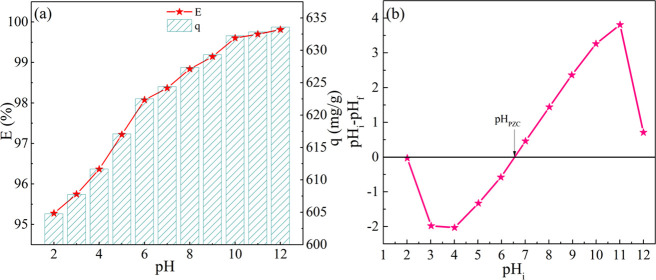
(a) Effect of pH on MB adsorption at an initial concentration of 200 mg/L, an adsorbent dose of 25 mg ZBC-3/25 mL solution, a contact time of 120 min, a temperature of 30 °C, and (b) pHPZC of ZBC-3.
Figure 9
Figure 9
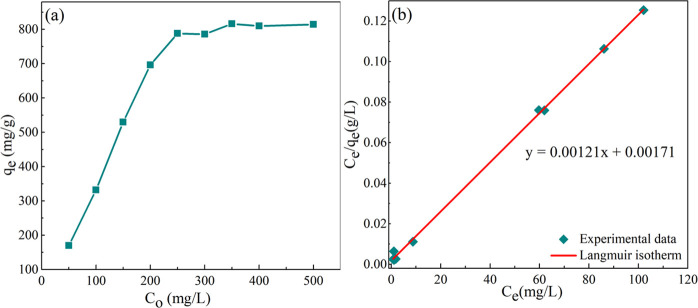
(a) Effect of initial concentrations on MB adsorption by ZnO/biochar; (b) experimental data fitted with the Langmuir model.
Figure 10
Figure 10
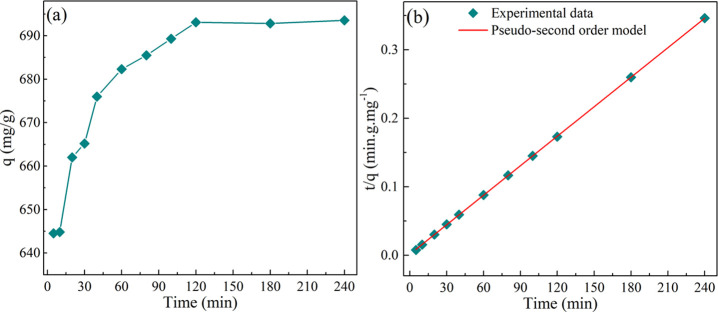
(a) Effect of contact time on MB adsorption onto ZnO/biochar at initial MB concentration of 200 mg/L; (b) the fitted results according to the pseudo-second order kinetics.
Figure 11
Figure 11
(a,b; c,d) TEM images of the ZnO/biochar before and after MB adsorption, respectively; (e) FTIR spectra; and (f) proposed mechanism for MB adsorption on ZnO/biochar.

References

    1. Kurwadkar S. Occurrence and Distribution of Organic and Inorganic Pollutants in Groundwater. Water Environ. Res. 2019, 91, 1001–1008. 10.1002/wer.1166. - DOI - PubMed
    1. Rong Y.; Li S.; Niu J.; Wang Z.; Hao X.; Song C.; Wang T.; Guan G. Carbon-Based Electroactive Ion Exchange Materials: Ultrahigh Removal Efficiency and Ion Selectivity for Rapid Removal of Cs+ Ions. Sep. Purif. Technol. 2021, 274, 11905610.1016/j.seppur.2021.119056. - DOI
    1. Qiu B.; Tao X.; Wang H.; Li W.; Ding X.; Chu H. Biochar as a Low-Cost Adsorbent for Aqueous Heavy Metal Removal: A Review. J. Anal. Appl. Pyrolysis 2021, 155, 10508110.1016/j.jaap.2021.105081. - DOI
    1. Dai Y.; Zhang N.; Xing C.; Cui Q.; Sun Q. The Adsorption, Regeneration and Engineering Applications of Biochar for Removal Organic Pollutants: A Review. Chemosphere 2019, 223, 12–27. 10.1016/j.chemosphere.2019.01.161. - DOI - PubMed
    1. Gwenzi W.; Chaukura N.; Wenga T.; Mtisi M. Biochars as Media for Air Pollution Control Systems: Contaminant Removal Applications and Future Research Directions. Sci. Total Environ. 2021, 753, 14224910.1016/j.scitotenv.2020.142249. - DOI - PubMed