Review
. 2023 Jun 21;4(8):533-547.
doi: 10.1039/d3cb00075c. eCollection 2023 Aug 3.

P1 Glutamine isosteres in the design of inhibitors of 3C/3CL protease of human viruses of the Pisoniviricetes class

Affiliations
Review

P1 Glutamine isosteres in the design of inhibitors of 3C/3CL protease of human viruses of the Pisoniviricetes class

Louise A Stubbing et al. RSC Chem Biol. .

Abstract

Viral infections are one of the leading causes of acute morbidity in humans and much endeavour has been made by the synthetic community for the development of drugs to treat associated diseases. Peptide-based enzyme inhibitors, usually short sequences of three or four residues, are one of the classes of compounds currently under development for enhancement of their activity and pharmaceutical properties. This review reports the advances made in the design of inhibitors targeting the family of highly conserved viral proteases 3C/3CLpro, which play a key role in viral replication and present minimal homology with mammalian proteases. Particular focus is put on the reported development of P1 glutamine isosteres to generate potent inhibitors mimicking the natural substrate sequence at the site of recognition.'


Conflict of interest statement

There are no conflicts to declare.

Figures

Fig. 1
Fig. 1. (A) Hexapeptide recognition sequence of 3C/3CLpro, where the scissile bond is located between P1 (Gln) and P1′. (B) Typical inhibitor design targeting 3C/3CLpro.
Fig. 2
Fig. 2. Representative 3C/3CLpro inhibitors possessing a P1 (l)-glutamine residue with various electrophilic warheads.
Scheme 1
Scheme 1. Generalised formation of hemiaminal B via tautomerisation of P1 glutamine inhibitors A onto the electrophilic warhead.
Fig. 3
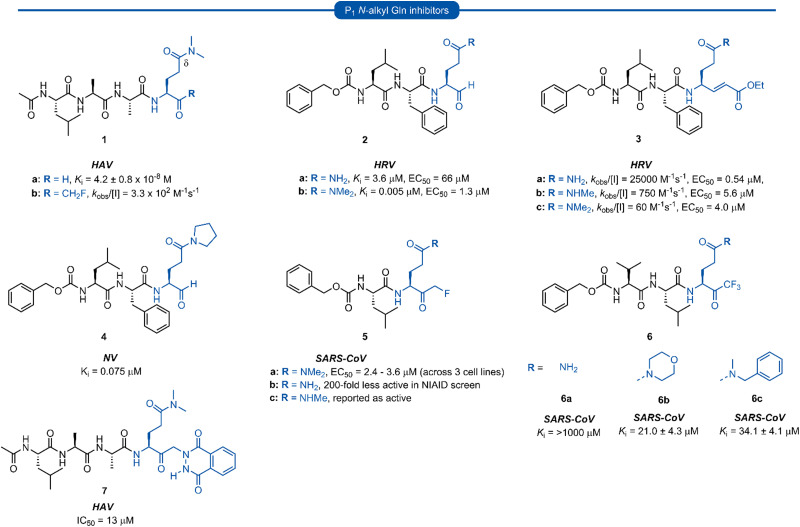
Fig. 3. Representative examples of P1N-alkyl-Gln inhibitors targeting 3C/3CLpro.
Fig. 4
Fig. 4. Representative examples of P1 Met derived inhibitors and their P1 Gln/N-alkyl-Gln analogues targeting 3C/3CLpro.
Fig. 5
Fig. 5. (A) Inhibitors targeting 3C/3CLpro containing non-proteogenic P1 isosteres. (B) Hydrophobic P1 residue inhibitors targeting 3C/3CLpro.
Scheme 2
Scheme 2. Putative mechanism of reversible covalent inhibition of a cysteine protease by SMAIs.
Fig. 6
Fig. 6. Representative examples of P1 His inhibitors targeting SARS-CoV 3CLpro.
Fig. 7
Fig. 7. Representative examples of P1 aza-Gln inhibitors targeting 3C/3CLpro.
Fig. 8
Fig. 8. Representative examples of macrocyclic lactam inhibitors containing a P1 Gln residue.
Fig. 9
Fig. 9. (A) Development of HRV inhibitors possessing a P1 (S)-γ-lactam moiety. (B) Alternative P1 lactam isosteres.
Fig. 10
Fig. 10. Representative examples of inhibitors targeting 3C/3CLpro containing a P1 (S)-γ/δ-lactam isostere.
Fig. 11
Fig. 11. Representative examples of SARS-CoV-2 inhibitors in preclinical (A) or clinical (B) development.
Scheme 3
Scheme 3. (A) The primary route of metabolism of nirmatrelvir 51via CYP3A4 hydroxylation of the P1 (S)-γ-lactam moiety. (B) Minor metabolites products of nirmatrelvir 51via CYP3A4 hydroxylation of the P2 and P3 moiety.

References

    1. World Health Organization, The top 10 causes of death, https://www.who.int/news-room/fact-sheets/detail/the-top-10-causes-of-death, 2020, accessed 13/03/2023
    1. Heikkinen T. Jarvinen A. Lancet. 2003;361:51. doi: 10.1016/S0140-6736(03)12162-9. - DOI - PMC - PubMed
    1. Wang X. Ren J. Gao Q. Hu Z. Sun Y. Li X. Rowlands D. J. Yin W. Wang J. Stuart D. I. Rao Z. Fry E. E. Nature. 2015;517:85. doi: 10.1038/nature13806. - DOI - PMC - PubMed
    1. Bouin A. Semler B. L. Curr. Clin. Microbiol. Rep. 2020;7:31. doi: 10.1007/s40588-020-00138-4. - DOI - PMC - PubMed
    1. Szopa T. M. Titchener P. A. Portwood N. D. Taylor K. W. Diabetologia. 1993;36:687. doi: 10.1007/BF00401138. - DOI - PubMed