


Clinical outcome of therapy-related acute myeloid leukemia patients. Real-life experience in a University Hospital and a Cancer Center in France
- PMID: 37548369
- PMCID: PMC10501294
- DOI: 10.1002/cam4.6322
Clinical outcome of therapy-related acute myeloid leukemia patients. Real-life experience in a University Hospital and a Cancer Center in France
Abstract
Background: t-AML occurs after a primary malignancy treatment and retains a poor prognosis.
Aims: To determine the impact of primary malignancies, therapeutic strategies, and prognostic factors on clinical outcomes of t-AML.
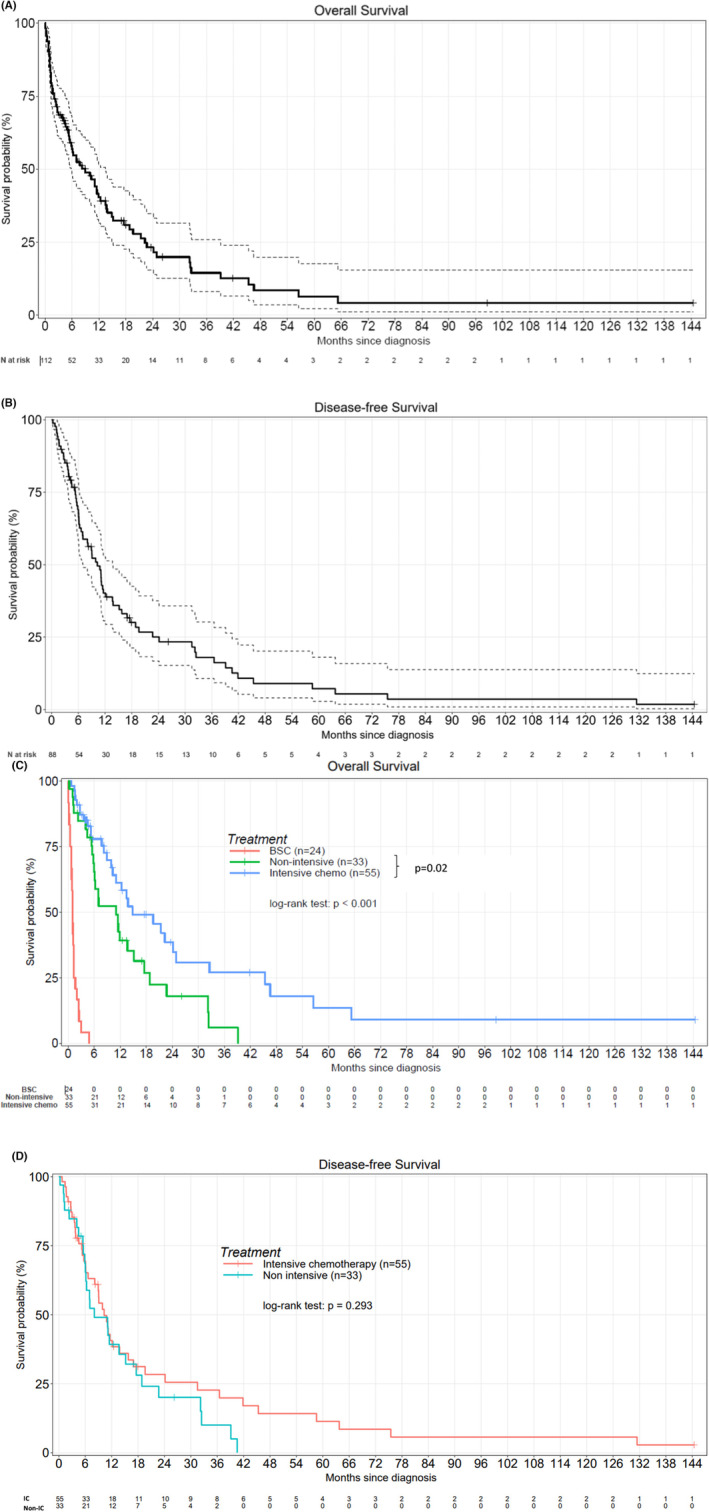
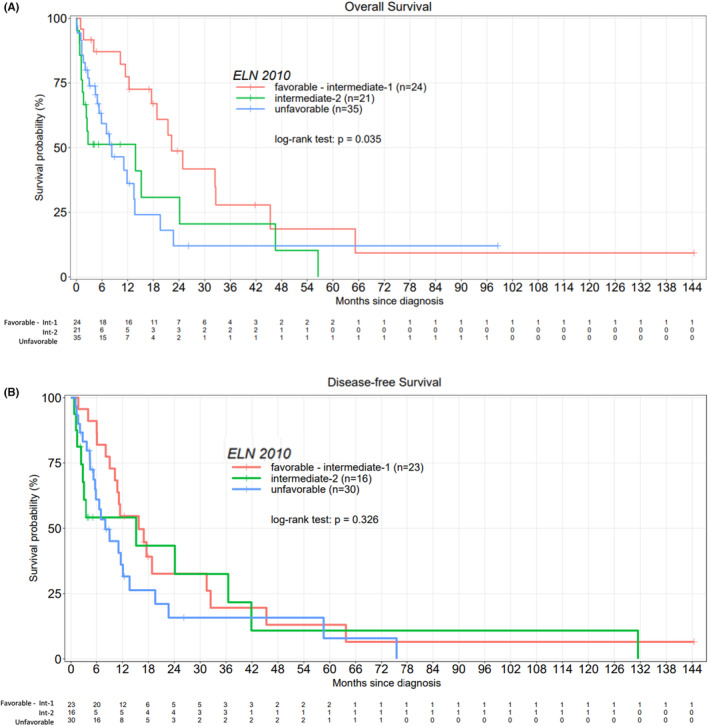
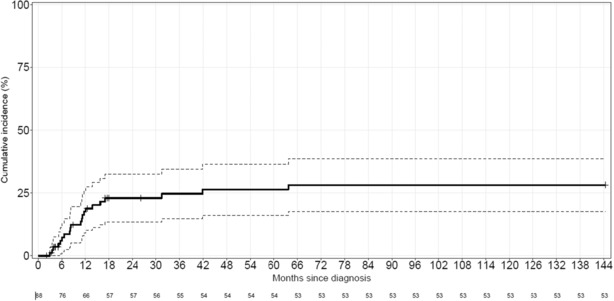
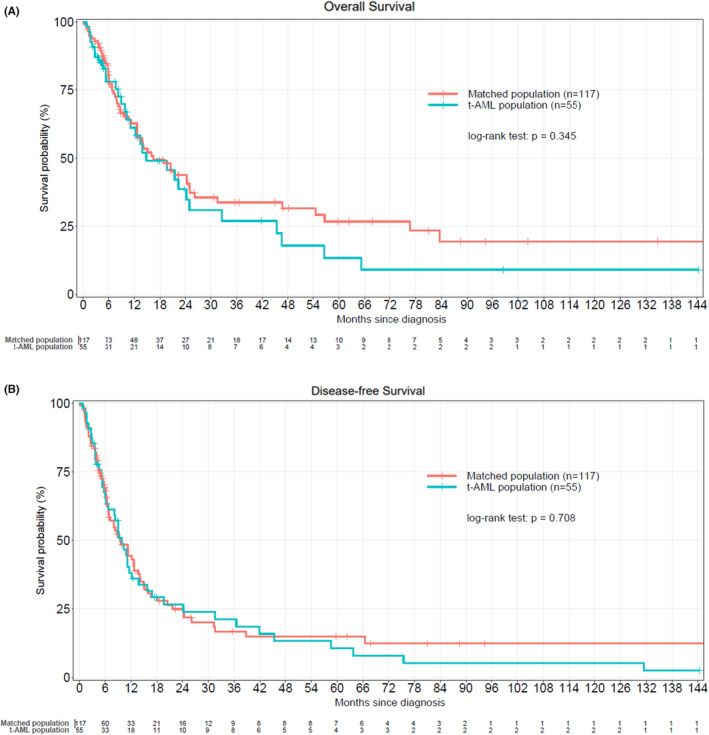
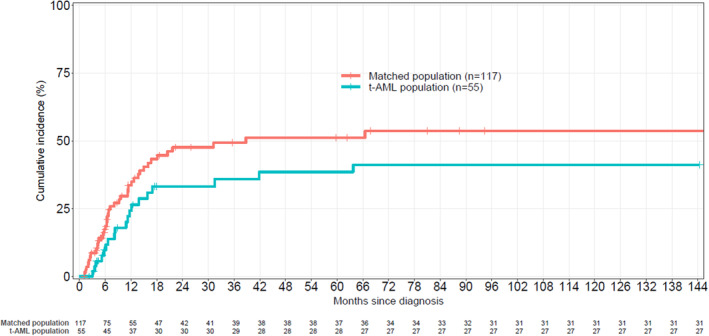
Results: A total of 112 adult patients were included in this study. Fifty-Five patients received intensive chemotherapy (IC), 33 non-IC, and 24 best supportive care. At t-AML diagnosis, 42% and 44% of patients presented an unfavorable karyotype and unfavorable 2010 ELN risk profile, respectively. Among treated patients (n = 88), 43 (49%) achieved complete remission: four out of 33 (12%) and 39 out of 55 (71%) in non-IC and IC groups, respectively. With a median follow-up of 5.5 months, the median overall survival (OS) and disease-free survival (DFS) for the whole population were 9 months and 6.3 months, respectively, and for the 88 treated patients 13.5 months and 8.2 months, respectively. Univariate analysis on OS and DFS showed a significant impact of high white blood cells (WBC) and blast counts at diagnosis, unfavorable karyotype and ELN classification. Multivariate analysis showed a negative impact of WBC count at diagnosis and a positive impact of chemotherapy on OS and DFS in the whole population. It also showed a negative impact of previous auto-HCT and high WBC count on OS and DFS and of IC on OS in treated patients which disappeared when we considered only confounding variables (age, previous cancers, marrow blasts, and 2010 ELN classification). In a pair-matched analysis comparing IC treated t-AML with de novo AML, there was no difference of OS and DFS between the two populations.
Conclusion: We showed, in this study that t-AML patients with unfavorable features represented almost half of the population. Best outcomes obtained in patients receiving IC must be balanced by known confounding variables and should be improved by using new innovative agents and therapeutic strategies.
Keywords: clinical outcome; real-life management; therapy-related AML.
© 2023 The Authors. Cancer Medicine published by John Wiley & Sons Ltd.
Conflict of interest statement
The authors do not declare any conflict of interest.
Figures
Similar articles
-
Salvage by timed sequential chemotherapy in primary resistant acute myeloid leukemia: analysis of prognostic factors.Ann Hematol. 2003 Nov;82(11):684-90. doi: 10.1007/s00277-003-0730-1. Epub 2003 Aug 19. Ann Hematol. 2003. PMID: 12928754 Clinical Trial.
-
Salvage therapy in refractory acute myeloid leukemia: prediction of outcome based on analysis of prognostic factors.Leuk Res. 2003 Mar;27(3):205-14. doi: 10.1016/s0145-2126(02)00089-9. Leuk Res. 2003. PMID: 12537972
-
[Prognostic significance of blood count at the time of achieving morphologic leukemia-free state in adults with acute myeloid leukemia].Zhonghua Xue Ye Xue Za Zhi. 2017 Mar 14;38(3):185-191. doi: 10.3760/cma.j.issn.0253-2727.2017.03.003. Zhonghua Xue Ye Xue Za Zhi. 2017. PMID: 28395440 Free PMC article. Chinese.
-
Prognosis of inv(16)/t(16;16) acute myeloid leukemia (AML): a survey of 110 cases from the French AML Intergroup.Blood. 2003 Jul 15;102(2):462-9. doi: 10.1182/blood-2002-11-3527. Epub 2003 Mar 20. Blood. 2003. PMID: 12649129 Review.
-
The prognostic value of cytogenetics is reinforced by the kind of induction/consolidation therapy in influencing the outcome of acute myeloid leukemia--analysis of 848 patients.Leukemia. 2001 Jun;15(6):903-9. doi: 10.1038/sj.leu.2402142. Leukemia. 2001. PMID: 11417475 Review.
Cited by
-
Myeloid neoplasms after CD19-directed CAR T cells therapy in long-term B-cell lymphoma responders, a rising risk over time?Leukemia. 2025 Jul;39(7):1714-1722. doi: 10.1038/s41375-025-02605-7. Epub 2025 Apr 24. Leukemia. 2025. PMID: 40275069 Free PMC article.
References
-
- Arber DA, Orazi A, Hasserjian R, et al. The 2016 revision to the World Health Organization classification of myeloid neoplasms and acute leukemia. Blood. 2016;127(20):2391‐2405. - PubMed
-
- Fianchi L, Pagano L, Piciocchi A, et al. Characteristics and outcome of therapy‐related myeloid neoplasms: report from the Italian network on secondary leukemias. Am J Hematol. 2015;90(5):e80‐e85. - PubMed
-
- Wheatley K, Brookes CL, Howman AJ, et al. Prognostic factor analysis of the survival of elderly patients with AML in the MRC AML11 and LRF AML14 trials. Br J Haematol. 2009;145(5):598‐605. - PubMed
-
- Feldman EJ. Does therapy‐related AML have a poor prognosis, independent of the cytogenetic/molecular determinants? Best Pract Res Clin Haematol. 2011;24(4):523‐526. - PubMed
MeSH terms
LinkOut - more resources
Full Text Sources
Medical
Research Materials
