The biting rate of Aedes aegypti and its variability: A systematic review (1970-2022)
- PMID: 37552669
- PMCID: PMC10456196
- DOI: 10.1371/journal.pntd.0010831
The biting rate of Aedes aegypti and its variability: A systematic review (1970-2022)
Abstract
Background: Transmission models have a long history in the study of mosquito-borne disease dynamics. The mosquito biting rate (MBR) is an important parameter in these models, however, estimating its value empirically is complex. Modeling studies obtain biting rate values from various types of studies, each of them having its strengths and limitations. Thus, understanding these study designs and the factors that contribute to MBR estimates and their variability is an important step towards standardizing these estimates. We do this for an important arbovirus vector Aedes aegypti.
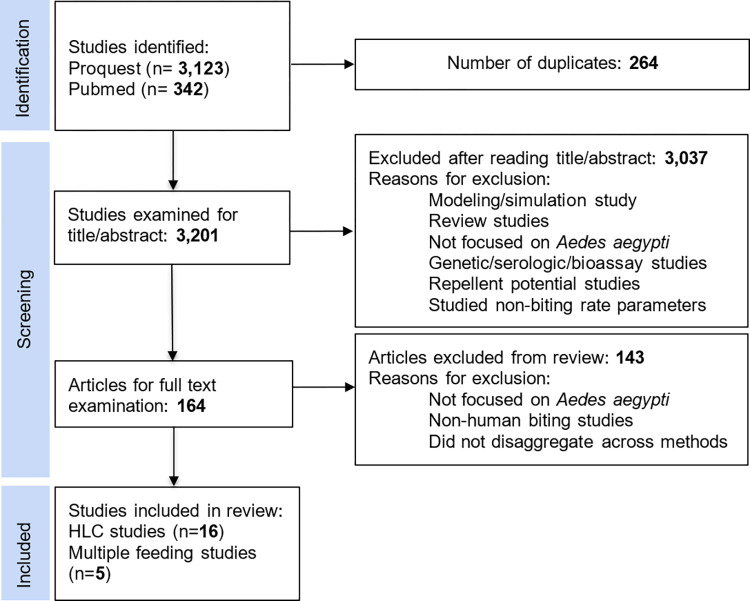
Methodology/principal findings: We perform a systematic review using search terms such as 'biting rate' and 'biting frequency' combined with 'Aedes aegypti' ('Ae. aegypti' or 'A. aegypti'). We screened 3,201 articles from PubMed and ProQuest databases, of which 21 met our inclusion criteria. Two broader types of studies are identified: human landing catch (HLC) studies and multiple feeding studies. We analyze the biting rate data provided as well as the methodologies used in these studies to characterize the variability of these estimates across temporal, spatial, and environmental factors and to identify the strengths and limitations of existing methodologies. Based on these analyses, we present two approaches to estimate population mean per mosquito biting rate: one that combines studies estimating the number of bites taken per gonotrophic cycle and the gonotrophic cycle duration, and a second that uses data from histological studies. Based on one histological study dataset, we estimate biting rates of Ae. aegypti (0.41 and 0.35 bite/mosquito-day in Thailand and Puerto Rico, respectively).
Conclusions/significance: Our review reinforces the importance of engaging with vector biology when using mosquito biting rate data in transmission modeling studies. For Ae. aegypti, this includes understanding the variation of the gonotrophic cycle duration and the number of bites per gonotrophic cycle, as well as recognizing the potential for spatial and temporal variability. To address these variabilities, we advocate for site-specific data and the development of a standardized approach to estimate the biting rate.
Copyright: © 2023 Zahid et al. This is an open access article distributed under the terms of the Creative Commons Attribution License, which permits unrestricted use, distribution, and reproduction in any medium, provided the original author and source are credited.
Conflict of interest statement
The authors have declared that no competing interests exist.
Figures
References
-
- Centers for Disease Control and Prevention. Fighting the world’s deadliest animal, https://www.cdc.gov/globalhealth/stories/2019/world-deadliest-animal.html. Update date: 08/15/2019. Access date: 05/18/2022.
-
- World Health Organization. Dengue and severe dengue. https://www.who.int/news-room/fact-sheets/detail/dengue-and-severe-dengue. Update date: 01/10/2022. Access date: 05/18/2022.
-
- Ewing D. A., Purse B. V., Cobbold C. A., and White S. M. A Novel Approach for Predicting Risk of Vector-Borne Disease Establishment in Marginal Temperate Environments under Climate Change: West Nile Virus in the UK. Journal of the Royal Society Interface. 2021; 18: 20210049 doi: 10.1098/rsif.2021.0049 - DOI - PMC - PubMed
Publication types
MeSH terms
Grants and funding
LinkOut - more resources
Full Text Sources
Medical
Miscellaneous