. 2023 Jul 9;13(12):4004-4015.
doi: 10.7150/thno.84865. eCollection 2023.

Click-to-Release: Cleavable Radioimmunoimaging with [89Zr]Zr-DFO- Trans-Cyclooctene-Trastuzumab Increases Tumor-to-Blood Ratio

Affiliations

Click-to-Release: Cleavable Radioimmunoimaging with [89Zr]Zr-DFO- Trans-Cyclooctene-Trastuzumab Increases Tumor-to-Blood Ratio

Maria Vlastara et al. Theranostics. .

Abstract

One of the main challenges of PET imaging with 89Zr-labeled monoclonal antibodies (mAbs) remains the long blood circulation of the radiolabeled mAbs, leading to high background signals, decreasing image quality. To overcome this limitation, here we report the use of a bioorthogonal linker cleavage approach (click-to-release chemistry) to selectively liberate [89Zr]Zr-DFO from trans-cyclooctene-functionalized trastuzumab (TCO-Tmab) in blood, following the administration of a tetrazine compound (trigger) in BT-474 tumor-bearing mice. Methods: We created a series of TCO-DFO constructs and evaluated their performance in [89Zr]Zr-DFO release from Tmab in vitro using different trigger compounds. The in vivo behavior of the best performing [89Zr]Zr-TCO-Tmab was studied in healthy mice first to determine the optimal dose of the trigger. To find the optimal time for the trigger administration, the rate of [89Zr]Zr-TCO-Tmab internalization was studied in BT-474 cancer cells. Finally, the trigger was administered 6 h or 24 h after [89Zr]Zr-TCO-Tmab- administration in tumor-bearing mice to liberate the [89Zr]Zr-DFO fragment. PET scans were obtained of tumor-bearing mice that received the trigger 6 h post-[89Zr]Zr-TCO-Tmab administration. Results: The [89Zr]Zr-TCO-Tmab and trigger pair with the best in vivo properties exhibited 83% release in 50% mouse plasma. In tumor-bearing mice the tumor-blood ratios were markedly increased from 1.0 ± 0.4 to 2.3 ± 0.6 (p = 0.0057) and from 2.5 ± 0.7 to 6.6 ± 0.9 (p < 0.0001) when the trigger was administered at 6 h and 24 h post-mAb, respectively. Same day PET imaging clearly showed uptake in the tumor combined with a strongly reduced background due to the fast clearance of the released [89Zr]Zr-DFO-containing fragment from the circulation through the kidneys. Conclusions: This is the first demonstration of the use of trans-cyclooctene-tetrazine click-to-release chemistry to release a radioactive chelator from a mAb in mice to increase tumor-to-blood ratios. Our results suggest that click-cleavable radioimmunoimaging may allow for substantially shorter intervals in PET imaging with full mAbs, reducing radiation doses and potentially even enabling same day imaging.

Keywords: IEDDA; click-to-release; radioimmunoimaging; trans-cyclooctene; trastuzumab.


Conflict of interest statement

Competing Interests: Maria Vlastara, Raffaella Rossin, Kim de Roode, Laurens Kleijn, and Marc Robillard are employees and/or shareholders of Tagworks. The other authors have no competing interests to declare.

Figures
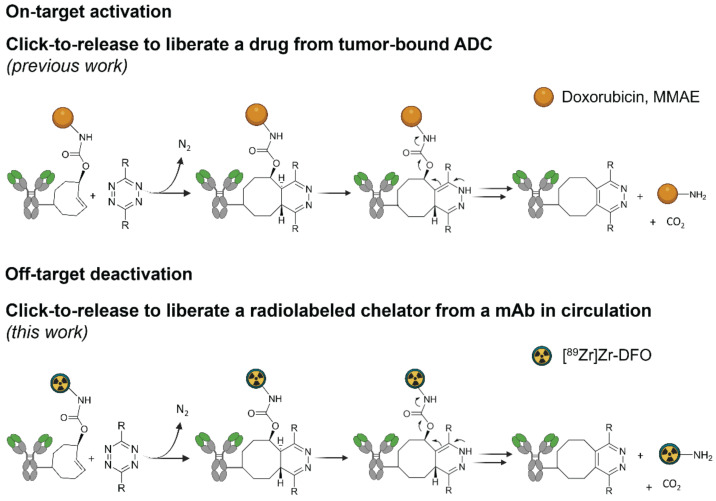
Figure 1
Figure 1
Click-to-release concept. Top: inverse electron-demand Diels-Alder (IEDDA) pyridazine elimination reaction between TCO and tetrazine, wherein the released payload is doxorubicin or MMAE (previous work) ,; bottom: IEDDA pyridazine elimination reaction wherein the released payload is a radioactive moiety (this work).
Figure 2
Figure 2
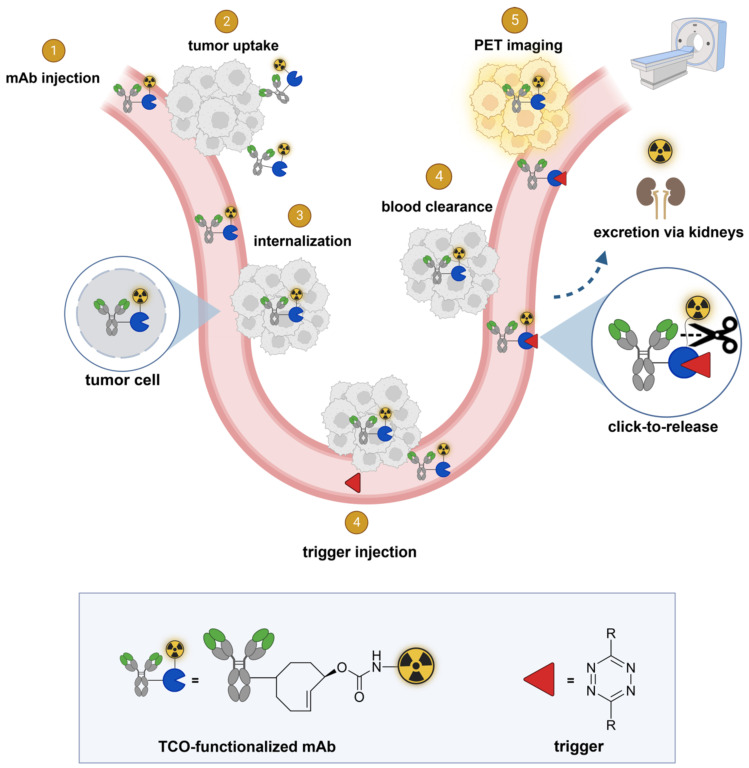
General concept of cleavable radioimmunoimaging using click-to-release chemistry in vivo. The TCO-linked and radiolabeled mAb is administered and internalizes in the tumor cells. Once enough tumor internalization has occurred, the trigger (tetrazine) is administered, which can solely react with TCO in blood and in other extracellular compartments given its non-cell-permeable nature. The result of this bioorthogonal reaction is the rapid release of the radiolabeled chelator in circulation and its efficient renal excretion, increasing the T/B ratio. Created with Biorender.com
Figure 3
Figure 3
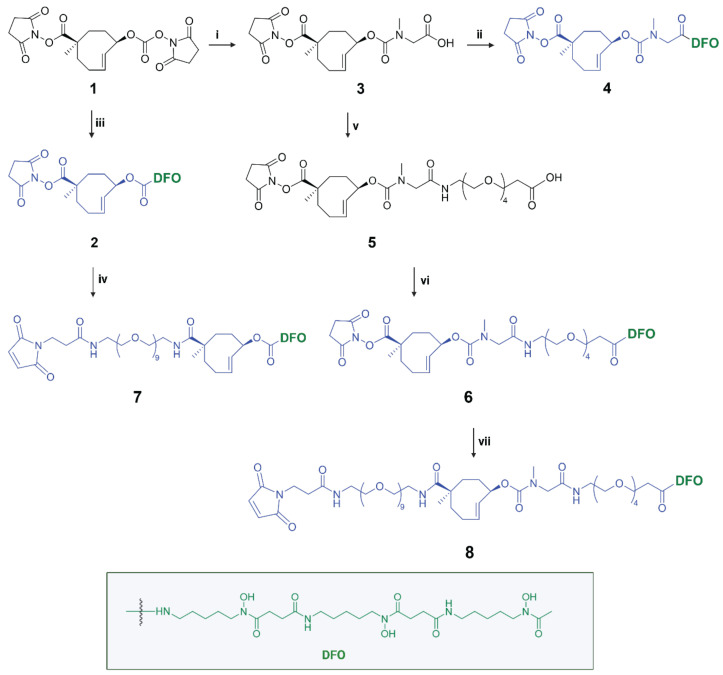
Synthesis of chemically-cleavable linker-chelators comprising a TCO functionalized on the releasing end (allylic position) with the [89Zr]Zr-DFO chelator. Reagents and conditions: (i) sarcosine, water, 10 min, RT (quantitative); (ii) PyBOP, DIPEA, deferoxamine mesylate salt, DMSO, 3h, RT (83%); (iii) deferoxamine mesylate salt, DMSO, 4 h, RT (84%); (iv) mal-amido-PEG9-amine, DMF, DIPEA, RT; (v) PyBOP, DIPEA, DMF, amino-PEG4-acid, 2 h, RT (14%); (vi) PyPOB, DIPEA, deferoxamine mesylate salt, DMSO, 4 h, RT (86%); (vii) mal-amido-PEG9-amine, DMF, DIPEA, 2 h, RT (11%).
Figure 4
Figure 4
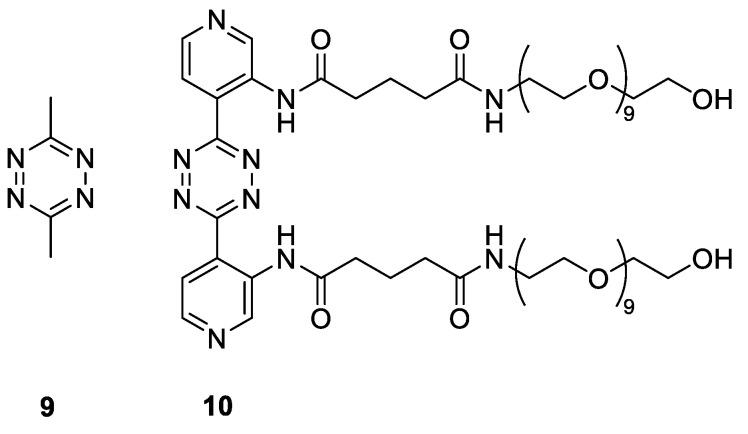
Triggers used in this study.
Figure 5
Figure 5
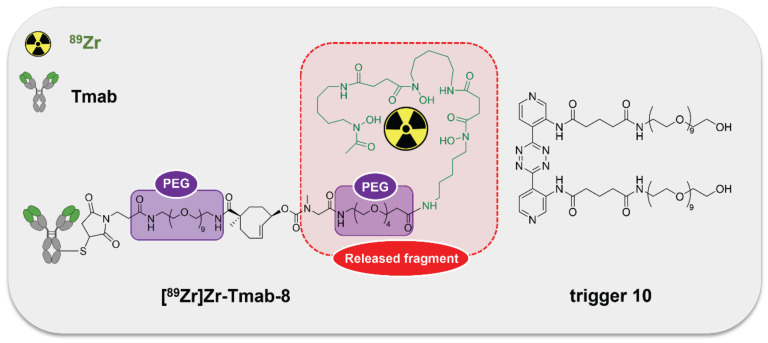
The [89Zr]Zr-TCO-Tmab and trigger pair used in the in vivo experiments. Structure of [89Zr]Zr-Tmab-8, comprising PEG spacers before and after the TCO and structure of trigger 10.
Figure 6
Figure 6
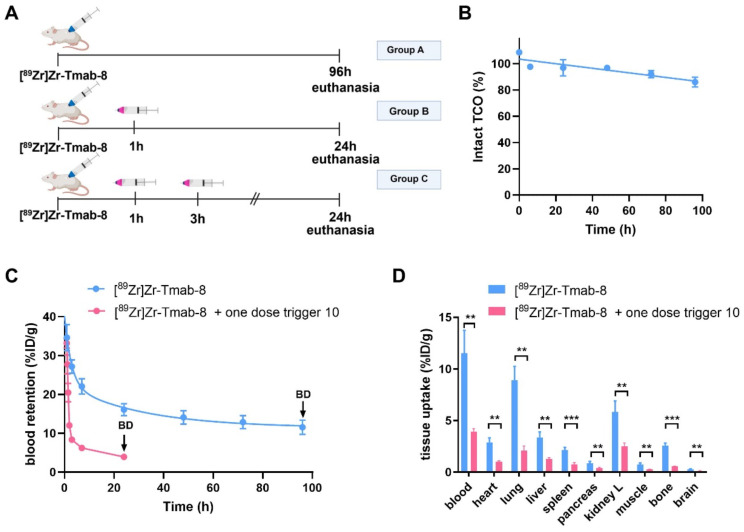
Evaluation of [89Zr]Zr-Tmab-8 and trigger 10 in tumor-free mice. (A) Experimental scheme of in vivo studies, where tumor-free mice received [89Zr]Zr-Tmab-8 alone (Group A), mAb followed by one dose of trigger 10 (Group B) or two doses of trigger 10 (Group C). (B) Normalized in vivo TCO linker stability in tumor-free mice. (C) [89Zr]Zr blood clearance profile of [89Zr]Zr-Tmab-8 alone and with trigger 10 1 h post-[89Zr]Zr-Tmab-8 administration. The data represent the mean % ± SD (n = 4), (D) Biodistribution (BD) at respectively 96 h and 24 h post-mAb injection of mice treated with [89Zr]Zr-Tmab-8 alone (blue) and in combination with one dose of trigger 10 1 h post-[89Zr]Zr-Tmab-8 (pink). Statistical analysis was performed using the unpaired Student's t-test (**p < 0.01 and ***p < 0.001).
Figure 7
Figure 7
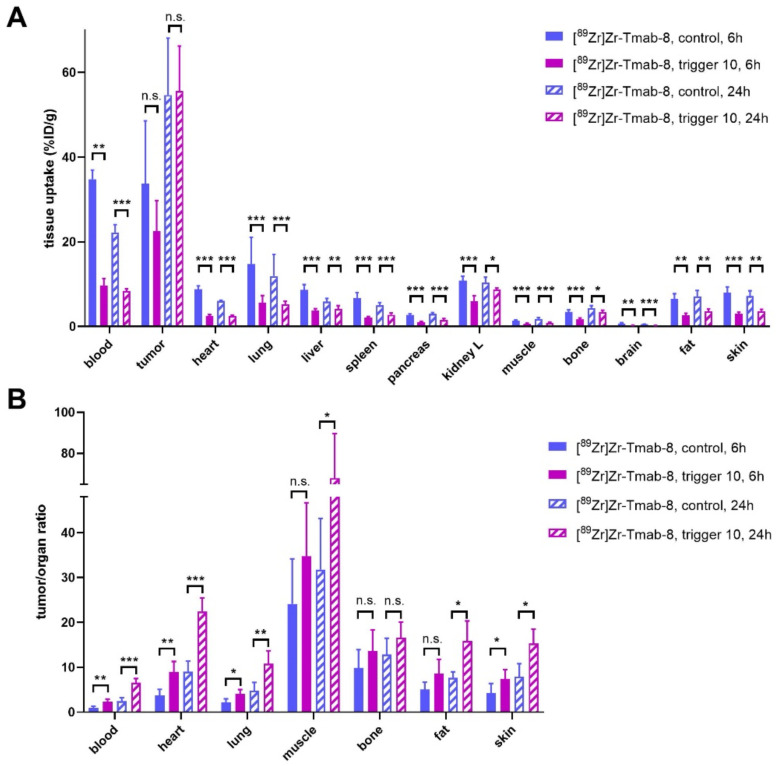
Evaluation of [89Zr]Zr-Tmab-8 and trigger 10 in mice bearing BT-474 xenografts at two different time points. (A) Biodistribution (4 h post-trigger administration) of mice bearing BT-474 xenografts receiving [89Zr]Zr-Tmab-8 alone or followed by trigger 10 at 6 h or 24 h post-mAb (B) Tumor-organ ratios from the mice in panel A The data represent the mean % ± SD (n = 5). Statistical analysis was performed using the unpaired Student's t-test, *p < 0.05, **p < 0.01, ***p < 0.001 and n.s.= not significant (A: tumor, 6 h: p = 0.1793; 24 h: p = 0.9042; B: tumor-muscle, 6 h: p = 0.1682; tumor-bone, 6 h: p = 0.2119; 24 h: p = 0.1219; tumor-fat, 6 h: p = 0.0719).
Figure 8
Figure 8
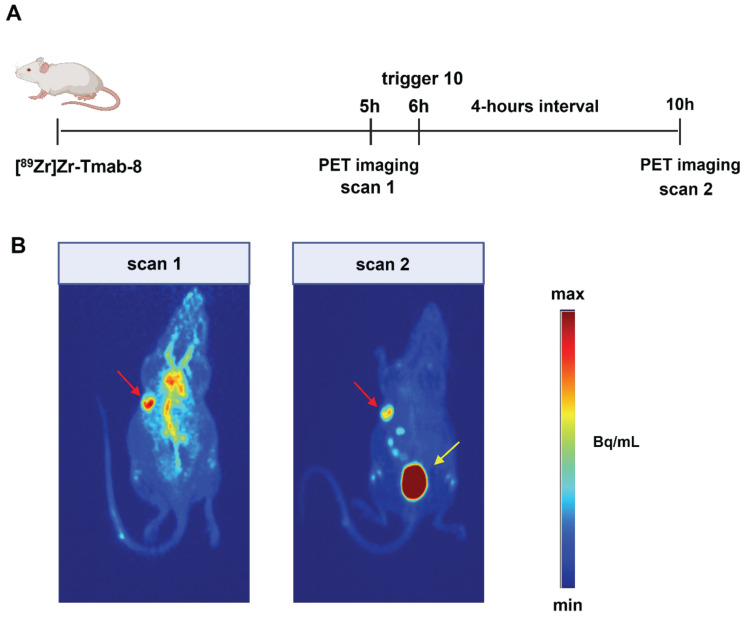
PET imaging studies in tumor-bearing mice. (A) Experimental scheme of the PET imaging studies. Mice bearing HER2-positive BT-474 xenografts (n = 4) received [89Zr]Zr-Tmab-8 and 5 h later were imaged under anesthesia (scan 1). One hour later the mice received trigger 10 and 4 h post-trigger 10 administration were imaged again under anesthesia (scan 2) (B) Representative PET maximum intensity projections from the same mouse, before trigger administration (scan 1) and after trigger administration (scan 2). The images are scaled to the same min and max values. Red arrows indicate the tumor site and yellow arrow indicates the bladder.

References

    1. Posner J, Barrington P, Brier T, Datta-Mannan A. Monoclonal antibodies: past, present and future. Concepts and Principles of Pharmacology: 100 Years of the Handbook of Experimental Pharmacology. 2019;260:81–141. - PubMed
    1. Lin M, Paolillo V, Le DB, Macapinlac H, Ravizzini GC. Monoclonal antibody based radiopharmaceuticals for imaging and therapy. Curr Probl Canc. 2021;45:100796. - PubMed
    1. Dilworth JR, Pascu SI. The chemistry of PET imaging with zirconium-89. Chem Soc Rev. 2018;47:2554–71. - PubMed
    1. Garousi J, Orlova A, Frejd FY, Tolmachev V. Imaging using radiolabelled targeted proteins: Radioimmunodetection and beyond. EJNMMI Radiopharm Chem. 2020;5:1–26. - PMC - PubMed
    1. O'Donoghue JA, Lewis JS, Pandit-Taskar N, Fleming SE, Shöder H, Larson SM. et al. Pharmacokinetics, biodistribution, and radiation dosimetry for 89Zr-trastuzumab in patients with esophagogastric cancer. J Nucl Med. 2018;59:161–6. - PMC - PubMed

Publication types