


The HEARTS partner forum-supporting implementation of HEARTS to treat and control hypertension
- PMID: 37554732
- PMCID: PMC10405076
- DOI: 10.3389/fpubh.2023.1146441
The HEARTS partner forum-supporting implementation of HEARTS to treat and control hypertension
Abstract
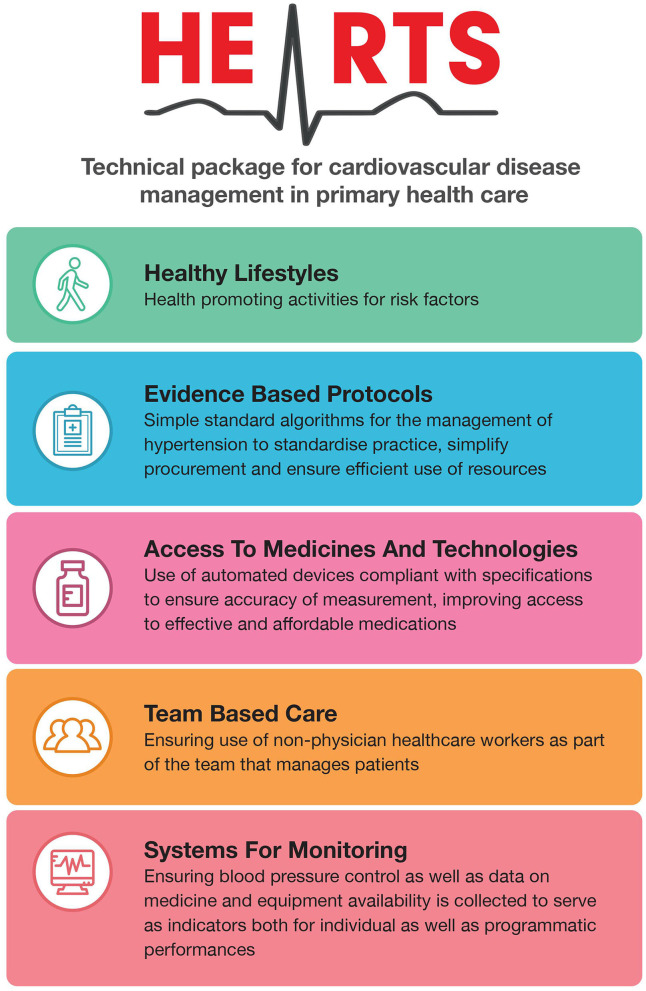
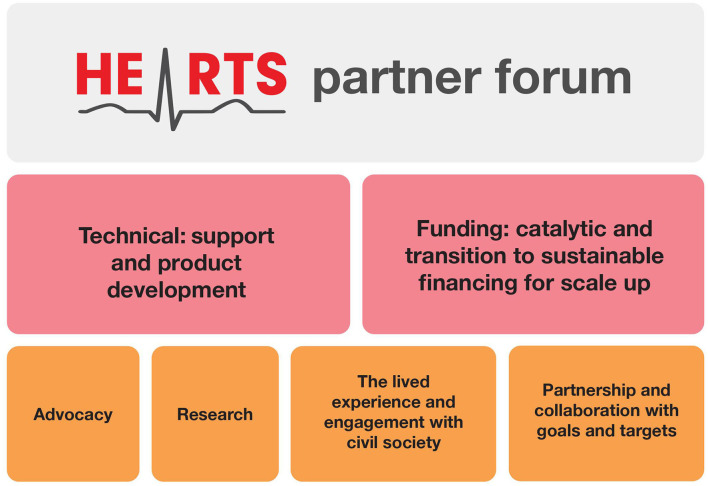
Cardiovascular diseases (CVD), principally ischemic heart disease (IHD) and stroke, are the leading causes of death (18. 6 million deaths annually) and disability (393 million disability-adjusted life-years lost annually), worldwide. High blood pressure is the most important preventable risk factor for CVD and deaths, worldwide (10.8 million deaths annually). In 2016, the World Health Organization (WHO) and the United States Centers for Disease Control (CDC) launched the Global Hearts initiative to support governments in their quest to prevent and control CVD. HEARTS is the core technical package of the initiative and takes a public health approach to treating hypertension and other CVD risk factors at the primary health care level. The HEARTS Partner Forum, led by WHO, brings together the following 11 partner organizations: American Heart Association (AHA), Center for Chronic Disease Control (CCDC), International Society of Hypertension (ISH), International Society of Nephrology (ISN), Pan American Health Organization (PAHO), Resolve to Save Lives (RTSL), US CDC, World Hypertension League (WHL), World Heart Federation (WHF) and World Stroke Organization (WSO). The partners support countries in their implementation of the HEARTS technical package in various ways, including providing technical expertise, catalytic funding, capacity building and evidence generation and dissemination. HEARTS has demonstrated the feasibility and acceptability of a public health approach, with more than seven million people already on treatment for hypertension using a simple, algorithmic HEARTS approach. Additionally, HEARTS has demonstrated the feasibility of using hypertension as a pathfinder to universal health coverage and should be a key intervention of all basic benefit packages. The partner forum continues to find ways to expand support and reinvigorate enthusiasm and attention on preventing CVD. Proposed future HEARTS Partner Forum activities are related to more concrete information sharing between partners and among countries, expanded areas of partner synergy, support for implementation, capacity building, and advocacy with country ministries of health, professional societies, academy and civil societies organizations. Advancing toward the shared goals of the HEARTS partners will require a more formal, structured approach to the forum and include goals, targets and published reports. In this way, the HEARTS Partner Forum will mirror successful global partnerships on communicable diseases and assist countries in reducing CVD mortality and achieving global sustainable development goals (SDGs).
Keywords: cardiovascular diseases; global health; health systems; hypertension; implementation; partnerships; primary healthcare; universal health coverage.
Copyright © 2023 Khan, Moran, Perel, Whelton, Brainin, Feigin, Kostova, Richter, Ordunez, Hennis, Lackland, Slama, Pineiro, Martins, Williams, Hofstra, Garg and Mikkelsen.
Conflict of interest statement
The authors declare that the research was conducted in the absence of any commercial or financial relationships that could be construed as a potential conflict of interest.
Figures
References
-
- Martinez R, Soliz P, Mujica OJ, Reveiz L, Campbell NRC, Ordunez P. The slowdown in the reduction rate of premature mortality from cardiovascular diseases puts the Americas at risk of achieving SDG 3.4: a population trend analysis of 37 countries from 1990 to 2017. J Clin Hypertens (Greenwich). (2020) 22:1296–309. 10.1111/jch.13922 - DOI - PMC - PubMed
-
- Zhou B, Carrillo-Larco RM, Danaei G, Riley LM, Paciorek CJ, Stevens GA, et al. . Worldwide trends in hypertension prevalence and progress in treatment and control from 1990 to 2019: a pooled analysis of 1201 population-representative studies with 104 million participants. The Lancet. (2021) 398:957–80. 10.1016/S0140-6736(21)01330-1 - DOI - PMC - PubMed
Publication types
MeSH terms
Grants and funding
LinkOut - more resources
Full Text Sources
Medical
