


Resilience and social change: Findings from research trends using association rule mining
- PMID: 37554774
- PMCID: PMC10404750
- DOI: 10.1016/j.heliyon.2023.e18766
Resilience and social change: Findings from research trends using association rule mining
Abstract
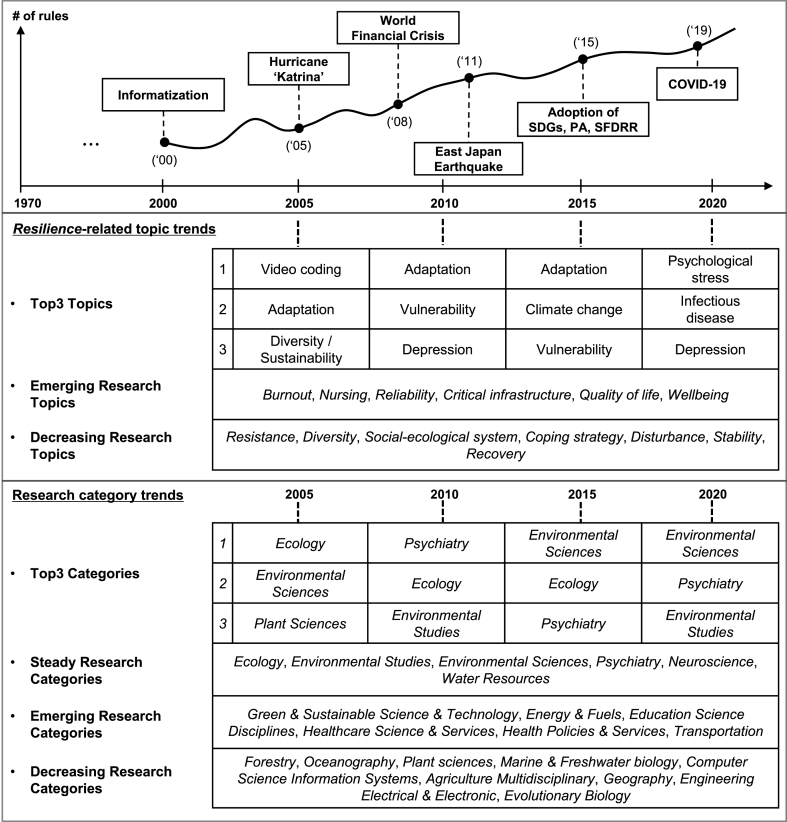
This study analyzed the historical development of resilience with respect to multidisciplinary aspects using association rule mining (ARM). ARM is a rule-based machine-learning approach tailored to identify validated relations among multiple variables in a large dataset. This study collected author keywords from all resilience-related literature in the Web of Science database and examined the changes in validated resilience-related topics using ARM. We found that resilience-related research tends to diversify and expand over time. Although topics and their academic fields related to engineering and complex adaptive systems were prominent in the early 2000s, psychosocial resilience and social-ecological resilience have received significant attention in recent years. The increasing interest in resilience-related topics linked to psychological and ecological factors, as well as social system components, can be attributed to the impact of a series of complex and global events that occurred in the late 2000s. Recently, resilience has been conceived as a way of thinking, perspective, or paradigm to address emergent complexity and uncertainty with vague concepts. Resilience is increasingly being regarded as a boundary spanner that promotes communication and collaboration among stakeholders who share different interests and scientific knowledge.
Keywords: Association rule mining; Bibliometric analysis; Research trends; Resilience; Resilience thinking; Social change.
© 2023 The Authors.
Conflict of interest statement
The authors declare that they have no known competing financial interests or personal relationships that could have appeared to influence the work reported in this paper.
Figures
References
-
- Brand F.S., Jax K. Focusing the meaning (s) of resilience: resilience as a descriptive concept and a boundary object. Ecol. Soc. 2007;12
-
- Fekete A., Hufschmidt G., Kruse S. Benefits and challenges of resilience and vulnerability for disaster risk management. Int. J. Disast. Risk Sc. 2014;5:3–20. doi: 10.1007/s13753-014-0008-3. - DOI
-
- Baggio J.A., Brown K., Hellebrandt D. Boundary object or bridging concept? A citation network analysis of resilience. Ecol. Soc. 2015;20
-
- Strunz S. Is conceptual vagueness an asset? Arguments from philosophy of science applied to the concept of resilience. Ecol. Econ. 2012;76:112–118.
-
- Norris F.H., Stevens S.P., Pfefferbaum B., Wyche K.F., Pfefferbaum R.L. Community resilience as a metaphor, theory, set of capacities, and strategy for disaster readiness. Am. J. Community Psychol. 2008;41:127–150. - PubMed
LinkOut - more resources
Full Text Sources
