


Prognostic significance of acute kidney injury stage 1B in hospitalized patients with cirrhosis: A US nationwide study
- PMID: 37556190
- PMCID: PMC10853477
- DOI: 10.1097/LVT.0000000000000241
Prognostic significance of acute kidney injury stage 1B in hospitalized patients with cirrhosis: A US nationwide study
Abstract
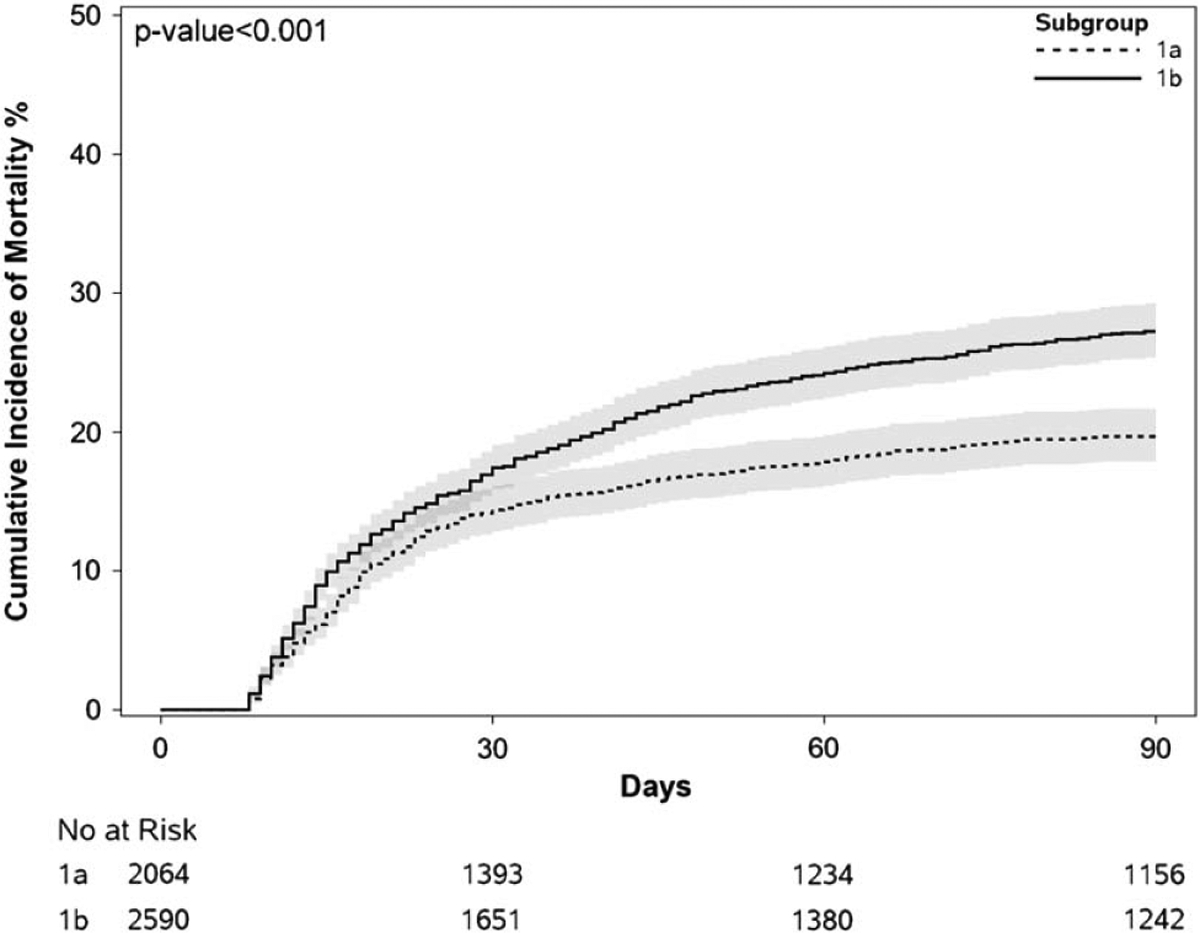
Understanding the prognostic significance of acute kidney injury (AKI) stage 1B [serum creatinine (sCr) ≥1.5 mg/dL] compared with stage 1A (sCr < 1.5 mg/dL) in a US population is important as it can impact initial management decisions for AKI in hospitalized cirrhosis patients. Therefore, we aimed to define outcomes associated with stage 1B in a nationwide US cohort of hospitalized cirrhosis patients with AKI. Hospitalized cirrhosis patients with AKI in the Cerner-Health-Facts database from January 2009 to September 2017 (n = 6250) were assessed for AKI stage 1 (≥1.5-2-fold increase in sCr from baseline) and were followed for 90 days for outcomes. The primary outcome was 90-day mortality; secondary outcomes were in-hospital AKI progression and AKI recovery. Competing-risk multivariable analysis was performed to determine the independent association between stage 1B, 90-day mortality (liver transplant as a competing risk), and AKI recovery (death/liver transplant as a competing risk). Multivariable logistic regression analysis was performed to determine the independent association between stage 1B and AKI progression. In all, 4654 patients with stage 1 were analyzed: 1A (44.3%) and 1B (55.7%). Stage 1B patients had a significantly higher cumulative incidence of 90-day mortality compared with stage 1A patients, 27.2% versus 19.7% ( p < 0.001). In multivariable competing-risk analysis, patients with stage 1B (vs. 1A) had a higher risk for mortality at 90 days [sHR 1.52 (95% CI 1.20-1.92), p = 0.001] and decreased probability for AKI recovery [sHR 0.76 (95% CI 0.69-0.83), p < 0.001]. Furthermore, in multivariable logistic regression analysis, AKI stage 1B (vs. 1A) was independently associated with AKI progression, OR 1.42 (95% CI 1.14-1.72) ( p < 0.001). AKI stage 1B patients have a significantly higher risk for 90-day mortality, AKI progression, and reduced probability of AKI recovery compared with AKI stage 1A patients. These results could guide initial management decisions for AKI in hospitalized patients with cirrhosis.
Copyright © 2023 American Association for the Study of Liver Diseases.
Conflict of interest statement
CONFLICTS OF INTEREST
Giuseppe Cullaro consults for Ocelot Bio and Retro. He owns stock in Eli Lilly and Novo Nordisk. Eric S. Orman advises BioVie. Salvatore Piano consults for Plasma Protein Therapeutics and Resolution Therapeutics. He advises Mallinckrodt. He is on the speakers’ bureau for Grifols. Andrew S. Allegretti consults for Mallinckrodt and Ocelot Bio. The remaining authors have no conflicts to report.
Figures
Comment in
-
The prognostic implications of early-stage AKI: Defining the threshold for concern.Liver Transpl. 2024 Mar 1;30(3):235-236. doi: 10.1097/LVT.0000000000000292. Epub 2023 Oct 30. Liver Transpl. 2024. PMID: 37903066 No abstract available.
References
-
- Huelin P, Piano S, Sola E, Stanco M, Sole C, Moreira R, et al. Validation of a staging system for acute kidney injury in patients with cirrhosis and association with acute-on-chronic liver failure. Clin Gastroenterol Hepatol. 2017;15:438–445 e435. - PubMed
-
- Wong F, O’Leary JG, Reddy KR, Garcia-Tsao G, Fallon MB, Biggins SW, et al. Acute kidney injury in cirrhosis: Baseline serum creatinine predicts patient outcomes. Am J Gastroenterol. 2017;112:1103–10. - PubMed
-
- Palevsky PM, Liu KD, Brophy PD, Chawla LS, Parikh CR, Thakar CV, et al. KDOQI US commentary on the 2012 KDIGO clinical practice guideline for acute kidney injury. Am J Kidney Dis. 2013; 61:649–72. - PubMed
-
- Angeli P, Gines P, Wong F, Bernardi M, Boyer TD, Gerbes A, et al. Diagnosis and management of acute kidney injury in patients with cirrhosis: revised consensus recommendations of the International Club of Ascites. J Hepatol. 2015;62: 968–74. - PubMed
Publication types
MeSH terms
Grants and funding
LinkOut - more resources
Full Text Sources
Medical
