


Rotavirus vaccine product switch in Ghana: An assessment of service delivery costs, switching costs, and cost-effectiveness
- PMID: 37556413
- PMCID: PMC10411789
- DOI: 10.1371/journal.pgph.0001328
Rotavirus vaccine product switch in Ghana: An assessment of service delivery costs, switching costs, and cost-effectiveness
Abstract
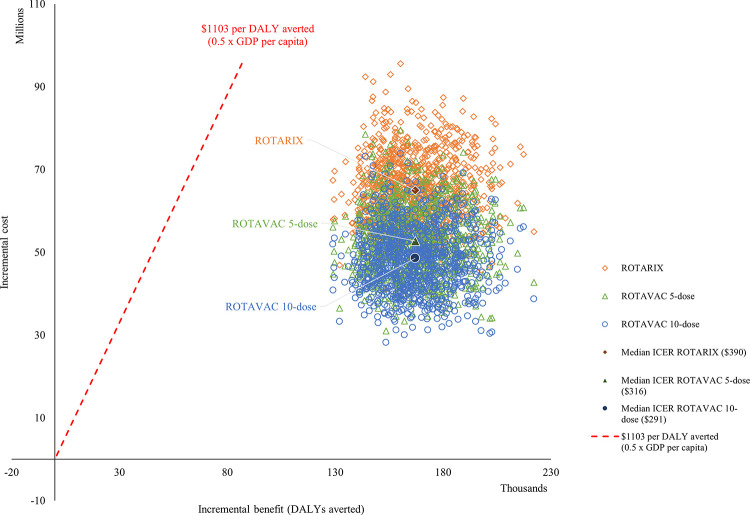
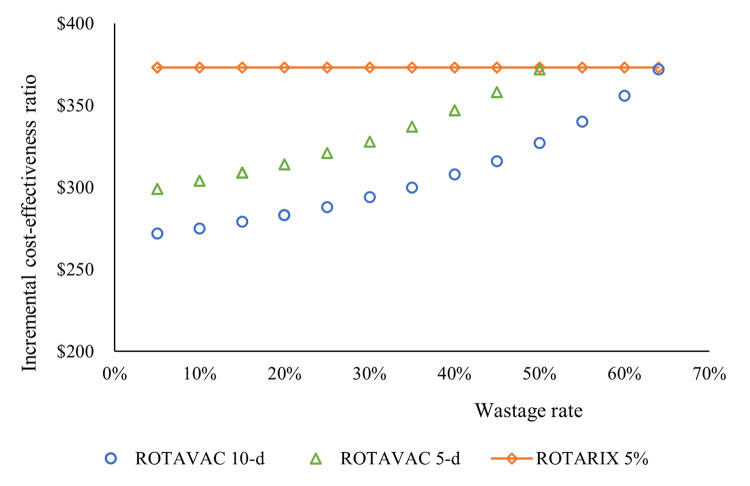
Ghana introduced rotavirus vaccine (ROTARIX 1-dose presentation) into the routine national immunization program in 2012 and switched to a different product (ROTAVAC 5-dose presentation) in 2020. ROTAVAC has a lower price per dose (US$0.85 versus US$2.15 for ROTARIX) and smaller cold chain footprint but requires more doses per regimen (three versus two). This study estimates the supply chain and service delivery costs associated with each product, the costs involved in switching products, and compares the cost-effectiveness of both products over the next ten years. We estimated the supply chain and service delivery costs associated with ROTARIX and ROTAVAC (evaluating both the 5-dose and 10-dose presentations) using primary data collected from health facilities in six of the 14 regions in the country. We estimated the costs of switching from ROTARIX to ROTAVAC using information collected from key informant interviews and financial records provided by the government. All costs were reported in 2020 US$. We used the UNIVAC decision-support model to evaluate the cost-effectiveness (US$ per disability-adjusted life-year (DALY) averted from government and societal perspectives) of ROTARIX and ROTAVAC (5-dose or 10-dose presentations) compared to no vaccination, and to each other, over a ten-year period (2020 to 2029). We ran probabilistic sensitivity analyses and other threshold analyses. The supply chain and service delivery economic cost per dose was $2.40 for ROTARIX, $1.81 for ROTAVAC 5-dose, and $1.76 for ROTAVAC 10-dose. The financial and economic cost of switching from ROTARIX to ROTAVAC 5-dose was $453,070 and $883,626, respectively. Compared to no vaccination, the cost per DALY averted was $360 for ROTARIX, $298 for ROTAVAC 5-dose, and $273 for ROTAVAC 10-dose. ROTAVAC 10-dose was the most cost-effective option and would be cost-effective at willingness-to-pay thresholds exceeding 0.12 times the national GDP per capita ($2,206 in the year 2020). The switch from ROTARIX to ROTAVAC 5-dose in 2020 was cost-saving. Rotavirus vaccination is highly cost-effective in Ghana. A switch from ROTAVAC 5-dose to ROTAVAC 10-dose would be cost-saving and should be considered.
Copyright: © 2023 Owusu et al. This is an open access article distributed under the terms of the Creative Commons Attribution License, which permits unrestricted use, distribution, and reproduction in any medium, provided the original author and source are credited.
Conflict of interest statement
The authors have declared that no competing interests exist.
Figures
References
-
- Clark A, Tate J, Parashar U, Jit M, Hasso-Agopsowicz M, Henschke N, et al. Mortality reduction benefits and intussusception risks of rotavirus vaccination in 135 low-income and middle-income countries: a modelling analysis of current and alternative schedules. Lancet Glob Heal [Internet]. 2019. Nov 1 [cited 2022 Feb 13];7(11):e1541–52. Available from: http://www.thelancet.com/article/S2214109X19304127/fulltext doi: 10.1016/S2214-109X(19)30412-7 - DOI - PMC - PubMed
-
- Abbafati C, Abbas KM, Abbasi-Kangevari M, Abd-Allah F, Abdelalim A, Abdollahi M, et al. Global burden of 369 diseases and injuries in 204 countries and territories, 1990–2019: a systematic analysis for the Global Burden of Disease Study 2019. Lancet. 2020. Oct 17;396(10258):1204–22. doi: 10.1016/S0140-6736(20)30925-9 - DOI - PMC - PubMed
-
- Osei FB, Stein A. Spatial variation and hot-spots of district level diarrhea incidences in Ghana: 2010–2014. BMC Public Health [Internet]. 2017. Jul 3 [cited 2022 Feb 14];17(1):1–10. Available from: https://bmcpublichealth.biomedcentral.com/articles/10.1186/s12889-017-45... - DOI - PMC - PubMed
LinkOut - more resources
Full Text Sources
Miscellaneous